For most houses that want a fridge, a furnace blower, a sump pump, and lights through an outage, the WEN DF480iX is the inverter generator we recommend first: WEN rates it at 4,000 running watts on gasoline and 3,600 on propane, and it carries a built-in carbon monoxide shutoff. That running figure clears the about 3,650 W a typical essentials plan needs once you leave 20 percent headroom. Its 4,800 W gasoline starting rating is a little under that plan’s 5,070 W starting check, so the worked example below leaves the TV off while the sump pump may start.
Carbon monoxide warning for every generator on this page
Inverter generators burn gasoline or propane and produce carbon monoxide (CO), a gas you cannot see or smell. The CPSC says to operate portable generators outside only, at least 20 ft from the house and far from windows, doors, and vents, and never inside a home, garage, basement, crawlspace, shed, or other enclosed space. Point the exhaust away from the home and any other building people can enter.
Install battery-operated or battery-backup CO alarms on each level of the home and outside sleeping areas, as the CPSC recommends. The CPSC estimates an average of about 100 people die in the U.S. each year from CO poisoning tied to portable generators.
A CO shutoff sensor on the generator helps, and the CPSC advises looking for one, but it does not replace CO alarms on every level and outside sleeping areas, or safe placement. Follow your owner’s manual and local rules.




Quick Comparison
Running watts are what a generator holds continuously; starting watts are the short burst it can give a motor on startup. Compare running to running first, and use the propane column if propane is your main outage fuel. Noise figures are the makers’ own, measured at different points, so treat them as a rough guide.
| Model | Running W (gas / propane) | Starting W (gas / propane) | Noise (maker figure) | Fuel | CO shutoff | 240 V outlet | Best for |
|---|---|---|---|---|---|---|---|
| WEN DF480iX | 4,000 / 3,600 | 4,800 / 4,320 | 62 dB at 1/4 load | Gasoline, propane | Yes (CO Watchdog) | No | Essentials on gasoline, TV off while the sump pump starts |
| WEN DF680iX | 5,100 / 4,500 | 6,800 / 6,000 | 64 dB at 1/4 load | Gasoline, propane | Yes (CO Watchdog) | Yes, L14-30R | Homes with a 240 V well pump |
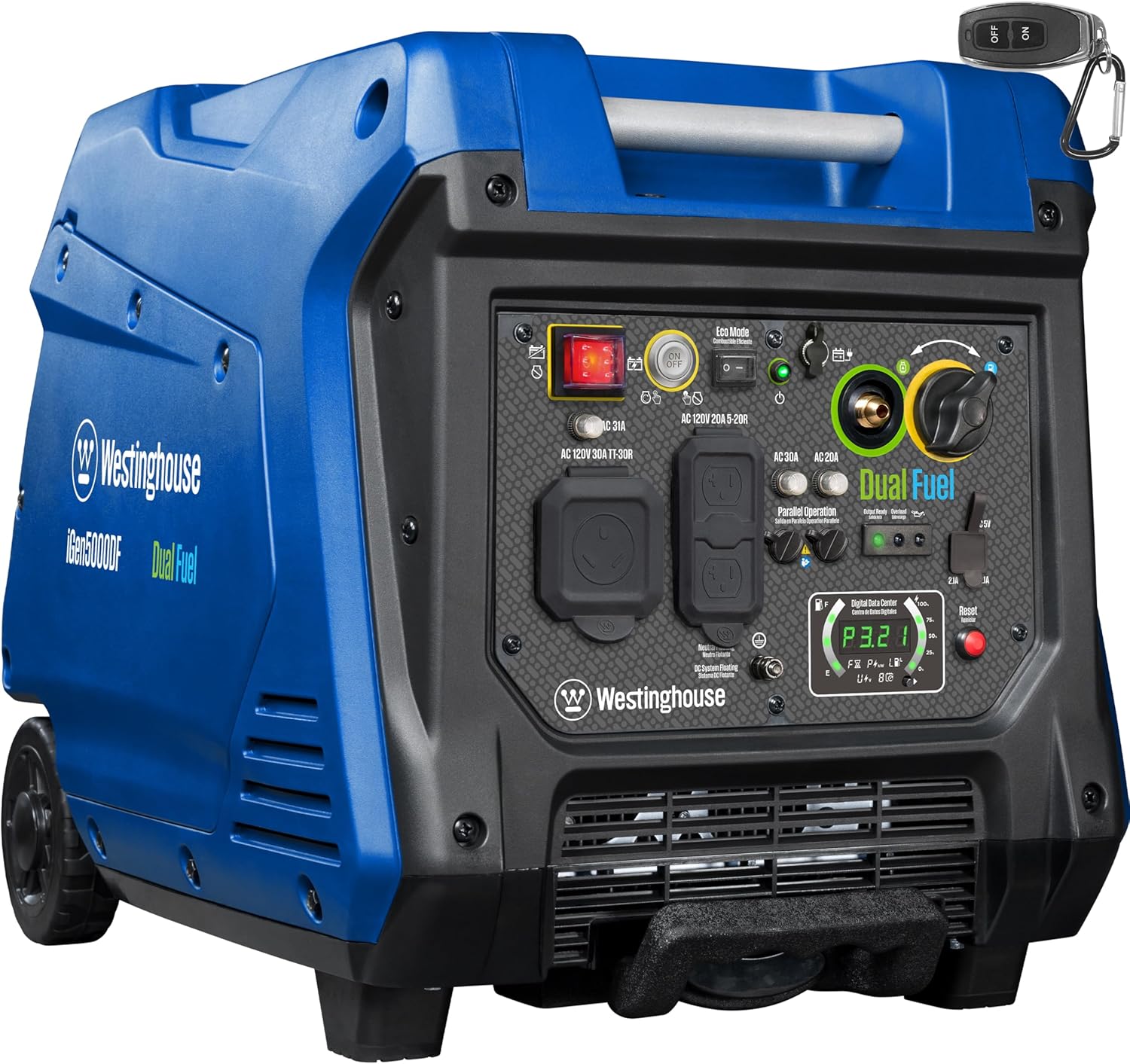
| Westinghouse iGen5000DF | 3,900 / 3,500 | 5,000 / 4,500 | As low as 52 dBA | Gasoline, propane | No (the iGen5000DFc has one) | No | Long, quiet overnight runs |
| Westinghouse iGen8200TFc | 6,600 / 5,940 (5,280 natural gas) | 8,200 / 7,380 (6,560 natural gas) | About 60 dBA at 25% load | Gasoline, propane, natural gas | Yes | Yes, 14-50R | Larger homes with a gas line |
| Westinghouse iGen12000DFc | 9,000 / 8,100 | 12,000 / 11,000 | As low as 64 dBA | Gasoline, propane | Yes | Yes, 14-50R and L14-30R | Near whole-house loads |
| WEN DF360iX | 2,900 / 2,600 | 3,600 / 3,500 | 65 dB at 1/4 load | Gasoline, propane | Yes (CO Watchdog) | No | Fridge, freezer, and lights |
| WEN 56235i | 1,900 | 2,350 | 51 dB at 1/4 load | Gasoline only | No (the 56235iX has one) | No | Apartments with outdoor space, small loads |
How We Chose
We started with the load and worked back to the machine. Every pick had to be an inverter generator, which makes clean power for electronics by converting the engine’s output electronically, and it had to cover at least a fridge and lights on its running rating. From there we ranked on four things, in this order:
- Running watts against real house plans, on both fuels where the maker lists both.
- A built-in CO shutoff. The CPSC recommends one, so a model without it ranks lower even when owners rate it higher.
- Published runtime per tank, converted to kilowatt-hours per gallon so different load points can be compared.
- Outlets and warranty: a 240 V outlet for well pumps, a 30 A outlet for an electrician-installed inlet, and the length of the limited warranty.
Our sources are manufacturer spec sheets and product pages from WEN and Westinghouse, owner manuals, public buyer reviews, and the Yard & Grid Score, which is built from verified buyer ratings. We research and compare; we do not run our own product trials. The full method is on our how we choose page.
1. WEN DF480iX
- WEN rates it at 4,000 running and 4,800 starting watts on gasoline, and 3,600 running and 4,320 starting on propane.
- The essentials plan in our generator sizing guide needs about 3,650 running watts and about 2,920 + 2,150 = 5,070 starting watts, adding the sump pump’s starting watts on top of the running load as Champion’s chart method does. On gasoline that leaves 4,000 minus 3,650 = 350 W of running margin, but its 4,800 starting watts sit 5,070 minus 4,800 = 270 W short if the sump pump starts with everything else on. Leaving the 400 W TV off brings the check to 5,070 minus 400 = 4,670 W, which clears 4,800 W.
- Its CO Watchdog sensor shuts the engine down when it detects dangerous CO levels, and it has electric start with a recoil backup.
- WEN lists up to 7 hours at half load on the 1.9 gal tank and up to 12 hours at half load on a 20 lb propane tank, with a three-year limited warranty.
- Outlets are four 120 V household receptacles, one TT-30R 30 A RV receptacle, 12 V DC, and two USB ports. It has no 240 V outlet.
Best for: a house that wants a fridge, furnace blower, sump pump, lights, and a TV through an outage on gasoline, with the TV off while the sump pump may start.
Avoid if: you have a 240 V well pump, your running total on propane is above 3,600 W, or you want the full essentials plan on propane, where 4,320 starting watts fall short of the 5,070 W starting check.
2. WEN DF680iX
- WEN rates it at 5,100 running and 6,800 starting watts on gasoline, and 4,500 running and 6,000 starting on propane.
- It adds an L14-30R 120/240 V outlet and a voltage selector, which is what a 240 V well pump needs once a licensed electrician has wired an inlet and a transfer switch or interlock.
- CO Watchdog shutoff, electric start, and a three-year limited warranty, per WEN.
- WEN lists up to 6.1 hours at half load on the 2.9 gal tank and up to 9 hours on a 20 lb propane tank.
The rural plan in our sizing guide, essentials plus a 1/2 HP well pump, needs about 4,900 running watts and about 3,920 + 2,150 = 6,070 starting watts. The DF680iX covers that on gasoline (5,100 W running, 6,800 W starting) but not on propane, where 4,500 W falls short of 4,900 W and 6,000 starting watts fall 70 W short of 6,070 W.
Best for: a rural house with a 240 V well pump on gasoline, or a home that wants room to add loads later.
Avoid if: you need to move it often by hand, or you plan to run a well pump plus essentials on propane alone.
3. Westinghouse iGen5000DF
- Westinghouse rates it at 3,900 running and 5,000 peak watts on gasoline, and 3,500 running and 4,500 peak on propane, with total harmonic distortion (THD) of 3 percent or less.
- Westinghouse lists 18 hours at 25 percent load on a 3.4 gal tank, and 22 hours at 25 percent load on propane (the page does not state the cylinder size for that figure).
- Westinghouse lists it as low as 52 dBA, the quietest rating among the mid-size picks.
- It has the highest owner rating on this list, but Westinghouse lists no CO sensor on the iGen5000DF. The iGen5000DFc version adds one, which is why this model sits third here.
- Remote start with a key fob, a 3 year limited residential warranty, and a dry weight of 104.7 lb.
Best for: quiet overnight runs of a fridge, furnace blower, and lights where long runtime per tank matters most.
Avoid if: you want a CO shutoff on the generator itself; look for the iGen5000DFc instead.
4. Westinghouse iGen8200TFc
- Tri fuel: Westinghouse rates it at 6,600 running watts on gasoline, 5,940 on propane, and 5,280 on natural gas.
- It has a CO sensor, a 120/240 V 14-50R 50 A outlet, a TT-30R outlet, and a GFCI duplex.
- Westinghouse lists 17 hours at 25 percent load on a 3.9 gal tank, and about 60 dBA at 25 percent load.
- Dry weight is 134.5 lb, so plan on wheeling it, not carrying it.
Natural gas only helps if a licensed plumber or gas fitter has installed a suitable outdoor connection; the fuel options are covered in dual fuel generators explained.
Best for: a larger home with a well pump and a natural gas service that wants fuel with no refills.
Avoid if: you have no gas line and your load fits a 5,000 W class unit, where you would pay for capacity you never use.
5. Westinghouse iGen12000DFc
- Westinghouse rates it at 9,000 running and 12,000 peak watts on gasoline, and 8,100 running and 11,000 peak on propane.
- It has a CO sensor plus both a 14-50R 50 A and an L14-30R 30 A outlet at 120/240 V.
- Westinghouse lists 19 hours at 25 percent load and 11 hours at 50 percent load on a 7.9 gal tank. On a 20 lb propane tank it lists only 9 hours at 25 percent and 5 hours at 50 percent.
- Dry weight is 189 lb.
Best for: an essentials plan plus a well pump and a window AC or two, run mostly on gasoline.
Avoid if: you plan to run on 20 lb propane tanks for days, since 5 hours per tank at half load means a cylinder swap several times a day.
6. WEN DF360iX
- WEN rates it at 2,900 running and 3,600 starting watts on gasoline, and 2,600 running and 3,500 starting on propane.
- CO Watchdog shutoff and a TT-30R outlet, at a listed 49 lb.
- WEN lists up to 5 hours at half load on a 1.5 gal tank and up to 14 hours at half load on a 20 lb propane tank, so propane is the better outage fuel on this one.
Best for: a fridge, a chest freezer, lights, and a router, run mostly on propane.
Avoid if: a sump pump or furnace blower is part of your plan; the essentials plan’s 3,650 W target is above its 2,900 W running rating.
7. WEN 56235i
- WEN rates it at 1,900 running and 2,350 starting watts, gasoline only, at 39 lb.
- WEN lists 51 dB at quarter load and over 5.7 hours of half-load runtime on a 1 gal tank.
- The base 56235i has no CO sensor; WEN sells the 56235iX with its CO Watchdog shutoff. WEN lists a two-year warranty on both.
The small-house plan in our sizing guide runs 1,070 W, so 1,070 / 0.8 = about 1,340 W with headroom, and the fridge’s 1,200 starting watts push the check to 1,070 + 1,200 = 2,270 W. Both fit under 1,900 W running and 2,350 W starting.
Best for: a fridge, lights, a router, and phone charging in a small house with a safe outdoor spot 20 ft from the walls.
Avoid if: you need a furnace blower or sump pump on the same generator, or you want propane as your stored fuel.
Cost of Ownership: Fuel, Oil, and Warranty
Fuel is the largest running cost, and the published runtimes let you compare it. Convert each figure to kilowatt-hours (kWh, 1,000 watt-hours of electricity delivered) per gallon: running watts x load fraction x hours / gallons.
| Model (maker gasoline figure) | Load at that point | kWh per tank | kWh per gallon |
|---|---|---|---|
| WEN DF480iX: 7 h at 1/2 load, 1.9 gal | 4,000 x 0.5 = 2,000 W | 2,000 x 7 = 14 kWh | 14 / 1.9 = about 7.4 |
| WEN DF680iX: 6.1 h at 1/2 load, 2.9 gal | 5,100 x 0.5 = 2,550 W | 2,550 x 6.1 = about 15.6 kWh | 15.6 / 2.9 = about 5.4 |
| Westinghouse iGen5000DF: 18 h at 25%, 3.4 gal | 3,900 x 0.25 = 975 W | 975 x 18 = about 17.6 kWh | 17.6 / 3.4 = about 5.2 |
| Westinghouse iGen8200TFc: 17 h at 25%, 3.9 gal | 6,600 x 0.25 = 1,650 W | 1,650 x 17 = about 28 kWh | 28 / 3.9 = about 7.2 |
| Westinghouse iGen12000DFc: 11 h at 50%, 7.9 gal | 9,000 x 0.5 = 4,500 W | 4,500 x 11 = 49.5 kWh | 49.5 / 7.9 = about 6.3 |
| WEN DF360iX: 5 h at 1/2 load, 1.5 gal | 2,900 x 0.5 = 1,450 W | 1,450 x 5 = about 7.3 kWh | 7.3 / 1.5 = about 4.8 |
| WEN 56235i: 5.7 h at 1/2 load, 1 gal | 1,900 x 0.5 = 950 W | 950 x 5.7 = about 5.4 kWh | 5.4 / 1 = about 5.4 |
Engines burn fuel more efficiently near half load than at a quarter, so compare like with like. The so-what: a house averaging 1,000 W around the clock uses 1,000 W x 24 h = 24 kWh a day, which is 24 / 5.2 = about 4.6 gal of gasoline a day on the iGen5000DF’s published figure. For three days, store about 14 gal, or plan on propane, which keeps far longer in storage.
- Oil and plugs: every model here needs break-in and periodic oil changes on the schedule in its manual. Keep a quart of the specified oil with the generator.
- Fuel care: stored gasoline needs stabilizer and rotation; WEN’s fuel shutoff runs the carburetor dry before shutdown, which helps with storage.
- Extras: outdoor-rated heavy gauge cords, a cover rated for running in wet weather, a parallel kit if you want to pair two units, and battery or battery-backup CO alarms on every level and outside sleeping areas.
- Connection to the house: an inlet and a transfer switch or interlock, installed by a licensed electrician. The wiring itself is a job for that electrician, not a weekend project.
- Warranty: WEN lists a three-year limited warranty on its dual fuel models here and a two-year warranty on the 56235i; Westinghouse lists 3 years limited for residential use.
How to Choose the Right Size
Four questions settle most purchases. Answer them in order, and the list above narrows to one or two models.
What is my running total, and what is my largest surge?
Add the running watts of everything on at once, divide by 0.8 for headroom, then add the largest single starting-watt figure to the running total, since Champion lists starting watts as the extra power a device needs to turn on. Our generator size worksheet uses Champion’s published wattage chart and lands on 2,920 W of running load for a fridge, furnace fan, sump pump, lights, TV, router, and chargers: 2,920 / 0.8 = 3,650 W running, and 2,920 + 2,150 W sump pump starting watts = 5,070 W starting. The difference between the two numbers is explained in running watts vs starting watts.
Which fuel will I actually store?
Size to the propane column if propane is your stock. The same 3,650 W plan fits the DF480iX on gasoline (4,000 W) but not on propane (3,600 W). Drop the 400 W TV and the plan becomes 2,520 / 0.8 = 3,150 W, which fits the running rating on either fuel. Its starting check, 2,520 + 2,150 = 4,670 W, clears 4,800 W on gasoline but not 4,320 W on propane. Propane-first options are ranked in our best propane generators guide.
Do I have a 240 V load?
Many well pumps run on 240 V. Only the DF680iX, iGen8200TFc, and iGen12000DFc here have 120/240 V outlets. If your list includes a 240 V pump, start with those three, and plan on a licensed electrician for the connection.
Does it have a CO shutoff?
Five of the seven picks do. The CPSC advises buying a generator with a CO shutoff feature; how those sensors work, and the two industry standards behind them, are covered in what is a CO shutoff sensor. Placement still matters most: the full setup is in how to run a generator safely.
FAQ
Is an inverter generator good for home backup?
Yes, for essentials. The makers here list THD of 3 percent or less, which suits electronics, and eco modes cut fuel use at light loads. For whole-house central air, the running totals usually point to a larger standby system instead.
What size inverter generator runs a refrigerator?
Using the high end of Champion’s chart, a fridge runs at 400 W and needs up to 1,200 W more to start, about 1,600 W at that moment. Any model on this list covers that, including the 1,900 W WEN 56235i, with room for lights and a router.
Can I plug the generator into a wall outlet to power the house?
No. A cord plugged into a wall outlet can backfeed the utility line and endanger line workers and your household. Use extension cords to individual appliances, or have a licensed electrician add an inlet with a transfer switch or interlock.
Can I run an inverter generator in the garage with the door open?
No. The CPSC lists the garage among the places a portable generator should never run, and says to keep it at least 20 ft from the house and far from windows, doors, and vents. A quieter inverter design does not change the exhaust.
Changelog: October 2026: first published. October 2026: corrected starting-watt math to Champion’s add-the-largest-starting-load method.