The WEN DF480iX is the dual fuel generator we would buy first for a typical house: it keeps 3,600 of its 4,000 running watts when you switch from gasoline to propane, a 3,600 / 4,000 = 0.90 ratio, and it shuts itself off if carbon monoxide builds up around it. Every dual fuel model here loses roughly 10 percent on propane, so the propane rating is the one to size against.
Both fuels make carbon monoxide (CO). The CPSC says to run a portable generator outside only, at least 20 ft from the house, far from windows, doors, and vents, with the exhaust pointed away from the house, never in a garage, basement, crawlspace, or shed, and to keep battery-operated or battery-backup CO alarms on every level of the home and outside sleeping areas. Follow the manual and local rules.

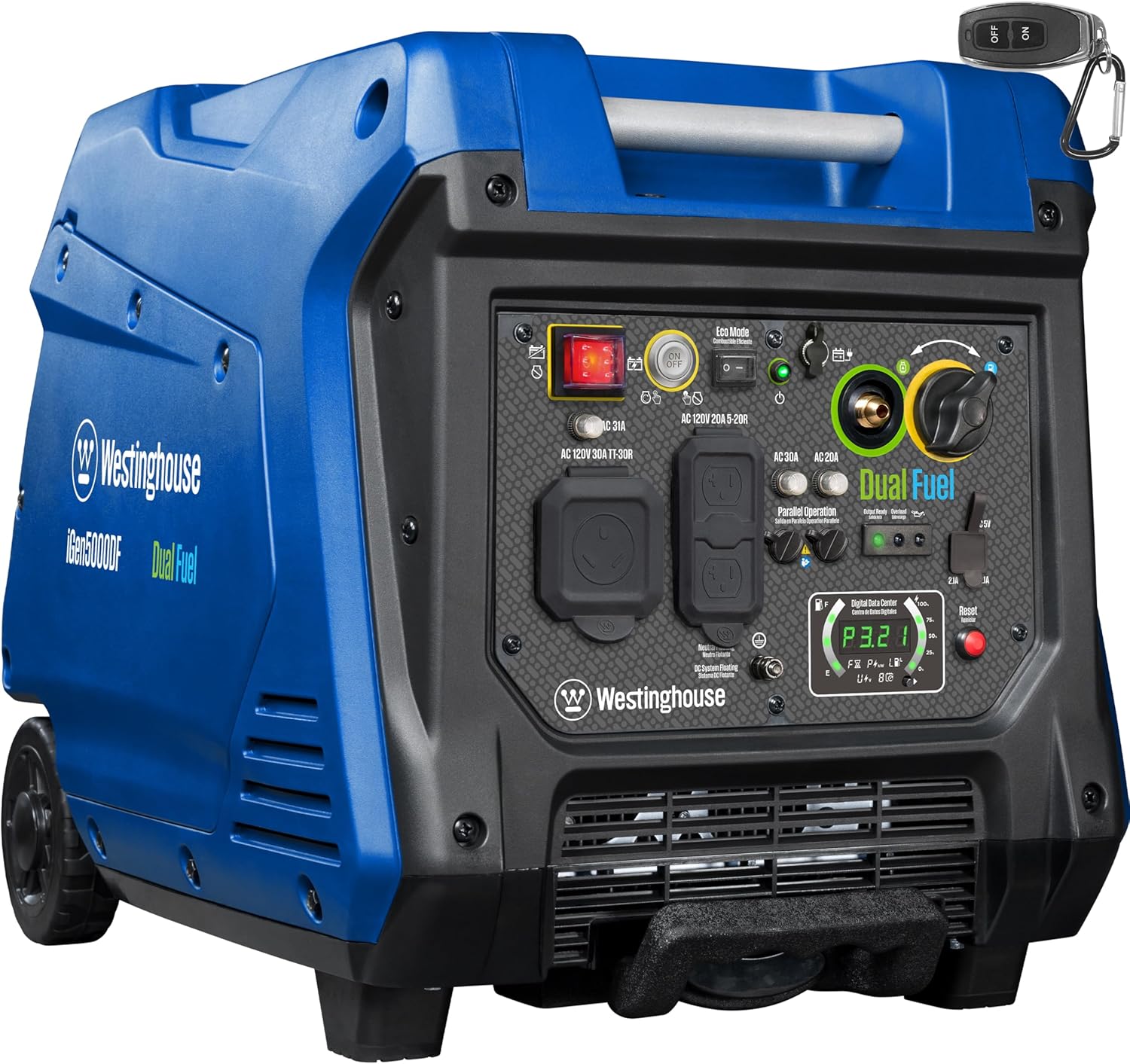


Quick Comparison
The propane derate column is propane running watts / gasoline running watts, from each maker’s own figures. Runtime on propane is shown exactly as the maker publishes it, with the load point.
| Model | Running W gas | Running W propane | Propane derate | Published propane runtime | CO shutoff | Best for |
|---|---|---|---|---|---|---|
| WEN DF480iX | 4,000 | 3,600 | 0.90 | 12 h at 1/2 load, 20 lb tank | Yes | Essentials on either fuel |
| Westinghouse iGen5000DF | 3,900 | 3,500 | 0.90 | 22 h at 25% load (cylinder size not listed) | No (iGen5000DFc has one) | Long, quiet runs |
| WEN DF680iX | 5,100 | 4,500 | 0.88 | 9 h at 1/2 load, 20 lb tank | Yes | 240 V well pumps |
| Westinghouse iGen12000DFc | 9,000 | 8,100 | 0.90 | 9 h at 25%, 5 h at 50%, 20 lb tank | Yes | Large loads on gasoline |
| WEN DF360iX | 2,900 | 2,600 | 0.90 | 14 h at 1/2 load, 20 lb tank | Yes | Fridge, freezer, lights |
| Pulsar PG2200BiS | 1,800 | 1,600 | 0.89 | 75 min at 1/2 load, 1 lb cylinder | None listed | Small loads, parallel pairs |
How We Chose
Every pick runs on gasoline and on propane from a standard cylinder, uses an inverter for clean power, and publishes separate ratings for each fuel. We ranked them on propane running watts against real house loads, a built-in CO shutoff (the CPSC advises buying one), published runtime per tank, and warranty length.
Data comes from WEN and Westinghouse product pages and manuals, Pulsar’s retail listing copy (we could not reach a Pulsar spec page), public buyer reviews, and the Yard & Grid Score built from verified buyer ratings. We research and compare; we do not run our own product trials. We left out a 5,500 W dual fuel model with solid owner ratings because its listed warranty is 90 days. Our method is on the how we choose page, and the basics of the engine design are in dual fuel generators explained.
1. WEN DF480iX
- WEN rates it at 4,000 running and 4,800 starting watts on gasoline, and 3,600 running and 4,320 starting on propane.
- It has the best published propane yield in this group. At half load, 3,600 W x 0.5 = 1,800 W for 12 h = 21.6 kWh per 20 lb tank, so 20 lb / 21.6 kWh = about 0.9 lb of propane per kilowatt-hour (kWh).
- CO Watchdog shutoff, electric start, a tool-free propane quick connector, and a three-year limited warranty.
- Four 120 V receptacles and a TT-30R, but no 240 V outlet.
Best for: a fridge, furnace blower, sump pump, and lights on propane, with gasoline as the backup fuel.
Avoid if: your running total needs more than 3,600 W on propane, or you need 240 V.
2. Westinghouse iGen5000DF
- Westinghouse rates it at 3,900 running and 5,000 peak watts on gasoline, and 3,500 running and 4,500 peak on propane.
- It lists 18 hours at 25 percent load on a 3.4 gal gasoline tank and 22 hours at 25 percent on propane. The product page does not name the cylinder size for the propane figure, so confirm it in the manual before you plan around it.
- Rated as low as 52 dBA, with remote start and a 3 year limited residential warranty.
- No CO sensor on this version; the iGen5000DFc adds one with the same fuel ratings.
Best for: light overnight loads where long runtime and a low noise rating come first.
Avoid if: a built-in CO shutoff is a requirement for you.
3. WEN DF680iX
- WEN rates it at 5,100 running and 6,800 starting watts on gasoline, and 4,500 running and 6,000 starting on propane.
- Its derate is a little steeper: 4,500 / 5,100 = 0.88, so you give up 600 W on propane.
- An L14-30R 120/240 V outlet with a voltage selector, CO Watchdog shutoff, and a three-year limited warranty.
- Propane runtime is 9 h at half load per 20 lb tank: 4,500 x 0.5 = 2,250 W x 9 h = about 20 kWh, or 20 lb / 20 kWh = about 1.0 lb per kWh.
Best for: a house with a 240 V well pump that wants propane as a second fuel.
Avoid if: your well pump plus essentials need about 4,900 running watts, which is more than its 4,500 W propane rating.
4. Westinghouse iGen12000DFc
- Westinghouse rates it at 9,000 running watts on gasoline and 8,100 on propane, with a CO sensor.
- Outlets include a 14-50R 50 A and an L14-30R 30 A at 120/240 V, both suited to an inlet a licensed electrician installs.
- On gasoline it lists 11 h at 50 percent load on a 7.9 gal tank. On propane it lists 5 h at 50 percent per 20 lb tank.
- Dry weight is 189 lb.
Those runtimes show the trade. One gas tank at half load lasts 11 h; matching that on propane takes 11 / 5 = 2.2, so about three 20 lb tanks. On this model, propane is best treated as the reserve fuel.
Best for: large essentials plans with a well pump and window AC, run on gasoline with propane in reserve.
Avoid if: you want to run for days on 20 lb cylinders alone.
5. WEN DF360iX
- WEN rates it at 2,900 running watts on gasoline and 2,600 on propane.
- Its 1.5 gal gas tank gives up to 5 h at half load; a 20 lb propane tank gives up to 14 h at half load, nearly three times as long.
- CO Watchdog shutoff, TT-30R outlet, and a listed weight of 49 lb.
Best for: a fridge, chest freezer, lights, and router, run mainly on propane.
Avoid if: a furnace blower and sump pump share the plan with the fridge.
6. Pulsar PG2200BiS
- Its retail listing rates it at 1,800 running and 2,200 peak watts on gasoline, and 1,600 running and 2,000 peak on propane.
- The listing gives 8 h at half load on its 1.18 gal gas tank and 75 minutes at half load on a 1 lb propane cylinder.
- It is parallel capable, so two units can be linked with a kit for about double the output.
- No CO sensor is listed, and the listing states a 1 year limited warranty.
Scaled to a 20 lb tank with an adapter hose, 20 x 75 min = 1,500 min = about 25 h at half load. That straight scaling (20 lb x 75 minutes per lb) is our estimate, not a Pulsar figure, so round down when you plan.
Best for: a fridge, lights, and phone charging in a small home with a safe outdoor spot 20 ft from the walls.
Avoid if: you want a CO shutoff or more than 1,600 W on propane.
What Owning Two Fuels Costs
Dual fuel adds a storage job, not a big expense. You keep gasoline that needs rotation and propane cylinders that need occasional inspection, and the generator needs the usual oil changes from its manual.
- Propane cylinders: a 20 lb tank holds about 4.7 gal, per the Propane Education and Research Council (PERC). U.S. DOT rules require a cylinder to be requalified 12 years after the manufacture date stamped on its collar before it can be refilled.
- Gasoline: add stabilizer for storage and rotate the cans. WEN’s fuel shutoff runs the carburetor dry at shutdown, which helps between outages.
- Hose and regulator: use only the propane hose the maker supplies or specifies; WEN and Westinghouse include one with the models here.
- Warranty: three years limited on the WEN and Westinghouse picks, 1 year on the Pulsar.
- House connection: an inlet with a transfer switch or interlock, installed by a licensed electrician.
How to Choose a Dual Fuel Generator
Does my load fit the propane rating?
Take your running total, divide by 0.8 for headroom, and compare it with the propane column. A plan with a fridge (400 W), furnace fan (800 W), lights (150 W), router (20 W), and chargers (100 W), using the high end of Champion’s published wattage chart, runs 400 + 800 + 150 + 20 + 100 = 1,470 W. With headroom that is 1,470 / 0.8 = about 1,840 W, which fits the DF360iX on propane (2,600 W). The largest starting load is the furnace fan, so the starting check is 1,470 + 1,600 = 3,070 W, under the DF360iX’s 3,500 W propane starting rating.
How should I split fuel for a three-day outage?
Plan by hours, then by fuel. Run the DF480iX 12 hours a day at about half load for three days: 12 x 3 = 36 h. All gasoline: 36 h / 7 h per tank = 5.1 tanks x 1.9 gal = about 10 gal. All propane: 36 h / 12 h per tank = 3 tanks of 20 lb. A mix of two propane tanks (24 h) plus gasoline for the last 12 h needs 12 / 7 x 1.9 = about 3.3 gal of gasoline. Keep at least one extra tank either way.
Which fuel should be my main stock?
Propane if the generator sits most of the year, gasoline if you need every watt or run a large unit at half load. The side by side numbers are in propane vs gas generator, and per-tank math is in how long a generator runs on a propane tank. If you also have a natural gas line, see our best tri fuel generators.
Does it shut itself off for CO?
Four of the six picks list a CO shutoff. The sensor is a backstop, not a license to run closer to the house; how it works is in what is a CO shutoff sensor. If you only need gasoline, compare more models in the best inverter generators for home use.
FAQ
Are dual fuel generators worth it?
For home backup, usually yes. You give up about 10 percent of running watts on propane, and in return you can store fuel that, according to propane suppliers, does not go bad in a sound cylinder, while keeping gasoline as the higher-output option.
Is a dual fuel inverter generator better than a conventional dual fuel model?
For electronics and fuel use at light loads, yes. Inverter models throttle the engine to the load and list low distortion. Conventional open-frame models are often sold at higher wattages for heavy loads, and they are usually louder.
Can I switch fuels while the generator is running?
Follow your manual; procedures differ by model. Never add gasoline while the engine runs or is hot, and keep propane cylinders outdoors and away from the exhaust.
Does propane make a generator safe to run in the garage?
No. Propane exhaust contains carbon monoxide too. The CPSC rules apply on both fuels: outside only, at least 20 ft from the house, far from windows, doors, and vents, exhaust pointed away from the house and other buildings, with CO alarms on every level of the home and outside sleeping areas.
Changelog: October 2026: first published. October 2026: corrected starting-watt math to Champion’s add-the-largest-starting-load method.