For most homes that lose power in winter, the Mr. Heater Portable Buddy is the heater to buy first: Mr. Heater certifies it for indoor use, it puts out 4,000 or 9,000 Btu per hour from a disposable 1 lb propane cylinder, and one cylinder holds about 21,800 Btu of heat, roughly what a 2,048 Wh power station would need to be recharged three to four times to match. If nobody in the house should be near a flame, pair a large LiFePO4 power station with a heater on its low setting and plan for hours, not nights.



Any heater that burns fuel inside the house can produce carbon monoxide (CO). Use only a model the manufacturer rates for indoor use, follow its manual for fresh-air openings and clearances, keep a working battery CO alarm in the room, plus CO alarms on every level and outside sleeping areas, never run it while you sleep, and check your state and local rules first. No heater on this page removes all risk, and an indoor rating is a set of conditions, not a guarantee.
Quick Comparison
The table puts both routes on the same scale: heat per hour in Btu (British thermal units) and how long one fill lasts. Ratings come from Mr. Heater, Anker, and EcoFlow; runtimes for the power stations are our math with a 1,500 W heater on high.
| Model | Type | Heat output | Rated area | Runtime per fill | Best for |
|---|---|---|---|---|---|
| Mr. Heater Portable Buddy (MH9BX) | Propane, indoor-rated | 4,000 or 9,000 Btu/h | Up to 225 sq ft | Listed 3 h high, 6 h low per 1 lb cylinder; about 2.4 h and 5.4 h by fuel math | One room through a daytime outage |
| Mr. Heater Big Buddy (MH18B) | Propane, indoor-rated | 4,000, 9,000, or 18,000 Btu/h | Up to 450 sq ft | Up to 11 h on low with two 1 lb cylinders | A larger living room or open plan |
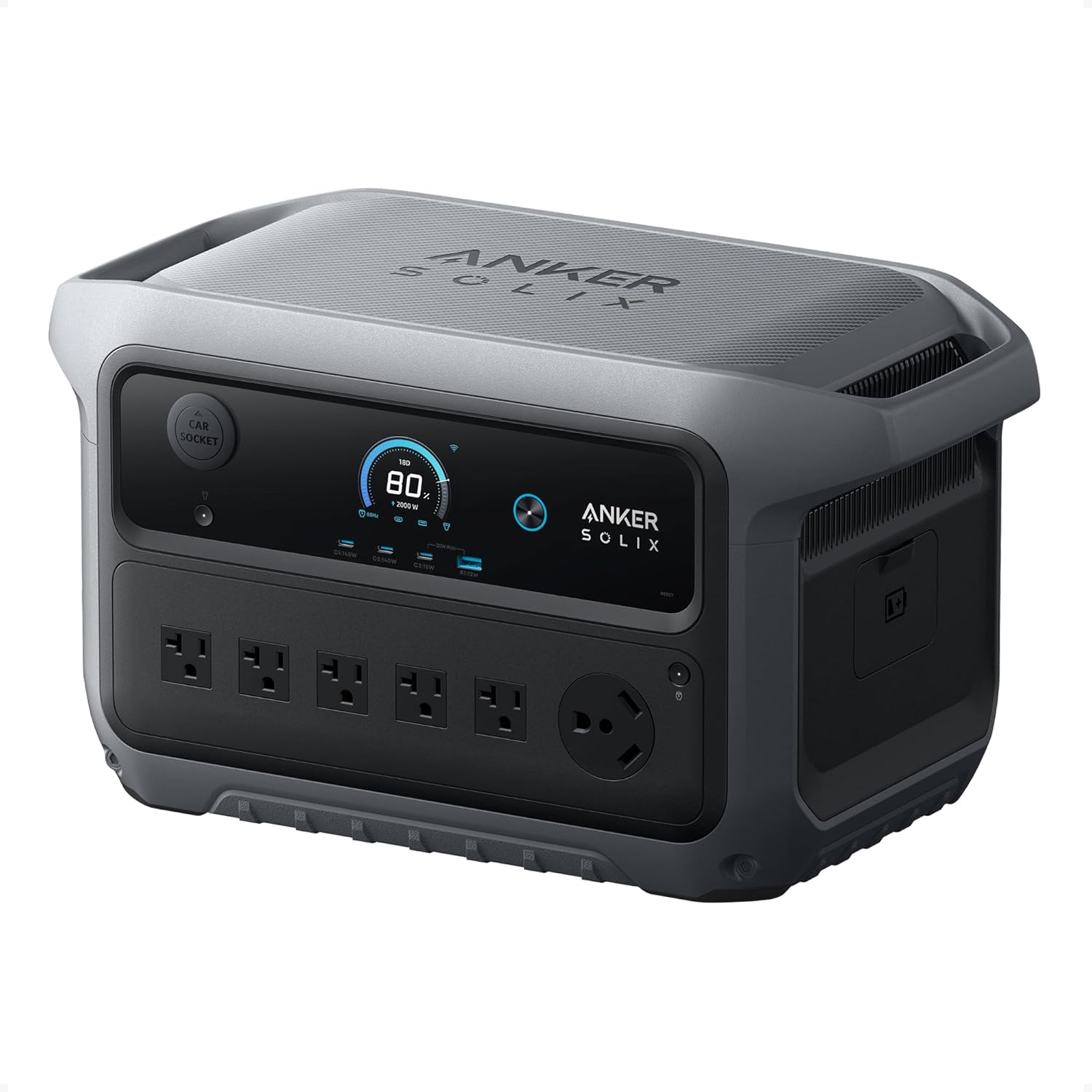
| Anker SOLIX C2000 Gen 2 | Battery, 2,048 Wh | About 5,100 Btu/h from a 1,500 W heater | Set by the heater | About 1 h 10 min at 1,500 W | Short heat bursts with no combustion indoors |
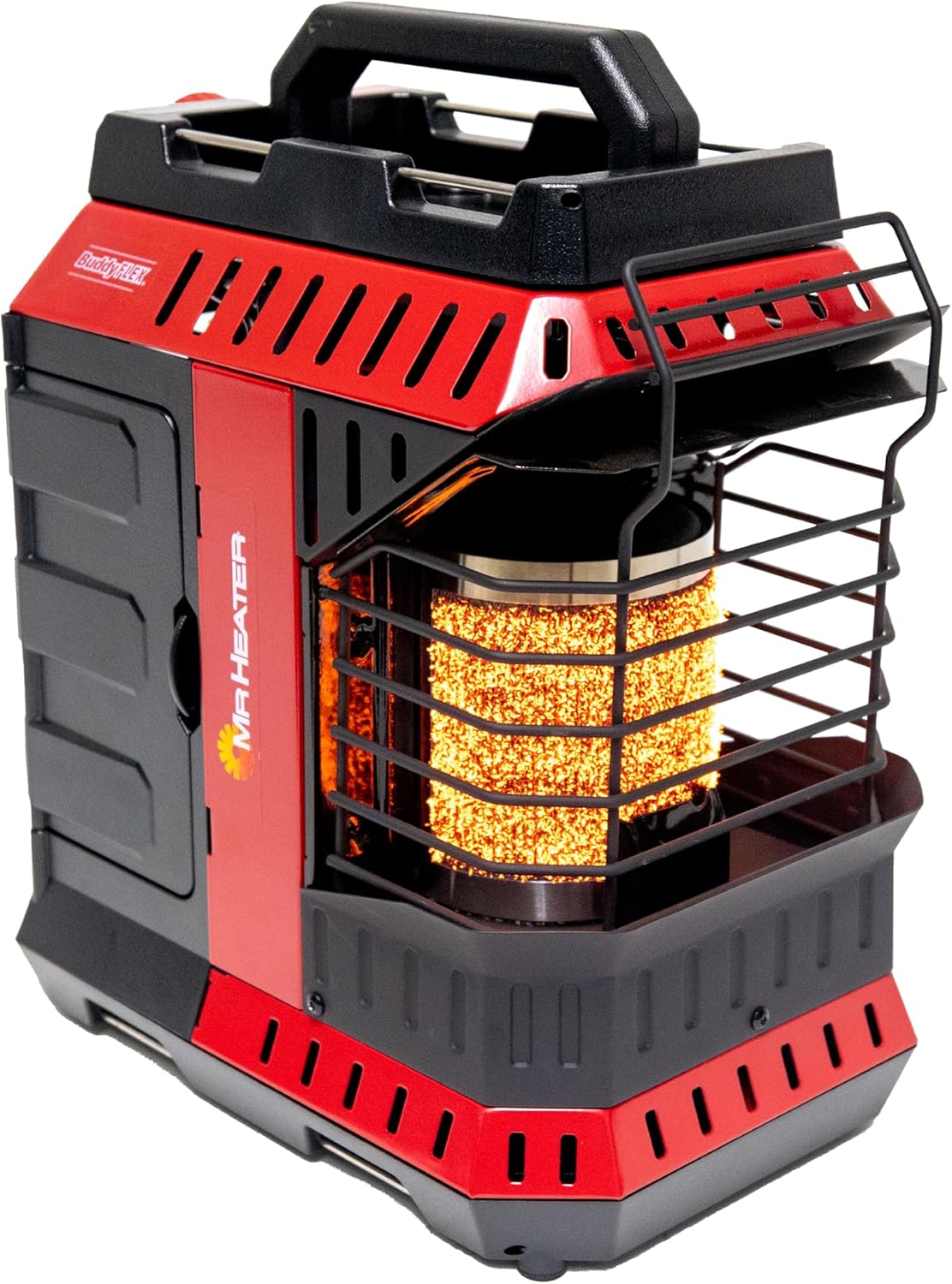
| Mr. Heater Buddy FLEX (MH11BFLEX) | Propane, indoor-rated | Up to 11,000 Btu/h | Up to 275 sq ft | About 2 h high, 3.5 h low per 1 lb cylinder | A medium room plus camping use |
| EcoFlow DELTA 3 Ultra | Battery, 3,072 Wh | About 5,100 Btu/h from a 1,500 W heater | Set by the heater | About 1 h 44 min at 1,500 W | Homes that also want the battery for a fridge and sump pump |
How We Chose
We started from one question: what can safely make heat in an occupied room when the grid is down. That ruled out tank-top heaters, forced-air construction heaters, and patio heaters, which are labeled for outdoor or job-site use, and it ruled out using a gas oven or stove for heat, which Ready.gov warns against. Our explainer on whether a propane heater is safe indoors walks through the label rules.
- Indoor rating from the manufacturer, plus an oxygen depletion sensor (ODS) and tip-over shutoff for every propane pick.
- Heat delivered per fill, converted to the same units so propane and battery options can be compared.
- Fuel you can store safely: disposable 1 lb cylinders outdoors, or a battery you charge before the storm.
- Yard & Grid Score, built from verified buyer ratings, as a check on long-term owner satisfaction.
Our sources are manufacturer spec sheets, owner’s manuals, CPSC and Ready.gov guidance, and public owner reviews. We research and compare; we do not run our own product trials. The full method is on how we choose.
The Picks
1. Mr. Heater Portable Buddy: the first heater for most homes
- Mr. Heater rates it at 4,000 or 9,000 Btu per hour, up to 225 sq ft, and lists it as indoor safe, with an ODS, a tip-over switch, and piezo ignition.
- Mr. Heater’s spec table lists about 3 hours on high and 6 hours on low per 1 lb cylinder, while its own product copy says up to 5.4 hours. Energy math lands on the shorter side: 21,800 Btu / 9,000 Btu per hour = about 2.4 hours on high, and 21,800 / 4,000 = about 5.4 hours on low, so plan with the lower figures.
- Its manual limits emergency indoor use to disposable 1 lb cylinders, asks for a fresh-air opening of at least 9 sq in at ceiling and floor level, and says never to run it while sleeping.
- Mr. Heater lists it as restricted in Massachusetts, and the manual says it is not for use in a dwelling in California.
- Warranty is 3 years limited, per Mr. Heater.
Best for: keeping one room of about 150 to 225 sq ft livable during waking hours of a 1 to 3 day outage.
Avoid if: you need heat overnight while everyone sleeps, or you live in California or Massachusetts.
2. Mr. Heater Big Buddy: more heat for a larger room
- Three settings, 4,000, 9,000, and 18,000 Btu per hour, rated for up to 450 sq ft, with ODS and tip-over shutoff, per Mr. Heater.
- Takes two 1 lb cylinders at once. Mr. Heater lists up to 11 hours with dual tanks without naming the setting; on low, 2 x 21,800 Btu / 4,000 Btu per hour = about 10.9 hours, so the figure fits the low setting.
- On high it burns through fuel fast: 43,600 Btu / 18,000 Btu per hour = about 2.4 hours per pair of cylinders.
- Mr. Heater notes the fan has been removed from some MH18B units; the spec list for this version shows no fan.
- A 20 lb cylinder hookup needs an optional hose. Read the manual on where the cylinder may sit; the Portable Buddy manual, for comparison, says refillable cylinders never come indoors.
Best for: a living room or open kitchen and family room of 300 to 450 sq ft where the family gathers during the day.
Avoid if: the room is small and tightly closed, where 18,000 Btu per hour is more combustion than the space needs.
3. Anker SOLIX C2000 Gen 2: electric heat with no flame in the room
- Anker rates it at 2,048 Wh (watt-hours, the size of the tank) with a LiFePO4 battery, 2,400 W continuous and 4,000 W peak output, so a 1,500 W heater sits well inside its limit.
- Usable energy: 2,048 Wh x 0.85 inverter efficiency = about 1,740 Wh. At 1,500 W that is 1,740 / 1,500 = about 1 hour 10 minutes; at a 750 W low setting, about 2 hours 19 minutes.
- It weighs about 41.7 lb, per Anker, and Anker lists a 5-year warranty and an optional expansion battery that doubles capacity.
- The same battery runs a fridge for far longer than it runs a heater, which is the real reason to own one.
Best for: apartments, homes with someone sensitive to CO, and short warm-ups before bed with an electric blanket after.
Avoid if: you expect the station alone to heat a room through a multi-day outage.
4. Mr. Heater Buddy FLEX: the middle size
- Mr. Heater lists up to 11,000 Btu per hour, 275 sq ft, ODS, tip-over switch, and electronic ignition, indoor safe except in Canada and Massachusetts.
- Runtime per 1 lb cylinder is about 2 hours at maximum and 3.5 hours at minimum, so it uses cylinders faster than the Portable Buddy.
- Fewer owner ratings than the other two Buddy models, which is why it ranks below them.
Best for: a room a bit larger than the Portable Buddy covers, by a household that also camps or ice fishes.
Avoid if: fuel storage is tight, since a 3-day plan needs noticeably more cylinders than the Portable Buddy.
5. EcoFlow DELTA 3 Ultra: the large battery option
- EcoFlow rates it at 3,072 Wh and 3,600 W continuous output with an LFP battery and a UPS switchover under 10 ms.
- Heater math: 3,072 x 0.85 = about 2,610 Wh usable, so 2,610 / 1,500 = about 1 hour 44 minutes on high.
- It weighs about 72 lb, so it is a unit you park, not one you carry room to room.
- Recharging it from an outdoor generator turns it into a quiet indoor buffer; the generator still has to stay outside.
Best for: homes that want one battery for the fridge, sump pump, and router, with an hour or two of heat as a bonus.
Avoid if: heat is your main goal, because a few 1 lb cylinders hold more heat for a fraction of the storage space.
Why a 1,500 W Heater Drains a Battery So Fast
An electric heater turns each watt-hour into 3.412 Btu, and no more. Propane packs far more heat into a small container, which is the whole contest in one line of math.
- One 1 lb cylinder: 91,452 Btu per gallon (EIA) / 4.2 lb per gallon (a common planning figure) = about 21,800 Btu.
- The same heat from electricity: 21,800 / 3.412 = about 6,400 Wh at the heater.
- A 2,048 Wh station delivers about 1,740 Wh, so one small cylinder equals 6,400 / 1,740 = about 3.7 full charges.
- A 1,500 W heater for an 8-hour night: 1,500 x 8 = 12,000 Wh at the outlet, or 12,000 / 0.85 = about 14,100 Wh of battery.
That is why the battery route works best when you heat people instead of rooms. A 100 W electric blanket (an example rating; check your own label) runs 1,740 / 100 = about 17 hours on the Anker. Our Power silo covers the station side in more detail in can a power station run a space heater.
A fuel generator can carry a heater for much longer, but it brings its own CO hazard. The CPSC says to run portable generators outdoors only, at least 20 ft from the home, far from windows, doors, and vents, with the exhaust pointed away from the home, never in a garage, basement, or shed, and to keep CO alarms on every level and outside sleeping areas. The cord rules for heaters on generators are in can you run a space heater on a generator.
Cost of Ownership
Fuel is the running cost on the propane side; for the batteries it is the charge you put in before the storm.
- Cylinders: 10 waking hours a day for 3 days on the Portable Buddy’s low setting is 10 x 3 / 5.4 = about 5.6 cylinders, so stock 6. On high, plan 10 x 3 / 2.4 = about 13.
- Storage: the Portable Buddy manual says to store cylinders outdoors, never in a building or garage.
- Accessories: a battery CO alarm per room you heat and per level. Mr. Heater warns that unauthorized accessories void the warranty.
- Batteries: Anker rates the C2000 Gen 2 for 4,000 cycles to 80% capacity, so a few outage nights a year barely register on its life. Recharging is the limit, not wear.
- Warranty: Mr. Heater lists 3 years limited; Anker lists 5 years for the C2000 Gen 2.
How to Choose for Your House
Answer these in order. Each one narrows the list.
- Are indoor propane heaters allowed where you live? Check state law, local fire code, and your lease. If the answer is no, skip to the battery picks.
- Does anyone in the home need extra caution around CO? The Portable Buddy manual names pregnant women and people with heart or lung disease or anemia. If so, lean on electric heat.
- How big is the one room you will live in? Size Btu to the room: a 12 ft x 14 ft bedroom is 168 sq ft, inside the Portable Buddy’s 225 sq ft rating; an 18 ft x 22 ft family room is 396 sq ft, which points to the Big Buddy.
- How many hours of heat a day, for how many days? Multiply hours x days / hours per cylinder to get your cylinder count before the season, when stores still have them.
- Can you keep a window cracked? A window 30 in wide opened 0.5 in gives 30 x 0.5 = 15 sq in, which clears the Portable Buddy’s 9 sq in minimum. Follow your own manual’s figure and location.
| Your home | Start with | Why |
|---|---|---|
| Apartment or rental | Power station plus electric blanket | Leases and building codes often bar fuel heaters |
| Single-family home, short outages | Portable Buddy and 6 cylinders | Covers one room for 3 days of waking hours |
| Cold-climate home, larger family room | Big Buddy | 18,000 Btu/h ceiling and two-cylinder runtime |
| Home with sump pump and medical devices | DELTA 3 Ultra, propane heater as backup | Battery protects the critical loads first |
| California dwelling | Battery route | The Portable Buddy manual excludes dwelling use there |
Heating is one part of the plan. Our guide to keeping a house warm without power covers closing off rooms, layering, and protecting pipes.
FAQ
What is the safest heater to use during a power outage?
No heater is free of risk. An electric heater plugged directly into a power station outlet makes no CO in the room, so it carries less combustion risk than any fuel heater, but it runs only an hour or two per charge. An indoor-rated propane heater used exactly as its manual says, with a working CO alarm, is the practical choice for longer heat.
Can I run a Mr. Heater Buddy overnight?
No. The Portable Buddy manual says never to operate it while sleeping, and the CPSC advises turning heaters off when you sleep. Warm the bedroom before bed, shut the heater off, and use extra blankets or a battery-powered electric blanket overnight.
Do I still need a CO alarm with an oxygen depletion sensor?
Yes. The ODS shuts the heater off when oxygen in the room drops; a CO alarm watches for carbon monoxide itself. The CPSC recommends CO alarms on every level and outside sleeping areas. See CO safety during power outages for placement and battery checks.
What is the best non-electric heater for indoor use?
For most homes, a portable propane heater the manufacturer certifies for indoor use, such as the Portable Buddy, used within its manual’s conditions. Kerosene heaters are restricted in many places; our kerosene vs propane comparison covers the differences.
Before the First Outage
- Read the heater manual now and note its vent area, clearances, and room limits.
- Buy cylinders for 3 days and store them outdoors.
- Put fresh batteries in CO alarms on every level, outside sleeping areas, and in the room you will heat.
- Charge any power station to full and keep it topped up through the season.
- Pick the one room you will live in and gather bedding there.
Changelog: October 2026: first published.