Starting watts decide this purchase: a 1/3 HP sump pump needs about 800 running watts plus 1,300 more to start, or 2,100 W total, and a 1/2 HP pump needs about 1,050 + 2,200 = 3,250 W, according to a utility generator-sizing chart from EWEB. The EcoFlow DELTA 3 Ultra clears both with room to spare at 7,200 W of surge, and its 3,072 Wh battery runs a 1/3 HP pump cycling 10 minutes an hour for about 19 hours.



Quick Comparison
The two pump columns compare each station’s rated surge with the EWEB starting figures above. “Margin” is surge divided by the pump’s total starting watts; above 1.0 the rating covers the start on paper.
| Model | Capacity | Continuous / surge | 1/3 HP start, 2,100 W | 1/2 HP start, 3,250 W | Best for |
|---|---|---|---|---|---|
| EcoFlow DELTA 3 Ultra | 3,072 Wh | 3,600 W / 7,200 W | margin 3.4 | margin 2.2 | 1/2 HP pumps, long storms |
| Anker SOLIX C2000 Gen 2 | 2,048 Wh | 2,400 W / 4,000 W | margin 1.9 | margin 1.2 | 1/2 HP pumps, expandable |
| Jackery Explorer 2000 v2 | 2,042 Wh | 2,200 W / 4,400 W | margin 2.1 | margin 1.4 | Carrying to the basement |
| DJI Power 2000 | 2,048 Wh | 3,000 W / not published | covered by continuous rating | no published surge | 1/3 HP pumps plus other loads |
| EcoFlow DELTA 3 Classic | 1,024 Wh | 1,800 W / 3,600 W | margin 1.7 | margin 1.1 | Short outages, UPS takeover |
| Jackery Explorer 1000 v2 | 1,070 Wh | 1,500 W / 3,000 W | margin 1.4 | below 1.0 | 1/3 HP pumps, short outages |
| Anker SOLIX C1000 Gen 2 | 1,024 Wh | 2,000 W / 3,000 W | margin 1.4 | below 1.0 | 1/3 HP pumps, fast recharge |
The EWEB chart lists starting watts as an amount added on top of running watts, so 1,300 W is the extra, not the total. Your pump’s nameplate and the maker’s manual are the final word; motors vary by brand and age, and some pull harder on a cold or worn start. More on the two numbers in running watts vs starting watts.
Runtime: The Duty Cycle Decides Everything
A sump pump draws its running watts only while it runs, so the battery math depends on how many minutes per hour it works. Average watts = running watts x (minutes on per hour / 60), and hours = rated Wh x 0.85 inverter efficiency / average watts. The 0.85 is a common planning figure for inverter loss.
- Light inflow, 2 minutes an hour: 800 W x (2 / 60) = about 27 W average for a 1/3 HP pump.
- Heavy rain, 10 minutes an hour: 800 W x (10 / 60) = about 133 W average, or 1,050 W x (10 / 60) = 175 W for a 1/2 HP pump.
- Daily energy at the heavy rate: 133 W x 24 h = about 3,200 Wh, more than any single battery on this list holds.
| Rated capacity | Usable (x 0.85) | 1/3 HP, light (27 W) | 1/3 HP, heavy (133 W) | 1/2 HP, heavy (175 W) |
|---|---|---|---|---|
| 1,024 Wh (DELTA 3 Classic, C1000 Gen 2) | about 870 Wh | about 32 h | about 6 h | about 4 h |
| 1,070 Wh (Explorer 1000 v2) | about 910 Wh | about 33 h | about 6 h | about 5 h |
| 2,048 Wh (C2000 Gen 2, DJI Power 2000) | about 1,740 Wh | about 64 h | about 13 h | about 9 h |
| 3,072 Wh (DELTA 3 Ultra) | about 2,610 Wh | about 96 h | about 19 h | about 14 h |
| 4,096 Wh (C2000 Gen 2 + BP2000) | about 3,480 Wh | about 128 h | about 26 h | about 19 h |
Hours are rounded down. To find your own duty cycle, time the pump during the next heavy rain: note how long one cycle lasts and how many cycles happen in an hour. A pump that runs 40 seconds six times an hour is on for 4 minutes, so 800 W x (4 / 60) = about 53 W average.
How We Chose
We screened for a published surge rating, or a continuous rating, at or above 2,100 W, then ranked by margin over a 1/2 HP start, capacity, and UPS speed. We research and compare; we do not run our own product trials. Data comes from manufacturer spec pages and manuals, published reviews, owner feedback, and the Yard & Grid Score built from verified buyer ratings; details at how we choose. The BLUETTI AC180 and Anker SOLIX S2000 were left off: the AC180’s 2,700 W surge and the S2000’s 3,000 W peak cover a 1/3 HP start but leave no room for a 1/2 HP pump.
The Picks, Ranked
1. EcoFlow DELTA 3 Ultra
- 3,600 W continuous and 7,200 W surge give a 1/2 HP pump more than twice its estimated start: 7,200 / 3,250 = about 2.2.
- 3,072 Wh LFP, expandable to 11 kWh with two DELTA Pro 3 Extra Batteries.
- Under 10 ms UPS switchover, so it can sit between the wall outlet and the pump and take over when the grid drops.
- 800 W solar input; 72.1 lb, so it stays in the basement.
Best for: a finished basement with a 1/2 HP pump in a region where storms knock out power for a day or more.
Avoid if: the pump sits at the bottom of steep stairs and the station has to come back up for charging.
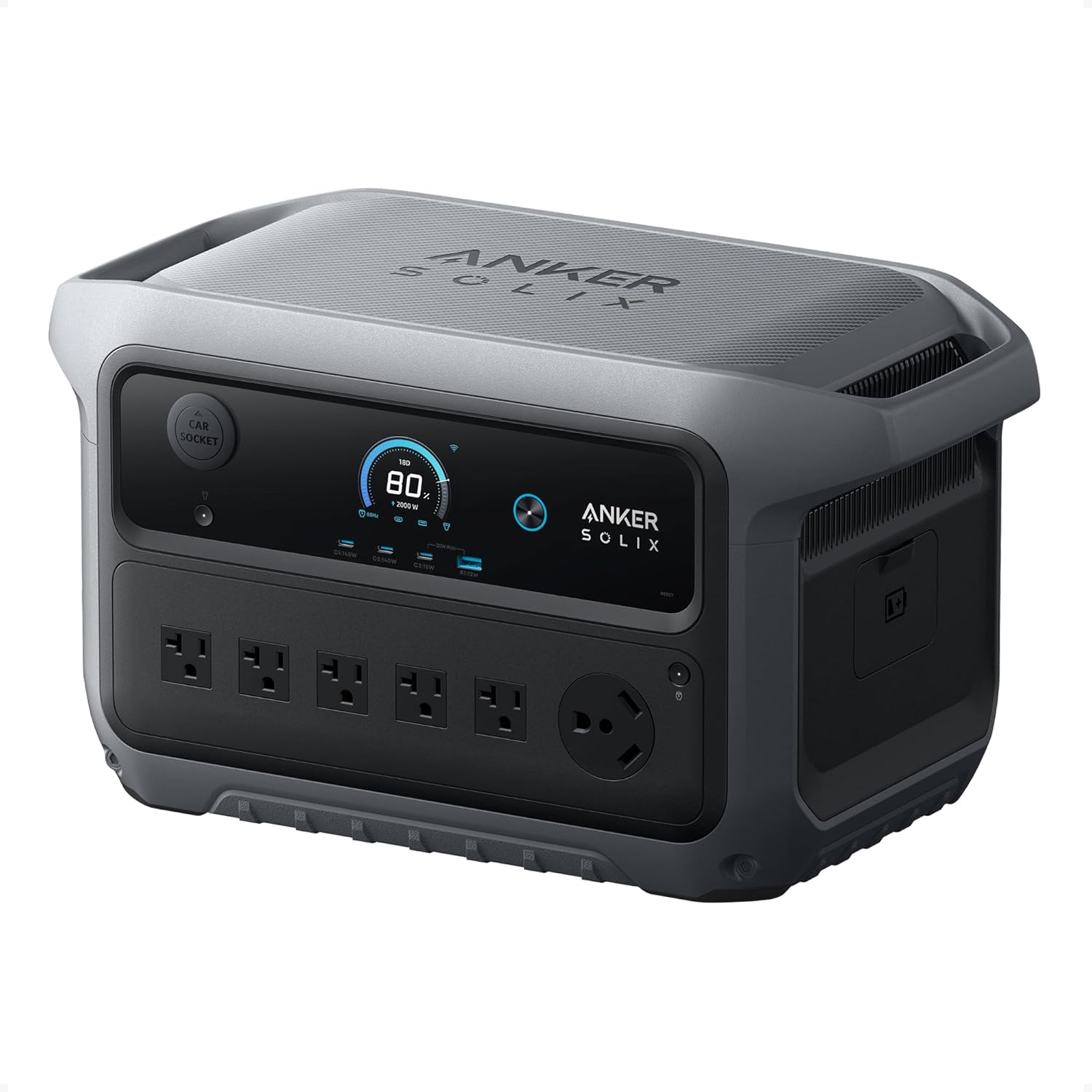
2. Anker SOLIX C2000 Gen 2
- 2,400 W continuous and 4,000 W peak: 4,000 / 3,250 = about 1.2 over a 1/2 HP start.
- 2,048 Wh, rising to about 4 kWh with the BP2000, which takes a heavy-rain 1/3 HP pump from about 13 to about 26 hours.
- 10 ms UPS, 9 W idle draw, 800 W solar input at 11 to 60 V, 41.7 lb.
Best for: households that want a pump covered now and a second battery before the next storm season.
Avoid if: your pump is larger than 1/2 HP, where the 4,000 W peak margin runs thin.
3. Jackery Explorer 2000 v2
- 2,200 W continuous and 4,400 W surge: about 1.4 over a 1/2 HP start.
- 39.5 lb for 2,042 Wh, the easiest 2 kWh unit here to carry down to the pit.
- UPS switchover is listed at 20 ms or less, slower than the 10 ms units; check your pump’s manual on brief interruptions.
Best for: bringing the station downstairs when the forecast turns and taking it back up after.
Avoid if: you want it on permanent automatic duty with the fastest switchover.
4. DJI Power 2000
- About 3,000 W continuous, which on its own exceeds a 1/3 HP pump’s 2,100 W total start.
- DJI does not publish a surge figure, so a 1/2 HP start at about 3,250 W cannot be checked against a spec.
- 2,048 Wh LFP, UPS switchover reported within 10 ms, about 48 lb.
Best for: a 1/3 HP pump that shares the station with a fridge or a dehumidifier.
Avoid if: you own a 1/2 HP pump and want a published surge rating to match.
5. EcoFlow DELTA 3 Classic
- 3,600 W surge clears a 1/2 HP start by about 1.1, the only 1 kWh pick that does on paper.
- 1,800 W continuous covers the 1,050 W running draw.
- 1,024 Wh means about 4 hours of a 1/2 HP pump in heavy rain, so it is a bridge, not a storm plan.
Best for: covering a pump through short outages while the station sits on UPS duty.
Avoid if: outages in your area last longer than an evening during rain.
6. Jackery Explorer 1000 v2
- 1,500 W continuous, 3,000 W surge peak: about 1.4 over a 1/3 HP start, short of a 1/2 HP start.
- 1,070 Wh LFP at 23.8 lb, the lightest pick.
- About 33 hours with light inflow, about 6 hours in heavy rain.
Best for: a 1/3 HP pump in a basement that sees light seepage during outages.
Avoid if: your pump is 1/2 HP, or it runs most of the hour in spring storms.
7. Anker SOLIX C1000 Gen 2
- 2,000 W continuous, 3,000 W peak: the same 1/3 HP coverage as the Explorer 1000 v2 with more running headroom.
- Refills in 49 minutes at 1,600 W with UltraFast mode, if the battery is above 68°F, per Anker.
- 1,024 Wh, 10 ms UPS, 24.9 lb, no expansion.
Best for: flicker-prone areas where the grid comes back often enough to refill fast.
Avoid if: the station would sit in an unheated basement below 68°F and you count on the fast recharge.
Cost of Ownership and Alternatives
A general power station costs more per pumping hour than a dedicated sump backup, but it also runs the fridge and lights. A dedicated battery backup sump system adds a second DC pump and its own battery in the pit; see the best battery backup sump pumps if the pump is the only load you care about.
- Extension cord: run the pump on a heavy-duty cord rated above its load, the same rule the CPSC gives for generator cords.
- Expansion batteries: the DELTA 3 Ultra and C2000 Gen 2 accept them; each one is a major add-on cost.
- Warranty: EcoFlow lists 3 years, extended to 5 with app registration.
- Wiring: a hardwired pump, or tying a station into a home circuit, is a job for a licensed electrician.
For multi-day storms, some owners pair the station with a fuel generator to recharge it. Any fuel-burning generator produces carbon monoxide: the CPSC advises running it outdoors only, at least 20 ft from the home and far from windows, doors, and vents, with the exhaust directed away from the home and other buildings people can enter, never in a garage, basement, porch, or carport, and keeping CO alarms with battery power or battery backup on every level and outside sleeping areas. Follow the manufacturer’s manual and local rules.
How to Choose a Station for Your Sump Pump
- What horsepower is the pump? Read the label. For 1/3 HP, look for 2,100 W of surge or more; for 1/2 HP, 3,250 W or more.
- How many minutes an hour does it run? Time it in heavy rain and use the average-watts formula above.
- How long are your rain-season outages? Hours x average watts / 0.85 = rated Wh. Twelve hours of a 1/2 HP pump at 10 minutes an hour: 12 x 175 / 0.85 = about 2,470 Wh, which points to the DELTA 3 Ultra or an expanded C2000 Gen 2.
- Will someone be home? If not, choose a fast UPS switchover so the station takes over by itself; see what UPS mode on a power station does.
- What else shares the station? Add the fridge and lights; the combined picks are in the best portable power stations for home backup.
FAQ
Can a portable power station run a sump pump?
Yes, if its surge rating covers the pump’s starting watts and its battery covers the hours. A 1/3 HP pump needs about 2,100 W to start, which every pick on this list is rated to deliver.
How long will a power station run a sump pump?
From a few hours to several days, depending on inflow. A 2,048 Wh station runs a 1/3 HP pump for about 13 hours at 10 minutes an hour and about 64 hours at 2 minutes an hour.
Will a 1,000 W power station start a 1/2 HP sump pump?
Check surge, not the headline watts. A 1/2 HP pump’s estimated 3,250 W start exceeds a 3,000 W peak rating, so look for 3,600 W or more.
Is a power station better than a battery backup sump pump?
It is more flexible, because it runs the main pump and other loads. A dedicated backup adds a second pump, which also helps if the main pump fails rather than the power.
Changelog: October 2026: first published.