


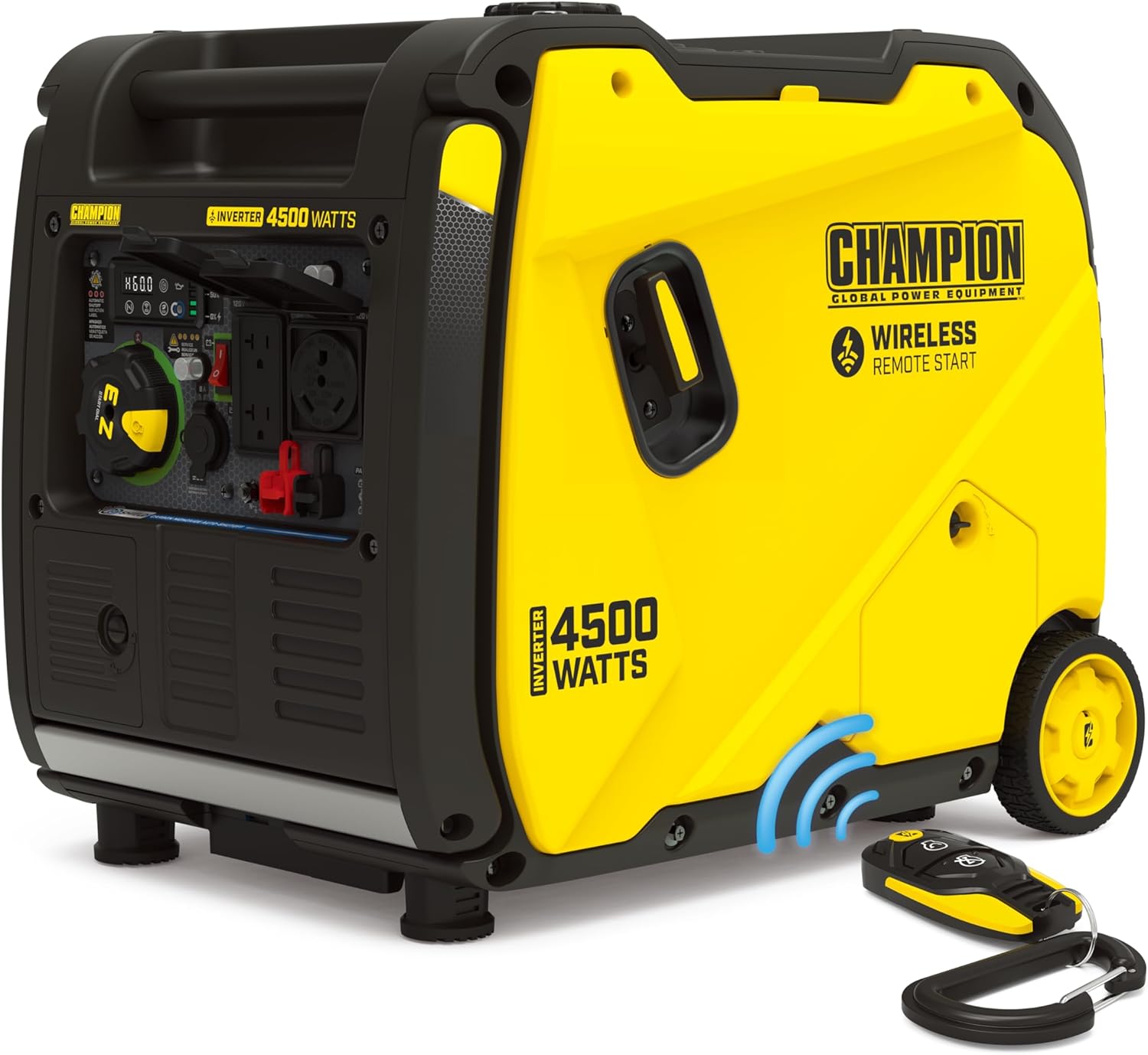
The quietest generator for a house is the one with a published noise figure you can actually compare, enough running watts for your load, and a carbon monoxide shutoff, and the Champion 4500-Watt Wireless Remote Start inverter (model 201324) clears all three: Champion rates it at 61 dBA from 23 ft with 3,500 running watts and CO Shield. Lower numbers exist on this list, but they come from different load points or with no distance stated, so they are not a like-for-like comparison.
Quiet does not mean safe indoors
A low-noise inverter generator still burns gasoline or propane and makes carbon monoxide (CO), a gas you cannot see or smell. The CPSC says to run portable generators outside only, at least 20 ft from the home, far from windows, doors, and vents, with the exhaust pointed away from the house. Never run one in a home, garage, basement, crawlspace, or shed, even with doors or windows open.
Install battery-operated or battery-backup CO alarms on every level and outside sleeping areas, as the CPSC recommends. A built-in CO shutoff helps, but Champion states its CO Shield is not a substitute for an indoor CO alarm, and the same logic applies to any brand. Follow the owner’s manual and local rules.


Quick Comparison
The noise column shows each maker’s figure exactly as published, including the condition it was quoted under. Champion states a distance, WEN states a load, and Westinghouse states neither, so read the column as three different yardsticks, not one ranking.
| Model | Noise (maker figure and basis) | Running W | Starting W | Fuel | CO shutoff | Weight | Best for |
|---|---|---|---|---|---|---|---|
| Champion 201324 (4500-Watt Wireless Remote Start) | 61 dBA at 23 ft | 3,500 | 4,500 | Gasoline | Yes (CO Shield) | 100.6 lb | Fridge, furnace blower, and lights on a suburban lot |
| WEN DF480iX | 62 dB at 1/4 load | 4,000 gas / 3,600 propane | 4,800 / 4,320 | Gasoline, propane | Yes (CO Watchdog) | 78.5 lb (listing) | Quiet dual fuel with stored propane |
| Westinghouse iGen5000 | As low as 52 dBA (no distance or load stated) | 3,900 | 5,000 | Gasoline | No (iGen5000cv has one) | 104.7 lb | Long overnight runs on one tank |
| WEN 56235i | 51 dB at 1/4 load | 1,900 | 2,350 | Gasoline | No (56235iX has one) | 39 lb | A fridge and lights, or a pair in parallel |
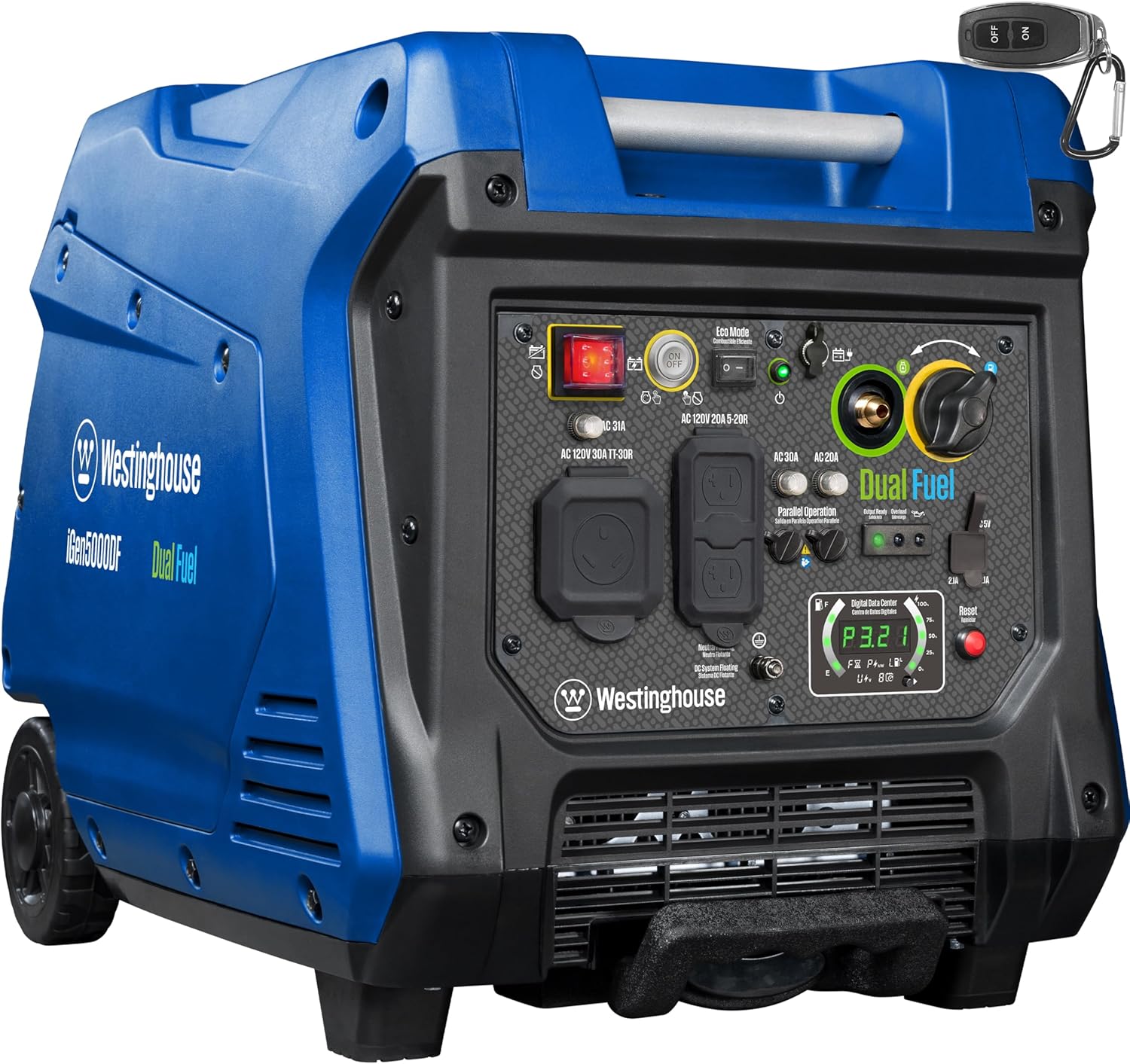
| Westinghouse iGen5000DF | As low as 52 dBA (no distance or load stated) | 3,900 gas / 3,500 propane | 5,000 / 4,500 | Gasoline, propane | No (iGen5000DFcv has one) | 104.7 lb | Dual fuel where a CO-sensor version is not needed |
How We Chose
We started from the noise number and asked what it was measured against. A decibel figure without a distance and a load is a marketing number; one with both is something you can carry into your own yard with the math below. We research and compare published data; we do not run our own product trials or sound measurements. The sources were maker spec pages and listings, owner manuals, CPSC safety guidance, and the Yard & Grid Score, which is built from verified buyer ratings and explained on our How We Choose page.
- Published noise with its basis. A stated distance ranked higher than a stated load, and both ranked higher than “as low as.”
- Running watts for a real house. At least a fridge and lights on the running rating; a fridge, furnace blower, and lights for the top spots.
- CO shutoff. The CPSC advises looking for generators with an automatic shutoff, so models without one sit lower even when their noise figure is smaller.
- Owner score and support. Used to separate close calls, not to override the first three.
Our inverter generator guide for home use ranks the same category on capacity first. This page reorders the field around sound, so some strong home picks from that guide appear lower here or not at all.
The Quiet Inverter Generators, Ranked
1. Champion 4500-Watt Wireless Remote Start Inverter (201324)
- The most usable noise figure here. Champion publishes 61 dBA at 23 ft, which is about 7 m. With a distance attached, you can estimate the level at your property line instead of guessing.
- Load headroom. 3,500 running watts and 4,500 starting watts cover a fridge, a furnace blower, and lights, with room left in the budget.
- Runtime. Champion lists up to 14 hours at 25% load on a 2.25 gal steel tank: 2.25 gal / 14 h = about 0.16 gal per hour at quarter load.
- Convenience on a cold night. The included key fob starts and stops it from up to 80 ft away according to Champion’s listing, so you are not walking out to the yard to shut it down.
- CO Shield shuts the engine off if CO builds up around the unit. It does not replace CO alarms on every level and outside sleeping areas.
Outlets are a TT-30R (30 A RV), a 5-20R duplex, and a 12 V outlet, with a parallel kit sold separately. It is gasoline only and heavy at 100.6 lb, but it rolls on wheels.
Best for: a suburban lot where the generator sits about 20 to 30 ft from the house and you want a fridge, furnace blower, and lights on through the night.
Avoid if: you store propane rather than gasoline for outages, or you need to lift the unit into a truck bed alone.
2. WEN DF480iX
- Quiet and dual fuel. WEN rates it at 62 dB at a quarter load. It is the quiet pick for “dual fuel generator quiet” searches that also want a CO shutoff.
- Propane derate is modest. 4,000 running watts on gasoline and 3,600 on propane: 3,600 / 4,000 = 0.90, so propane gives up about 10 percent.
- Fuel math. WEN lists 7 hours at half load on 1.9 gal and 12 hours at half load on a 20 lb cylinder: 1.9 / 7 = about 0.27 gal per hour, and 20 lb / 12 h = about 1.7 lb per hour.
- CO Watchdog shuts the engine down when CO builds up.
It has four 5-20R outlets and a TT-30R, no 240 V outlet, and a 3-year warranty.
Best for: households that keep 20 lb propane cylinders on hand and want a quiet unit that runs on either fuel.
Avoid if: you have a 240 V well pump; there is no 240 V outlet.
3. Westinghouse iGen5000
- Lowest number among the larger units. Westinghouse lists “as low as 52 dBA.” Its product page gives no distance or load for that figure, which is why it is not ranked first.
- Long runtime. 18 hours at 25% load on a 3.4 gal tank: 3.4 / 18 = about 0.19 gal per hour. That covers a full night and the next morning on one fill.
- Load. 3,900 running and 5,000 peak watts, a little more than the Champion on both.
- No CO sensor on this version, per Westinghouse’s spec table. The iGen5000cv adds automatic CO shutdown.
Outlets are a 5-20R duplex, a TT-30R, and USB ports; the warranty is 3 years for residential use.
Best for: overnight runs where refueling at 2 a.m. is the problem you most want to avoid.
Avoid if: you require a built-in CO shutoff; look for the iGen5000cv instead.
4. WEN 56235i
- The smallest published number here. WEN rates it at 51 dB at a quarter load, with a 79cc engine. A quarter of 1,900 W is only 1,900 x 0.25 = 475 W, so that figure describes a light load.
- Light enough to carry. 39 lb, the only pick on this list one person can lift easily.
- Capacity is the limit. 1,900 running and 2,350 starting watts run a fridge and lights but not a fridge plus a furnace blower starting together (see the sizing example below).
- Parallel option. Two WEN inverters link with a WEN parallel kit, sold separately.
WEN lists over 5.7 hours at half load on 1 gal, no CO sensor on the base model (the 56235iX adds CO Watchdog), and a 2-year warranty.
Best for: a fridge, a few lights, and a router in a townhouse with a small yard.
Avoid if: you need to start a furnace blower or a sump pump while the fridge is running.
5. Westinghouse iGen5000DF
- Same “as low as 52 dBA” claim as the gasoline iGen5000, again with no distance or load stated.
- Dual fuel. 3,900 running watts on gasoline and 3,500 on propane: 3,500 / 3,900 = about 0.90, the same 10 percent propane derate as the WEN.
- Runtime. 18 hours at 25% on 3.4 gal of gasoline and 22 hours at 25% on propane; Westinghouse does not state the cylinder size for the propane figure.
- No CO sensor on this version. The iGen5000DFcv is the dual fuel model with automatic CO shutdown.
Best for: owners who want the quiet Westinghouse platform with a propane option.
Avoid if: you want a CO shutoff, or you cannot move a 104.7 lb unit on uneven ground.
Reading Decibel Figures: The Math Makers Leave Out
Decibels are logarithmic, so you cannot add them or compare them across different conditions the way you compare watts. Three rules cover most of what a homeowner needs.
Distance: about 6 dB less each time you double it
For a single source in open air, sound level falls by 20 x log10(far distance / near distance). Take the Champion’s 61 dBA at 23 ft and move to a neighbor’s window 50 ft away: 20 x log10(50 / 23) = 20 x 0.34 = about 6.7 dB, so roughly 61 minus 6.7 = about 54 dBA. Walls, fences, and hard pavement reflect sound, so treat that as a best case, not a promise.
Load: quarter-load figures run lower than rated-load figures
Inverter generators slow the engine at light load, which is why makers like to quote a quarter-load number. Honda, for example, lists its current EU2200i at 48 dB(A) at a quarter load and 57 dB(A) at rated load: 57 minus 48 = 9 dB between the two. That is why the WEN figures (quarter load) and the Champion figure (stated distance, load not given) cannot be lined up as a simple ranking.
Two units in parallel: add about 3 dB, not double
Combined level = 10 x log10(10^(L1 / 10) + 10^(L2 / 10)). Two WEN 56235i units at 51 dB each give 10 x log10(2 x 10^5.1) = 51 + 10 x log10(2) = 51 + 3.0 = about 54 dB, not 102 dB. Mix a louder and a quieter unit, say 61 dB and 52 dB, and you get 10 x log10(10^6.1 + 10^5.2) = 10 x log10(1,258,925 + 158,489) = about 61.5 dB: the quieter unit barely registers. A common acoustics rule of thumb is that a 10 dB rise sounds roughly twice as loud, so a 3 dB rise from pairing is noticeable but modest.
Cost of Ownership
Fuel is the running cost that grows with outage length, so compare gallons per hour at a similar load. From each maker’s runtime figure:
- Champion 201324: 2.25 gal / 14 h = about 0.16 gal per hour at 25% load, or 24 / 14 x 2.25 = about 3.9 gal a day.
- Westinghouse iGen5000 and iGen5000DF: 3.4 gal / 18 h = about 0.19 gal per hour at 25% load, or about 4.5 gal a day.
- WEN DF480iX: 1.9 gal / 7 h = about 0.27 gal per hour at half load.
- WEN 56235i: 1 gal / 5.7 h = about 0.18 gal per hour at half load of a much smaller engine.
Beyond fuel, budget for oil changes on the schedule in each manual, a fuel stabilizer for stored gasoline, a heavy-duty outdoor-rated extension cord whose rating exceeds the load (CPSC guidance), and a parallel kit if you plan to pair units. Warranties are 3 years for the Champion, WEN DF480iX, and both Westinghouse models, and 2 years for the WEN 56235i.
How to Choose a Quiet Generator for Your House
What load are you actually carrying?
Start with the load. Using Champion’s wattage chart at the high end of each range: fridge 400 W, 1/2 HP furnace blower 800 W, ten LED bulbs at 15 W = 150 W, router 20 W, and chargers 100 W. Running total: 400 + 800 + 150 + 20 + 100 = 1,470 W. Champion’s method adds only the highest single starting figure on top, and the furnace blower’s is 1,600 W: 1,470 + 1,600 = 3,070 W peak. The WEN 56235i’s 2,350 starting watts fall short; the other four clear it. Our generator sizing worksheet walks through a full house.
How far will it sit from the nearest bedroom window?
The CPSC minimum is 20 ft from the home. If the neighbor’s bedroom is 40 ft from where you can place it, the distance rule above gives 61 minus 20 x log10(40 / 23) = 61 minus 4.8 = about 56 dBA from the Champion in open air. Check your local noise ordinance, since many set nighttime limits at the property line.
Do you need propane?
If you store fuel for winter outages, propane avoids the stale-gasoline problem. The quiet dual fuel picks here are the WEN DF480iX and the Westinghouse iGen5000DF; our dual fuel generator guide covers the wider field.
Inverter or conventional?
Every pick here is an inverter generator, which throttles the engine down at light load. Conventional open-frame units hold a fixed engine speed and are louder; Champion’s own 7500 W conventional dual fuel model is rated at 74 dB(A). The trade-offs are laid out in inverter generator vs regular generator.
FAQ
What is the quietest inverter generator on this list?
By published number, the WEN 56235i at 51 dB at a quarter load. By a figure you can carry to your own yard, the Champion 201324 at 61 dBA from 23 ft. The two are measured differently, so neither number proves one is quieter than the other at the same load and distance.
Does running two generators in parallel double the noise?
No. Two identical units add about 3 dB: 10 x log10(2) = 3.0. Two 51 dB units come to about 54 dB at the same spot.
Can I build a box around the generator to quiet it?
Do not enclose it in anything the maker has not approved. The CPSC warns against running generators in sheds, garages, or partly enclosed spaces because CO can build up there. Distance is the safer noise tool: each doubling of distance cuts about 6 dB in open air.
Is a quiet inverter generator safe to run on a porch or in a carport?
No. The CPSC says never to run a generator on a porch or in a carport. Noise level has nothing to do with CO output. Our guide to running a generator safely covers placement, cords, and refueling.
Changelog: October 2026: first published.









