


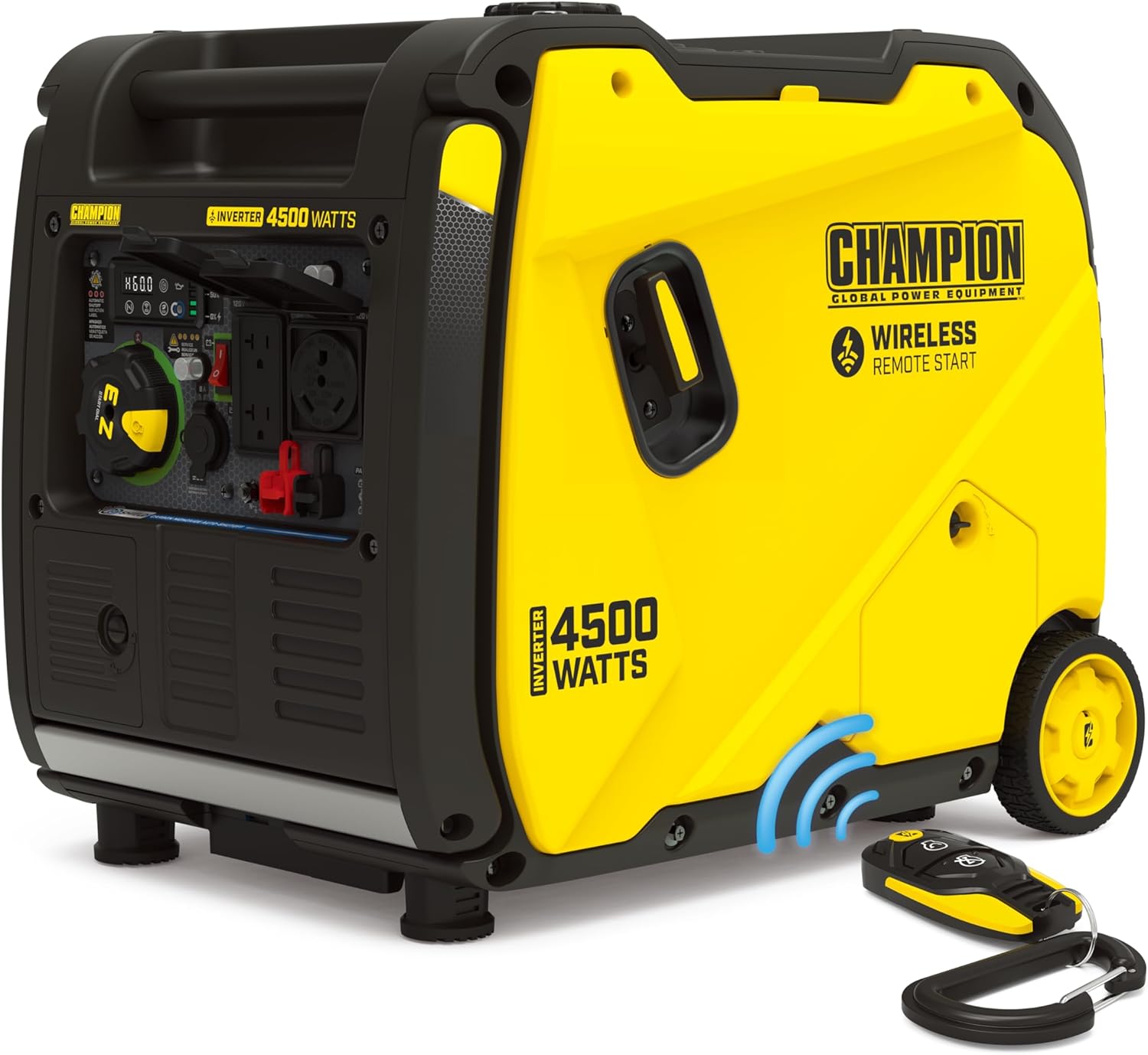
For most homes choosing within Champion’s lineup, the 4500-Watt Wireless Remote Start inverter (model 201324) is the one to start with: 3,500 running watts covers a fridge, a furnace blower, and lights, Champion lists up to 14 hours at 25% load on 2.25 gal, and CO Shield shuts the engine off if carbon monoxide builds up. If you store propane instead of gasoline, the lighter 4000-Watt Dual Fuel model (201050) is the better fit.
Carbon monoxide warning for every Champion generator
Gasoline and propane generators make carbon monoxide (CO), a gas you cannot see or smell. The CPSC says to run portable generators outside only, at least 20 ft from the home, far from windows, doors, and vents, with the exhaust pointed away from the house. Never run one in a home, garage, basement, crawlspace, or shed, even with doors or windows open. The CPSC estimates about 100 people die in the U.S. each year from CO tied to portable generators.
Install battery-operated or battery-backup CO alarms on every level of the home and outside sleeping areas. Champion states that CO Shield is not a substitute for an indoor carbon monoxide alarm. Follow the owner’s manual and local rules.


This guide ranks three Champion models because those are the Champion generators with usable listings in our current product data. Other Champion models that come up in searches, including the 4500-Watt Dual Fuel inverter (201321) and the 2500-Watt Dual Fuel inverter (201530), are covered in the lineup map below from Champion’s own spec pages.
Quick Comparison
Running watts are what the generator holds; starting watts are the short burst it gives a motor at startup. Champion quotes noise at 23 ft for all three, so the noise column is a fair comparison here.
| Model | Running W (gas / propane) | Starting W | Runtime at 25% load | Noise at 23 ft | CO Shield | Weight | Best for |
|---|---|---|---|---|---|---|---|
| Champion 201324, 4500-Watt Wireless Remote Start Inverter | 3,500 / gas only | 4,500 | 14 h on 2.25 gal | 61 dBA | Yes | 100.6 lb | Fridge, furnace blower, and lights on gasoline |
| Champion 201050, 4000-Watt Dual Fuel RV Ready Inverter | 3,000 / 2,700 | 4,000 (both fuels) | 10 h on 1.54 gal; 25 h on 20 lb propane | 64 dBA | Yes | 51.8 lb | Propane storage and a unit one person can lift |
| Champion 200914, 4250-Watt Dual Fuel Open Frame Inverter | 3,500 / 3,150 | 4,250 (both fuels) | 22 h on 4 gal (gas) | 64 dBA | Not listed | 79 lb | Longest gasoline runtime per fill |
How We Chose
We limited the field to Champion generators in our product data, then ranked them for home backup, not camping. We research and compare published specifications; we do not run our own product trials. Specs come from Champion’s model pages where they are still online, Champion’s operator’s manual and listing text where they are not, CPSC guidance, and the Yard & Grid Score built from verified buyer ratings, explained on our How We Choose page. The ranking weighed:
- Running watts against a typical essentials load, using Champion’s own wattage chart and method.
- CO Shield, Champion’s automatic CO shutoff, since the CPSC advises choosing generators with one.
- Fuel flexibility and runtime, for outages that run past one tank.
- Data quality. Where Champion’s own pages disagree with a listing, we say so in the product notes.
The Champion Generators, Ranked
1. Champion 4500-Watt Wireless Remote Start Inverter (201324)
- Most running watts with CO Shield in this set. 3,500 running and 4,500 starting watts from a 212cc engine, per Champion’s model page.
- Runtime and fuel use. Up to 14 hours at 25% load on a 2.25 gal steel tank. At a quarter load, 3,500 x 0.25 = 875 W for 14 h = 12,250 Wh, or 12.25 kWh / 2.25 gal = about 5.4 kWh per gallon.
- Quietest Champion here at 61 dBA from 23 ft.
- Remote start. Champion’s model page says the key fob works from up to 80 ft away.
It has a TT-30R (30 A RV), a 5-20R duplex, and a regulated 12 V outlet; a parallel kit, sold separately, pairs it with another Champion inverter of 2,800 W or more. The warranty is 3 years with free lifetime technical support.
Best for: a house that needs the fridge, a gas furnace blower, and lights through a winter night on stored gasoline.
Avoid if: you want to run on propane; this model is gasoline only.
2. Champion 4000-Watt Dual Fuel RV Ready Inverter (201050)
- Best propane math in this set. Champion lists 2,700 running watts on propane and up to 25 hours at 25% load on a 20 lb tank: 2,700 x 0.25 = 675 W x 25 h = about 16.9 kWh per tank, or 20 lb / 16.9 kWh = about 1.2 lb of propane per kWh.
- Light. 51.8 lb, about half the weight of the 201324.
- Small gasoline tank. 1.54 gal and up to 10 hours at 25% load, so on gasoline it needs a refill overnight.
- CO Shield and the same 4,000 starting watts on both fuels.
Outlets are a 5-20R duplex, a TT-30R, a 12 V outlet, and parallel ports; it starts by recoil. Verified buyers rate it 4.6 across 702 reviews, which gives it a Yard & Grid Score of 89.
Best for: homes that keep a few 20 lb propane cylinders for winter and want a unit one person can carry to the yard.
Avoid if: you need to start a sump pump and a furnace blower on the same circuit plan; 3,000 running watts leaves little room.
3. Champion 4250-Watt Dual Fuel Open Frame Inverter (200914)
- Biggest tank. 4 gal and up to 22 hours at 25% load on gasoline: 3,500 x 0.25 = 875 W x 22 h = 19.25 kWh / 4 gal = about 4.8 kWh per gallon.
- Propane rating. Champion’s operator’s manual lists 4,250 starting and 3,150 running watts on propane, and Champion’s product copy gives up to 21 hours at 25% load on a 20 lb tank. The Amazon listing’s lower figures (3,825 starting watts and 14 hours) do not match Champion’s manual.
- No CO Shield listed, and Champion’s model page for it returned an error when we checked in October 2026, so the operator’s manual on Champion’s site and the listing are the main sources.
- CARB compliant, per Champion’s listing.
It has a TT-30R, two 5-20R outlets, and a 12 V outlet with a USB adapter, plus a 3-year warranty.
Best for: long gasoline runs where one fill should last a full day at light load.
Avoid if: a built-in CO shutoff is a requirement for you.
Champion Lineup Map: Models Not Ranked Here
Several Champion model names are close enough to confuse. The table below lists the ones people search for most, from Champion’s spec pages, so you can match a model number to the job.
| Champion model | Type | Running W (gas / propane) | Starting W | Runtime (Champion figure) | Noise | Fits |
|---|---|---|---|---|---|---|
| 201321, 4500W Dual Fuel Open Frame Inverter | Inverter | 3,650 / 3,285 | 4,500 (both fuels) | 22 h at 25% on 4.02 gal; 21 h at 25% on 20 lb | 64 dB(A) | The “Champion 4500 dual fuel” search; CO Shield; 92.6 lb |
| 201530, 2500W Dual Fuel Inverter | Inverter | 1,850 / 1,665 | 2,500 | 11.5 h at 25% on 1.05 gal; 25 h at 25% on 20 lb | 53 dBA at 23 ft | Fridge and lights, RV trips |
| 200970, Dual Fuel (conventional) | Conventional | 3,650 / 3,285 | 4,550 / 4,100 | 14 h gas, 10.5 h propane at 50% | 68 dB(A) | Budget essentials; louder, 110 lb |
| 7500W Dual Fuel (201281) | Conventional | 7,500 / 6,750 | 9,375 / 8,400 | About 10 h gas, about 5.5 h on 20 lb at 50% | 74 dB(A) | Larger essentials loads where noise matters less |
The propane running figures on Champion’s dual fuel models sit about 10 percent below gasoline: 3,285 / 3,650 = 0.90 and 6,750 / 7,500 = 0.90. If propane is your main outage fuel, size from the propane column. For a head-to-head with the Honda EU2200i, see Honda EU2200i vs Champion 2500.
Cost of Ownership
Fuel dominates the cost of a long outage. At a quarter load for 24 hours:
- 201324 on gasoline: 24 h / 14 h x 2.25 gal = about 3.9 gal a day.
- 201050 on propane: 24 h / 25 h x 20 lb = about 19 lb a day, close to one standard cylinder.
- 201050 on gasoline: 24 h / 10 h x 1.54 gal = about 3.7 gal a day, spread over three fills.
- 200914 on gasoline: 24 h / 22 h x 4 gal = about 4.4 gal a day, a little more than one full tank.
Add 10W-30 oil changes on the schedule in each manual, fuel stabilizer for stored gasoline, a spare 20 lb cylinder if you run propane, and a heavy-duty outdoor extension cord rated above the total load, as the CPSC advises. All three carry Champion’s 3-year limited warranty. Champion says CO Shield lasts a minimum of a decade, so it is not a part you plan to replace.
How to Choose the Right Champion
How many watts does your essentials list need?
Champion’s own sizing method is to add up running watts, then add the single highest starting figure on top, because its chart lists starting watts as the extra a motor needs. Using the high end of Champion’s chart: fridge 400 W, 1/2 HP furnace blower 800 W, ten LED bulbs at 15 W = 150 W, router 20 W, chargers 100 W. Running: 400 + 800 + 150 + 20 + 100 = 1,470 W. Peak: 1,470 + 1,600 (the furnace blower’s starting figure) = 3,070 W. All three ranked models clear both numbers on gasoline.
Add a 1/2 HP sump pump at 1,050 running and 2,150 starting watts and the running total becomes 1,470 + 1,050 = 2,520 W, with a peak of 2,520 + 2,150 = 4,670 W. That is above every starting rating in this set, so you would either keep the sump pump on its own schedule or move up to a larger model. Our generator sizing worksheet has the full method.
Gasoline, propane, or both?
Propane stores well and avoids gasoline going stale, at the cost of about 10 percent less output. If you want that option across brands, our dual fuel generator guide compares WEN and Westinghouse models alongside it.
Does noise matter where you live?
All three ranked models are inverters rated at 61 to 64 dBA at 23 ft, against 68 to 74 dB(A) for Champion’s conventional units in the lineup map. If noise is the deciding factor, our quiet inverter generator guide explains how to compare decibel figures across brands.
Will it connect to the house?
None of the three ranked models has a 240 V outlet. Feeding a home circuit from any generator requires a transfer switch or interlock installed by a licensed electrician; never plug a generator into a wall outlet, which the CPSC warns can put utility workers and neighbors at risk.
FAQ
Is the Champion 4500 inverter generator dual fuel?
It depends on the model number. The 201324 Wireless Remote Start model is gasoline only. The 201321 4500W Dual Fuel Open Frame Inverter runs on gasoline (3,650 running watts) or propane (3,285 running watts), per Champion.
Which Champion generator is best for an RV?
All three ranked models have a TT-30R 30 A RV outlet. The 201050 is the easiest to carry at 51.8 lb. Check the starting watts on your RV air conditioner’s label against each model’s starting rating before you rely on it.
Does CO Shield mean I can skip a CO alarm?
No. Champion states CO Shield is not a substitute for an indoor carbon monoxide alarm. It protects the area around the generator; CO alarms on every level and outside sleeping areas cover CO that drifts in through windows, doors, or vents.
How long will a Champion generator run on a 20 lb propane tank?
Champion lists up to 25 hours at 25% load for the 201050 and the 201530, and 21 hours for the 201321. Runtime falls as load rises; Champion’s 7500 W conventional model lists about 5.5 hours at 50% load. Our article on propane runtime works through the math by load.
Changelog: October 2026: first published.









