


Champion is the better fit if you want propane or a unit one person can carry: the 201050 weighs 51.8 lb and gives 2,700 W on propane, while the Predator 3500 is a gasoline unit that Harbor Freight lists at 102 lb. Choose the Predator 3500 if you want the larger tank and a stated 56 dB(A), and weight does not matter.
Harbor Freight sells Predator generators itself, and the Predator is not in our Amazon product data, so this page does not link to it or compare prices. Predator figures come from Harbor Freight’s owner’s manual for this generator (Harbor Freight lists it as item 71358 / 59137) and its listing; Champion’s come from Champion’s product page.
Champion 201050

Champion 4000-Watt Dual Fuel RV Ready




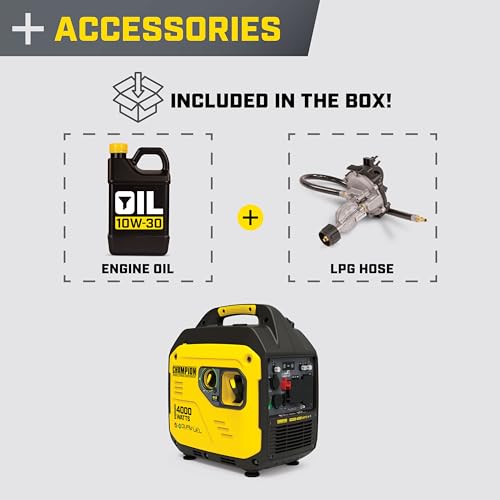
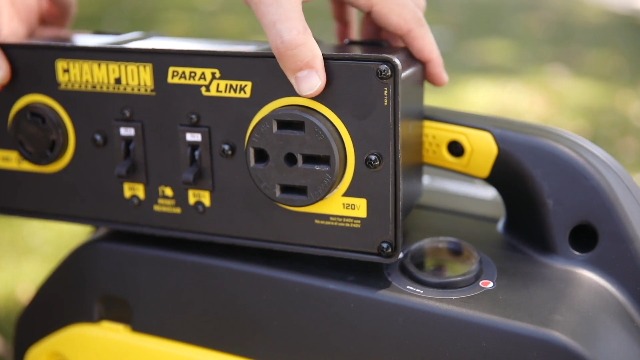
As an Amazon Associate we earn from qualifying purchases. Product prices and availability are accurate as of the date/time indicated.
Specs Side by Side
The pair is the closest match in rating: the Predator 3500 Super Quiet with CO SECURE (item 71358) and the Champion 4000-Watt Dual Fuel RV Ready Inverter (201050).
| Spec | Predator 3500 (71358) | Champion 201050 |
|---|---|---|
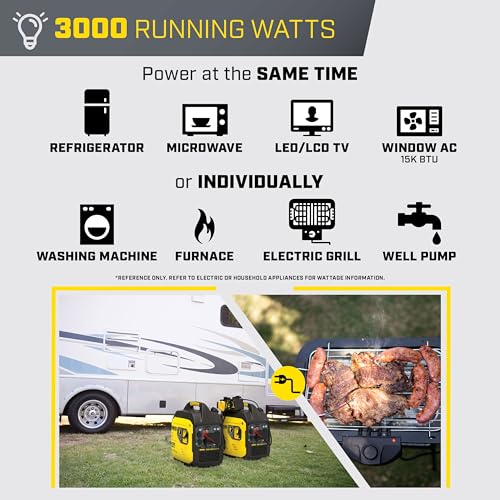
| Running watts | 3,000 W | 3,000 W gas / 2,700 W propane |
| Starting watts | 3,500 W | 4,000 W |
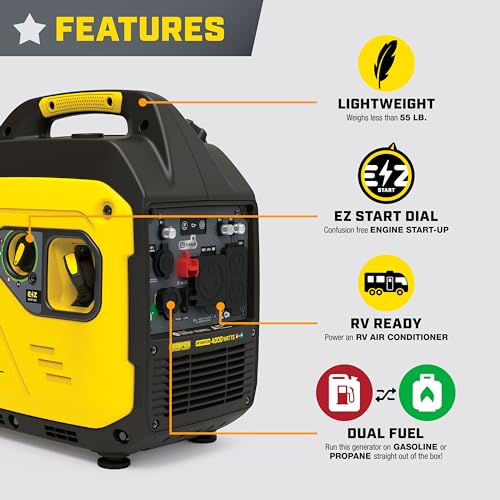
| Fuel | Gasoline | Gasoline or propane |
| Tank | 2.3 gal (listing); the EPA-version manual says 2.64 gal | 1.54 gal |
| Runtime at 25% load | 11 hours | 10 hours gas; 25 hours on a 20 lb propane tank |
| Noise | 56 dB(A) at 23 ft, 25% load | 64 dBA at 23 ft, load not stated |
| Weight | 102 lb per Harbor Freight’s listing; Consumer Reports lists 115 lb | 51.8 lb |
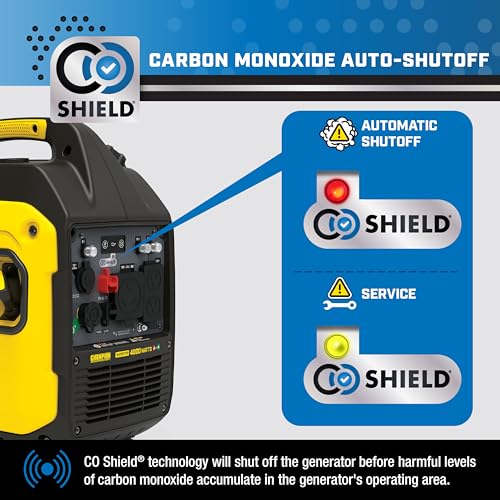
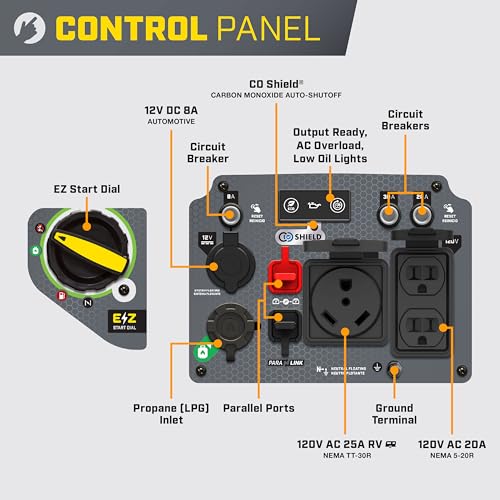
| CO shutoff | CO SECURE | CO Shield |
| Warranty | 90-day limited (owner’s manual) | 3-year limited |
| Power quality | Not confirmed here | Under 3% THD |
Where a cell says “not confirmed,” the maker’s documents did not give us a figure we could read, and we left it open. Harbor Freight’s product page did not open for us, and its manual revisions disagree on tank size, so confirm tank and weight on the unit you buy.
The Differences That Matter
Fuel economy on paper
At 25% load, Predator: 3,000 W x 0.25 = 750 W x 11 h = 8,250 Wh from the listed 2.3 gal, or about 3,590 Wh per gallon (about 3,130 if the tank is the manual’s 2.64 gal). Champion on gasoline: 750 W x 10 h = 7,500 Wh from 1.54 gal, or about 4,870 Wh per gallon. That is about 4,870 / 3,590 = 1.4 times the energy per gallon for the Champion on paper, but its tank is smaller, so the Predator’s listed runtime is about 1 hour longer.
Propane changes the outage math
Champion’s propane rating is 2,700 W, which is 2,700 / 3,000 = 90% of its gas rating. At 25% load that is 2,700 x 0.25 = 675 W x 25 h = about 16,900 Wh per 20 lb tank. Propane suppliers say propane does not go stale like gasoline, which favors the Champion for a unit that sits for months.
Weight and noise
Champion’s 51.8 lb is a one-person lift; the Predator at 102 lb (115 lb per Consumer Reports) needs a cart or two people. Harbor Freight rates the Predator at 56 dB(A) at 23 ft and 25% load, against Champion’s 64 dBA at 23 ft. Champion does not state the load there, so the 8 dB gap may be smaller or larger at matched load. Our quiet inverter guide explains how to compare these.
Starting watts for motors
Champion’s chart treats starting watts as the extra a motor needs on top of running watts. A fridge (400 W) plus a 1/2 HP furnace blower (800 W) plus lights, router, and chargers (270 W) runs 1,470 W; the blower’s start adds 1,600 W, so the peak is 3,070 W. Both units clear that: Predator 3,500 W, Champion 4,000 W. See running watts vs starting watts.
Carbon Monoxide
Both burn fuel and make carbon monoxide (CO). The CPSC says to run a portable generator outdoors only, never in the home, basement, shed, or garage, at least 20 feet from the home, far from windows, doors, and vents, with exhaust pointed away, and to keep working CO alarms on every level of the house and outside sleeping areas. Follow the owner’s manual and local rules too. CO SECURE and CO Shield are shutoffs, not substitutes for an alarm. See how to run a generator safely.
Choose the Predator 3500 If
- You buy from Harbor Freight, run gasoline, and want a bigger tank and lower stated noise.
- The unit lives on a cart or in a garage rack, so a 100 lb plus unit does not matter.
- Skip it if you want propane, a warranty longer than 90 days, or you must lift it alone.
Choose the Champion 201050 If
- You want propane as a backup fuel, or stored fuel that lasts.
- You need a 51.8 lb unit, the higher 4,000 W starting rating, and a 3-year limited warranty.
- Skip it if the 1.54 gal tank would force midnight refills at your load.
For more Champion models see best Champion generators; for another head-to-head see Honda EU2200i vs Champion 2500. We research and compare published specs; we do not run our own product trials. See how we choose.
FAQ
Is the Predator 3500 dual fuel?
The 71358 listed here is a gasoline model. Harbor Freight sells separate dual-fuel Predator models; check the item number.
Are Predator and Champion both inverter generators?
Yes. Champion lists under 3% total harmonic distortion (THD) for the 201050; Harbor Freight’s THD figure is not confirmed here.
Do I still need a CO alarm?
Yes. A shutoff does not replace working CO alarms on every level of the home and outside sleeping areas.
Changelog: November 2026: first published.









