


For most small and mid-size yards, a manual core aerator with hollow tines beats a spiked tool, because Illinois Extension says core aerators remove soil while spikes can press soil tighter around each hole. The LawnVigor three-tine model is the top pick below, with a four-tine Dolibest close behind when you want fewer presses.




Quick Comparison
| Aerator | Type | Tines per press | Tine detail (listing) | Best for |
|---|---|---|---|---|
| LawnVigor Manual Core Aerator | Core, hollow | 3 | Heat-treated, replaceable, plastic inserts | Compacted soil |
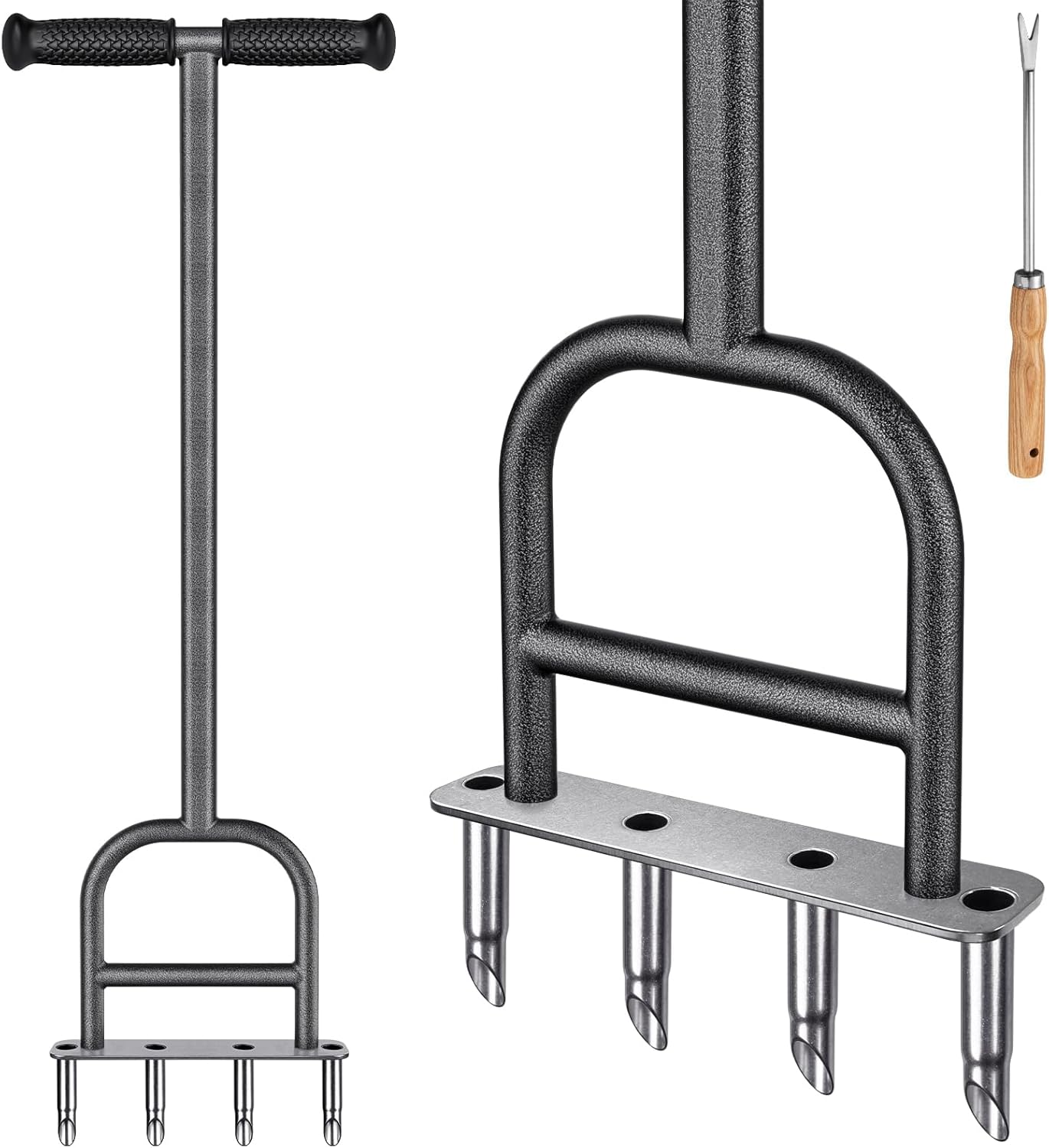
| Dolibest with storage tray | Core, hollow | 4 | Stainless plugs, plug-catching tray | Less cleanup |
| Dolibest with weeder handle | Core, hollow | 4 | 3.5 in long, 0.5 in wide, 12 in weeder | One tool for two jobs |
| Yard Butler ID-6C | Core, hollow | 2 | Dual plugs, foot bar, long handle | Standing work, sore backs |
| Walensee 15-spike | Spike | 15 | Iron spikes about 2.8 in long | Small spot jobs only |
How We Chose
We research and compare; we do not buy or use the products ourselves. Each tool was weighed on the number of tines, whether they are hollow, how plugs get cleared, and how the handle and foot bar work, using the listing text. We also looked at the Yard & Grid Score built from verified buyer ratings; the method is on How We Choose. Claims such as “will not rust” are the seller’s words, and size and weight figures come from listings, a weaker source than a maker spec sheet, so treat them as approximate.
The Picks
LawnVigor Manual Core Aerator
- Three hollow, replaceable tines, which the listing says are heat-treated and built not to clog.
- The listing asks owners to water dry soil first and not to rock, twist, or pry the tool sideways while it is in the ground.
- Keep the white plastic inserts in place; the listing says they help release plugs.
Best for: Compacted yards where plugs tend to jam. Avoid if: You want the most holes per press.
Dolibest Lawn Coring Aerator with Storage Tray
- Four hollow stainless plugs per press, so it covers ground faster than a two-tine tool.
- A tray catches ejected plugs, so you are not picking soil cores off the grass.
- The listing gives a weight of 2.81 kg (about 6.2 lb), heavier than the Yard Butler.
Best for: Small to mid-size lawns. Avoid if: Heavy lifting is a problem.
Dolibest Lawn Coring Aerator with Weeder Handle
- Four corer plugs, each 3.5 inches long and 0.5 inch across by the listing.
- The listing includes a 12 inch hand tool for weeding and cleaning the tines; the tray model’s listing includes one too.
- No collection tray, so plugs stay on the lawn to break down.
Best for: Owners who also want a weeder. Avoid if: You dislike raking up plugs.
Yard Butler Manual Lawn Coring Aerator (ID-6C)
- Two plugs per press, a foot bar for leverage, and a long handle so you stay upright.
- Powder-coated steel; the listing weight is 1.77 lb and the length 38 inches.
Best for: Small lawns and sore backs. Avoid if: You have a large lawn.
Walensee 15-Spike Manual Aerator
- Fifteen iron spikes about 2.8 inches long on a 34.6 inch handle.
- The seller says it is not recommended for heavy sticky clay, rocky ground, or large jobs.
- Spikes push soil aside instead of removing it, which is why Illinois Extension favors core aerators. Spike aerator shoes share that limit, so none made our list.
Best for: Light spot work on loose soil. Avoid if: Your soil is compacted.
When to Aerate
Clemson Extension says cool-season grasses (Kentucky bluegrass, tall fescue) are best aerated in fall, with at least four weeks of good growing weather to recover. Warm-season grasses (bermudagrass, zoysiagrass, centipedegrass, St. Augustinegrass) are best aerated in late spring and summer while actively growing. Work when soil is moderately moist but not wet. Pair a fall job with overseeding or bare spot repair; thick thatch is a separate fix in how to dethatch a lawn.
Cost of Owning and Safety
A manual tool has no fuel, battery, or cord, so the costs are your time and eventually replacement tines. Clemson says power core aerators penetrate about 2 to 3 inches. The national 811 service says to contact it a few business days before any digging, because some utilities sit only inches below the surface. The 811 site says even shallow digging counts, so call a few business days ahead if you are unsure what runs under the lawn. If you rent a core machine, call 811 and mark sprinkler heads and lines first. Wear closed shoes, lift with your legs, and keep children and pets off the area while you work.
How to Choose
Illinois Extension’s thatch guidance cites 15 to 20 holes per square foot, made in two perpendicular passes. Take 15 on a 1,000 square foot lawn: 15 x 1,000 = 15,000 holes. A four-tine tool needs 15,000 / 4 = 3,750 presses; a three-tine tool, 5,000; a two-tine tool, 7,500. Clemson says larger lawns call for a power-driven core aerator, which you can rent. Then ask two questions: is your soil heavy clay (pick hollow tines with a plug-clearing feature), and is bending a problem (pick the long-handled Yard Butler)?
FAQ
Do spike aerators work?
Illinois Extension says core aerators are the better choice because they remove soil, while spikes can increase compaction around the holes.
How do I know my lawn needs aeration?
Clemson suggests pushing a screwdriver into the soil. If it goes in easily, aeration is probably unnecessary; if it is difficult, aeration may help. Thinning turf and ground that feels hard underfoot are other signs.
How often should I aerate?
Clemson says “as often as needed,” from once every couple of years to two to four times per growing season on high-traffic lawns or grasses with low traffic tolerance. See when to fertilize your lawn for follow-up timing.
Changelog: November 2026: first published.









