


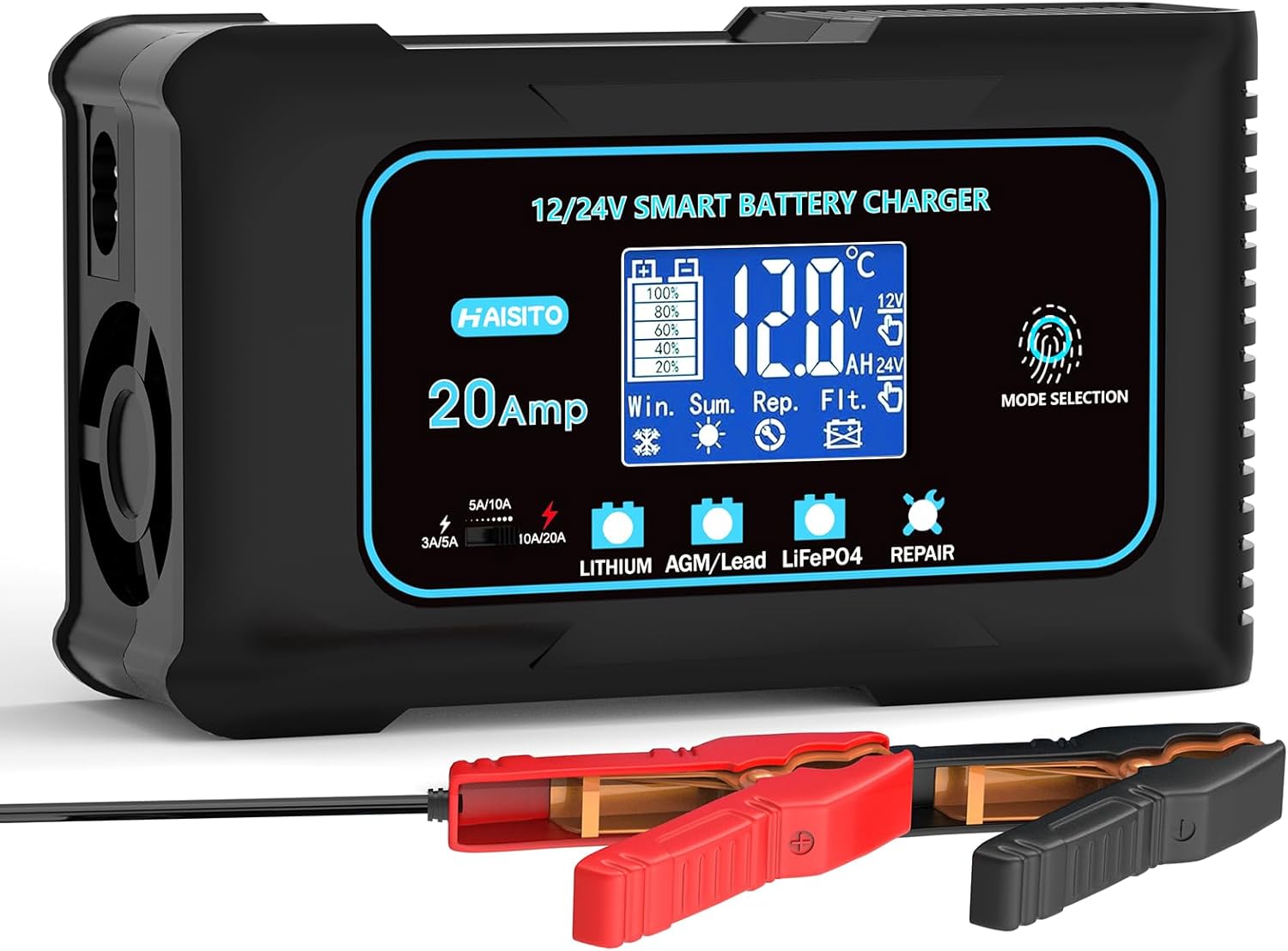
For a 12V LiFePO4 battery, the LiTime 12V 20A is the cleanest match: a fixed 14.6 V output at 20 A, a lithium-only design, and an Anderson plug. If you also keep lead-acid batteries on the same bench, a multi-mode 20 A unit such as the Haisito H-20 covers both.



Quick Comparison
| Model | Output (12 V) | Chemistry (listing) | Connectors | Best for |
|---|---|---|---|---|
| LiTime 12V 20A | 14.6 V, 20 A | LiFePO4 only | Anderson, M8 | RV and off-grid banks |
| Haisito H-20 | 20 A (12 V), 10 A (24 V) | LiFePO4, AGM, gel, lead-acid | X-Connect | Mixed battery shop |
| BROODAY 20A | 14.6 V, 20 A | 12V LiFePO4 | M8, clips, Anderson | Budget lithium-only |
| YONHAN FPT-200 | 20 A (12 V), 10 A (24 V) | LiFePO4 and lead-acid | Clamps | Temporary bench charging |
| RCProducts 20A | 20 A (12 V), 10 A (24 V) | Lithium, LiFePO4, lead-acid | Clamps | Shoppers who read the manual first |
How We Chose
We compared output voltage, amps, supported chemistries, connectors, protections, and the Yard & Grid Score built from verified-buyer ratings (see how we choose). We research and compare; we do not use or review the products ourselves. These brands publish little beyond their Amazon listings, so figures below are “per the listing.” Your battery maker’s charging limits outrank any charger claim.
Why the Voltage Number Matters
A 12V LiFePO4 battery has four cells in series, and each cell tops out near 3.65 V, so a full charge target lands at 14.6 V. A lead-acid profile that climbs to 14.7 V and then floats or pulses is a different recipe. Battle Born’s manual for its 100Ah battery lists absorption at 14.2 to 14.6 V and float at 13.4 to 13.8 V, and says the battery management system blocks charging above 14.7 V. So a charger needs a dedicated LiFePO4 profile. Our explainer on charging LiFePO4 with a regular charger covers the failure modes, and what a BMS does explains the protection layer.
LiTime 12V 20A
- Fixed 14.6 V, 20 A output with constant current, constant voltage, then float or cut-off, per the listing.
- Lists 0V activation to wake a BMS-tripped battery. Ask your battery maker before using any wake-up feature.
- Aluminum case, 2.9 lb, 2-year warranty per the listing. The listing says it is not waterproof, so keep it off boats and trolling-motor rigs.
Best for: RV, solar, and off-grid lithium banks. Avoid if: you need to charge lead-acid or want a display.
Haisito H-20
- Separate Lithium LiFePO4 and lead-acid modes, automatic 12V or 24V detection, and an LCD with amps, volts, and temperature, per the listing.
- Temperature compensation is listed, which helps lead-acid more than lithium.
- The listing says pulse repair cannot activate a 0 V battery. 4.5 stars on 2,028 ratings.
Best for: one charger for a lithium house bank plus lead-acid starter and tractor batteries. Avoid if: you dislike picking modes by hand.
BROODAY 20A 12V
- 14.6 V at 20 A, M8 ring terminals and alligator clips, plus an Anderson plug, per the listing.
- Lists soft-start, short-circuit, over-current, and over-voltage protection; CE mark only.
- 4.4 stars on 900 ratings. The warranty field on the listing is unclear, so confirm it before buying.
Best for: a lean lithium-only charger with several connection options. Avoid if: you want a clear warranty term in writing.
YONHAN FPT-200
- 20 A at 12 V, 7-stage charging, LCD, and a UL claim on the listing; 2-year warranty per the listing.
- The listing says it will not charge below 0.3 V and is for temporary charging only. Disconnect when done.
- 4.4 stars on 3,871 ratings, the deepest rating base here.
Best for: occasional bench charging of mixed batteries. Avoid if: you want to leave it connected for months.
RCProducts 20A
- Lists lithium, LiFePO4, and lead-acid modes with 12V and 24V detection, a 13 ft cable, and a 1 V minimum start voltage.
- The listing prints “Lithium: 12.4 V” next to “LiFePO4: 14.6 V.” That is a confusing pair of numbers. Use only the LiFePO4 setting and confirm it against the manual.
- The listing names several brands (RCProducts, HTRC, ZHIHIUI), so support is harder to judge. It shows 4.4 stars on 1,668 ratings.
Best for: a mixed shop where you will read the manual. Avoid if: you want clear documentation and a known brand.
Cost of Ownership
The charger is a one-time cost, but pick connectors you will actually use. Anderson plugs suit an RV battery bay; clamps suit a bench. A mismatched cable means a crimped adapter, and a poor crimp is a heat point. Most listings give a 1 to 2 year warranty, and the LiTime model lists 2 years.
How to Choose
- Check the battery’s max charge current. Charge rate in C = charger amps / battery amp-hours. A 20 A charger on a 100 Ah battery is 0.2C; on a 50 Ah battery it is 0.4C. Battle Born’s manual recommends 0.5C and lists 50 A as the maximum for its 100 Ah model, so follow your own maker’s number.
- Estimate the time. Hours = missing amp-hours / (amps x 0.9), where 0.9 is our efficiency assumption. A 100 Ah battery at 20 percent has 80 Ah missing: 80 / (20 x 0.9) = 4.4 hours.
- Mind the cold. Battle Born says a standard model should not be charged below 32°F; only heated versions go lower. A garage charger will not fix that.
- Choose your battery first. See best 12V LiFePO4 batteries, and for the chemistry basics what LiFePO4 is.
Charge in a ventilated spot, keep the charger dry, and unplug before connecting or removing clamps. For maintainer-style storage charging see battery maintainers.
FAQ
Do I need a special charger for LiFePO4?
You need one with a LiFePO4 profile that stops near 14.6 V. Many battery makers also publish a charging voltage range; match it.
Can a 20 A charger be too big?
Only if it exceeds your battery’s rated charge current. Check the manual, then do the C-rate math above.
Can I leave it connected?
Follow each listing. The YONHAN says disconnect after charging, and a lithium-only model with float or cut-off is a better fit for long hookups, but confirm in the manual.
Changelog: November 2026: first published.









