


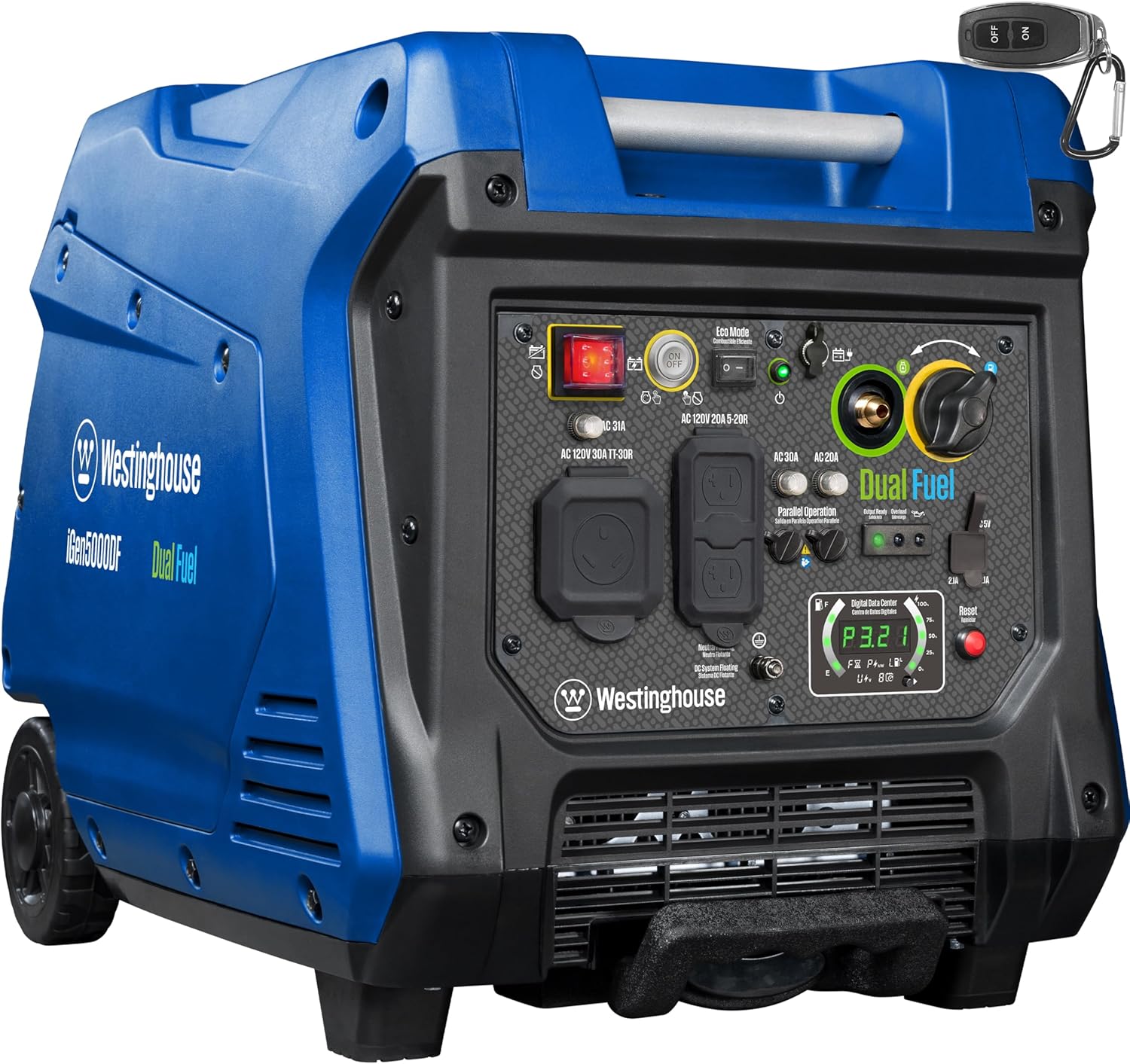
For a 30 amp RV with one rooftop air conditioner, pick an inverter generator rated at least 3,500 W running, and put the Westinghouse iGen5000DF first: it is rated 3,900 W running on gasoline, which is already above the 30 A x 120 V = 3,600 W a TT-30 cord can carry. That means the cord, not the engine, becomes your limit.
The six picks below run from a 49 lb TT-30R unit that suits small rigs to a 134.5 lb 120/240 V unit for a 50 amp fifth wheel.


Quick Comparison
Running and starting watts are on gasoline unless noted. Starting watts here is the generator’s peak rating, so compare your largest start to it and your total running load to the running column.
| Model | Running / starting W (gas) | Running W (propane) | RV outlet | Noise (maker) | Weight | Best for |
|---|---|---|---|---|---|---|
| Westinghouse iGen5000DF | 3,900 / 5,000 | 3,500 | TT-30R | 52 dBA | 104.7 lb | 30 A rig with one A/C and headroom |
| WEN DF480iX | 4,000 / 4,800 | 3,600 | TT-30R | 62 dB at 1/4 load | 78.5 lb | Electric start at a lower weight |
| Champion 200914 | 3,500 / 4,250 | 3,150 | TT-30R | 64 dBA at 23 ft | 79 lb | Propane use with one A/C |
| Champion 201050 | 3,000 / 4,000 | 2,700 | TT-30R | 64 dBA at 23 ft | 51.8 lb | Lighter unit for one A/C |
| WEN DF360iX | 2,900 / 3,600 | 2,600 | TT-30R | 65 dB | 49 lb | Small rigs, no A/C or a small one |
| Westinghouse iGen8200TFc | 6,600 / 8,200 | 5,940 | 14-50R and TT-30R | about 60 dBA at 25% load | 134.5 lb | 50 A rigs with two A/Cs |
How We Chose
We started from the plug on the RV, not the generator. A TT-30 inlet means 30 A, so 30 A x 120 V = 3,600 W is the ceiling; a 14-50 inlet means two 120 V legs at 50 A each, so 2 x 50 A x 120 V = 12,000 W. Those are cord ceilings, not targets, and how a generator connects to the rig is a job for an RV technician or the manual (our guide to sizing a generator for an RV covers the concept).
Then we kept only inverter generators with an RV outlet, a published running rating, and a manufacturer spec sheet or manual we could read. Numbers come from the maker’s pages and manuals; where a retail listing disagreed with the maker, we went with the maker. We also weighed owner review volume, but we do not rely on a score where a listing has no reviews yet. We research and compare; we do not run our own product trials. The how we choose page explains the Yard & Grid Score.
How Much Headroom Each One Leaves
The example rig from our RV sizing guide draws 2,320 W running and 3,990 W at the moment the air conditioner compressor starts. Every figure in that rig is an example value, including a 13,500 BTU rooftop unit at 1,670 W running that we could not confirm from a manufacturer spec sheet. Swap in the numbers from your own data labels.
Headroom = generator rating minus the example load.
| Model | Running headroom (gas) | Starting headroom (gas) | Running headroom (propane) |
|---|---|---|---|
| Westinghouse iGen5000DF | 3,900 minus 2,320 = 1,580 W | 5,000 minus 3,990 = 1,010 W | 3,500 minus 2,320 = 1,180 W |
| WEN DF480iX | 4,000 minus 2,320 = 1,680 W | 4,800 minus 3,990 = 810 W | 3,600 minus 2,320 = 1,280 W |
| Champion 200914 | 3,500 minus 2,320 = 1,180 W | 4,250 minus 3,990 = 260 W | 3,150 minus 2,320 = 830 W |
| Champion 201050 | 3,000 minus 2,320 = 680 W | 4,000 minus 3,990 = 10 W | 2,700 minus 2,320 = 380 W |
| WEN DF360iX | 2,900 minus 2,320 = 580 W | 3,600 minus 3,990 = short by 390 W | 2,600 minus 2,320 = 280 W |
The pattern is plain: the DF360iX cannot start that air conditioner on paper, and the 201050 has almost no margin. A soft start device on the A/C lowers the starting draw; check that the A/C maker allows one.
Westinghouse iGen5000DF
- Westinghouse rates it 3,900 W running and 5,000 W starting on gasoline, and 3,500 W / 4,500 W on propane.
- The 3.4 gal tank runs up to 18 hours at 25% load on gasoline and 22 hours on propane at 25% load. Westinghouse does not state the propane cylinder size.
- It has a TT-30R outlet and is listed as parallel capable. Noise is “as low as 52 dBA” with no distance or load given, so treat it as a best case.
- This version has no CO sensor; the iGen5000DFc variant adds one. At 104.7 lb dry it is the heaviest of the 30 A options.
Best for: a 30 A rig with one rooftop A/C where you want roughly 1,000 W of starting headroom and the lowest stated noise.
Avoid if: you lift it in and out of a truck bed alone, or you want a built-in CO shutoff on this exact model.
WEN DF480iX
- WEN rates it 4,000 W running and 4,800 W starting on gasoline, 3,600 W and 4,320 W on propane. The Amazon listing shows 4,000 W on propane, which does not match WEN’s page.
- It has electric start, CO Watchdog, four 5-20R outlets, and a TT-30R. There is no 240 V outlet.
- Runtime is 7 hours at half load from 1.9 gal, or 12 hours at half load on a 20 lb propane cylinder, per WEN. The listing gives 78.5 lb.
- Warranty is three years limited. The manual packing list includes an LPG regulator hose.
Best for: a 30 A rig that wants more running watts than the Champion units without moving up to 100 lb.
Avoid if: noise at a quiet campground is your first filter; WEN’s 62 dB is measured at 1/4 load and is louder than Westinghouse’s stated figure.
Champion 200914
- The operator’s manual gives 4,250 W starting and 3,500 W running on gasoline, 4,250 W / 3,150 W on propane. The Amazon listing’s 3,825 W propane figure is an outlier; we did not use it.
- It is an open frame design with a 4 gal tank, a 224cc engine, recoil start only, and a TT-30R outlet per Champion’s listing text. The manual has no runtime or noise table; the 64 dBA at 23 ft figure comes from Champion’s listing text. A search summary of Champion’s now-offline product page lists about 21 hours at 25% load on a 20 lb tank.
- This listing is the CARB-compliant version, relevant if you camp or live in a state that follows California rules.
Best for: long propane stays where a 4 gal gasoline tank and a 3,150 W propane rating cover one A/C plus basics.
Avoid if: you want electric start or a published noise number you can check in the manual.
Champion 201050
- Champion rates it 4,000 W starting and 3,000 W running on gasoline, 2,700 W running on propane. The TT-30R is rated 120 V and 25 A, which is 25 A x 120 V = 3,000 W, so the outlet matches the engine.
- Runtime is up to 10 hours at 25% load from 1.54 gal of gasoline, or 25 hours on a 20 lb propane tank, with 64 dBA at 23 ft. It weighs 51.8 lb and has CO Shield, a 149cc engine, and recoil start.
- The Amazon listing shows no reviews yet, so there is no owner feedback to lean on. We ranked it on its spec sheet, not on a score.
Best for: a 30 A rig with one A/C and a short list of other loads, where weight under 55 lb matters.
Avoid if: your rig adds a microwave or other loads on top of the example load; the 10 W starting headroom above leaves no room for them.
WEN DF360iX
- WEN rates it 2,900 W running and 3,600 W starting on gasoline, 2,600 W and 3,500 W on propane.
- It weighs 49 lb, runs 5 hours at half load on 1.5 gal, or 14 hours at half load on a 20 lb cylinder, and has CO Watchdog and a TT-30R. Noise is 65 dB.
- Warranty is three years limited.
Best for: small travel trailers and camper vans with lights, a fridge, a TV, and a small A/C or none.
Avoid if: your rooftop air conditioner is 13,500 BTU or larger and you plan to start it from this unit.
Westinghouse iGen8200TFc
- Westinghouse rates it 6,600 W running and 8,200 W starting on gasoline, 5,940 W / 7,380 W on propane, and 5,280 W / 6,560 W on natural gas.
- Outlets are a 14-50R, a TT-30R, and a GFCI 5-20R. It has a CO sensor, weighs 134.5 lb, and runs 17 hours at 25% load from 3.9 gal; propane runtime is 9.8 hours at 25% load.
- On a 120/240 V generator, each 120 V leg carries only part of the total, so the manual’s per-outlet and per-leg limits matter.
Best for: a 50 A fifth wheel with two air conditioners, where the example load is about 5,490 W running.
Avoid if: you have a 30 A rig; you would carry 134.5 lb for a 14-50R you cannot use.
Carbon Monoxide Around Campers
Any gasoline, propane, or dual fuel generator makes carbon monoxide (CO). Run it outdoors, with the exhaust pointed away from your RV and from neighboring campers, and keep a working CO alarm inside the RV near where people sleep. CPSC guidance for homes calls for at least 20 feet from the home, far from windows, doors, and vents, with CO alarms on every level and outside sleeping areas. Follow the manufacturer’s manual and campground rules. A built-in shutoff such as Champion’s CO Shield or WEN’s CO Watchdog helps, and Champion says CO Shield is not a substitute for an indoor CO alarm.
Cost of Ownership
- Fuel: a 20 lb propane tank is the easiest to store. Champion says the 201050 runs 25 hours at 25% load on one tank: on propane it is rated 2,700 W, so 25% is 675 W, and 675 W x 25 h = about 16,875 Wh. An A/C drawing 1,670 W would use that in 16,875 / 1,670 = about 10 hours at best, because efficiency drops at higher load.
- Gasoline storage: Honda warns that fuel problems can start in less than 30 days, as little as 15 depending on region. Propane suppliers say propane does not go bad; the cylinder is the limit.
- Oil: the 201050 uses 0.5 qt of 10W-30.
- Parallel kits: Champion’s parallel kit is sold separately; our parallel kit explainer covers when two small units beat one big one.
- Warranty: three years limited on each model listed, residential use on the Westinghouse units.
How to Choose
- What is your inlet? TT-30 caps you at 3,600 W. 14-50 opens up to 12,000 W, and only the iGen8200TFc here has a 14-50R.
- What is your largest start? Read the A/C data label or manual. If you only have a rule of thumb, running watts vs starting watts shows how to add it.
- How much quiet do you need? Noise figures are not comparable unless they state distance and load. Westinghouse lists no distance, Champion lists 23 ft, WEN lists 1/4 load.
- Propane or gasoline? Propane trims 10 percent or so from the running rating (the 201050 goes from 3,000 W to 2,700 W: 300 / 3,000 = 10 percent) but stores easily.
- Can you lift it? The spread here is 49 lb to 134.5 lb.
For quiet-first ranking across all uses, see our quiet inverter generator list.
FAQ
Can an inverter generator run an RV air conditioner?
Yes, if its running watts clear your total load and its starting rating clears the A/C’s start draw. A 13,500 BTU unit in the example above needs about 3,990 W at the start, which only the 3,500 W-plus units here cover with margin.
Is a 2,000 W inverter generator enough for an RV?
For lights, a fridge, a TV, and chargers, usually yes. It generally cannot start a rooftop air conditioner. Our Honda EU2200i vs Champion 2500 comparison covers that class.
Can I run two generators together?
Some models parallel with a kit, which adds running watts. Check that both units are parallel capable and follow the kit manual.
Do I need a CO alarm if my generator has a CO shutoff?
Yes. Champion states CO Shield does not replace an indoor alarm, and CPSC recommends CO alarms on every level and outside sleeping areas.
Changelog: October 2026: first published.









