


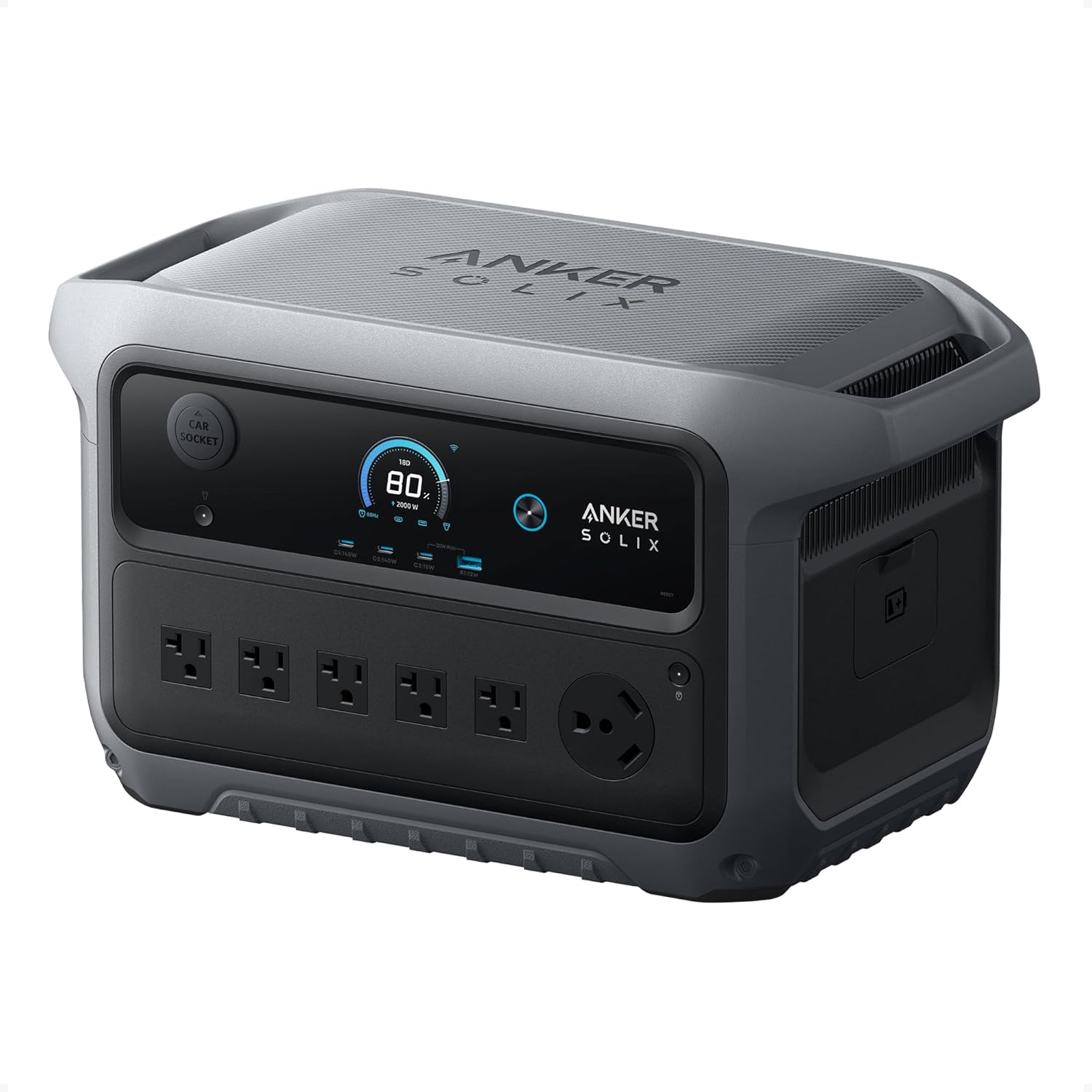
Under $1,000, the station to buy is a 2,000 Wh unit, and the Anker SOLIX C2000 Gen 2 leads our list because it pairs 2,048 Wh with 2,400 W of continuous output: enough to carry a fridge, router, and lights for about a full day, since 2,048 Wh x 0.85 inverter efficiency = about 1,740 Wh at the outlet against a 1,800 Wh daily load. Below that tier, a 1,000 Wh unit covers one night, not one day.


Quick Comparison
All five hold between 2,010 and 2,048 Wh, so capacity barely separates them. Output, weight, expansion, and solar input do. Wh per pound is our calculation from each maker’s capacity and weight.
| Station | Capacity | Continuous / peak output | Weight | Wh per lb | Solar input | Expansion | Best for |
|---|---|---|---|---|---|---|---|
| Anker SOLIX C2000 Gen 2 | 2,048 Wh LiFePO4 | 2,400 W / 4,000 W | 41.7 lb | about 49 | 800 W (11 to 60 V) | To about 4 kWh | All-round 24-hour outage plan |
| Jackery Explorer 2000 v2 | 2,042 Wh LiFePO4 | 2,200 W / 4,400 W | 39.5 lb | about 52 | 400 W (11 to 60 V) | None | Simple plug-in backup, UPS use |
| DJI Power 2000 | 2,048 Wh LFP | 3,000 W | about 48.5 lb | about 42 | Via separate charger | To 22,528 Wh | Growing into a larger system |
| Anker SOLIX S2000 | 2,010 Wh LFP | 1,500 W / 3,000 W | 35.7 lb | about 56 | 400 W | None | Long fridge runtime, low idle draw |
| Dabbsson 2000L | 2,048 Wh LiFePO4 | 2,200 W / 3,300 W boost | 41 lb | about 50 | 800 W | Not listed | Fast solar refill on a budget tier |
How We Chose
This list covers the 2,000 Wh class only; the 1,000 Wh class has its own page, the best portable power stations under $500. We kept stations that listed under $1,000 when we pulled data, hold close to 2,000 Wh, and come from a maker with a published spec sheet. We compared continuous and peak output, idle draw where the maker lists it, solar input, expansion, cycle ratings, and weight from manufacturer pages, manuals, and retailer spec tables, then read public owner feedback. The Yard & Grid Score on each card comes from verified buyer ratings. We research and compare; we do not run our own product trials. More on the method at how we choose.
A 1,843 Wh unit sold under the EBL name also fit the price line, but we found no manufacturer spec page to confirm its figures, so it is left out.
The 24-Hour Load Budget
Start with the load. This is the plan we sized the list against, for a house with one full-size fridge.
| Load | Average draw | Hours | Wh |
|---|---|---|---|
| Full-size fridge (planning average) | 55 W | 24 | 1,320 |
| Wi-Fi router and modem | 10 W | 24 | 240 |
| Three 10 W LED lamps | 30 W | 6 | 180 |
| Four phone charges | 15 Wh each | n/a | 60 |
| Total | 1,800 Wh |
Rated capacity needed: 1,800 Wh / 0.85 = about 2,120 Wh. A 2,048 Wh station delivers about 1,740 Wh, so it runs this plan for about 1,740 / 1,800 x 24 h = about 23 hours. Idle draw eats into that too: Anker lists 9 W standby for the C2000 Gen 2, which over a day is 9 W x 24 h = 216 Wh, and 6 W for the S2000, which is 144 Wh. The fridge average comes from our fridge runtime guide.
The Stations, Ranked
1. Anker SOLIX C2000 Gen 2
- Anker rates it at 2,400 W continuous and 4,000 W peak, enough headroom for a window AC or a microwave alongside the fridge.
- Solar input is 11 to 60 V up to 800 W. Four 200 W panels on a clear day give 800 W x 5 peak sun hours x 0.75 derate = about 3,000 Wh, more than a full refill.
- An expansion battery takes it to about 4 kWh, per Anker, so a one-day plan can become a two-day plan later.
- Anker lists 4,000 cycles to 80 percent capacity and a 10 ms UPS switchover.
Best for: a fridge, router, and lights for about a day, with room to add a second battery.
Avoid if: you need to run a 240 V well pump or start central AC; no station on this list does that.
2. Jackery Explorer 2000 v2
- Jackery rates it at 2,042 Wh with 2,200 W total AC output and a 4,400 W surge.
- At 39.5 lb it gives about 52 Wh per pound, among the lightest ratios here.
- Jackery lists a UPS switchover under 20 ms, and the Amazon listing cites UL 1778 certification for uninterruptible power systems.
- Jackery rates the cells for 4,000 cycles to 70 percent or more of capacity, cites an 11-year theoretical cell life based on those cycles, and quotes a 3-year standard plus 2-year extended warranty on jackery.com purchases.
Best for: owners who want a plug-in, set-and-forget backup for a fridge and home office.
Avoid if: you expect to grow beyond one battery (Jackery says it is not expandable) or want more than 400 W of solar input.
3. DJI Power 2000
- DJI lists 3,000 W of continuous output, the highest on this list, with a 10 ms UPS switchover.
- It expands with up to ten 2,048 Wh batteries to 22,528 Wh, per DJI, the largest growth path here.
- DJI rates the LFP cells to keep more than 80 percent capacity after 4,000 cycles.
- Solar and car charging need a separate DJI charger; the listing says MPPT is not built in. It is also the heaviest at about 48.5 lb.
Best for: households that want to start with 2 kWh and build toward multi-day backup.
Avoid if: you want solar to plug straight in, or the unit must be carried up stairs.
4. Anker SOLIX S2000
- At 35.7 lb for 2,010 Wh it is the lightest 2 kWh unit here, about 56 Wh per pound.
- Anker lists a 6 W idle draw, the lowest stated figure in this group, which favors long, light loads like a fridge.
- Output is lower: 1,500 W continuous and 3,000 W peak.
- Anker rates it for 6,000 cycles to 80 percent capacity; its headline 10,000-cycle figure, tied to a 15-year estimate, ends at 60 percent, a looser end point than the 80 percent ratings elsewhere.
Best for: stretching a fridge-and-router plan as far as possible.
Avoid if: you plan to run a 1,500 W space heater or a large microwave, which sits at or above its rating.
5. Dabbsson 2000L
- Dabbsson lists 2,048 Wh of LiFePO4 cells rated for 4,000 cycles to 80 percent; “semi-solid” appears only in the Amazon title.
- Output is 2,200 W continuous with a 3,300 W boost, and solar input reaches 800 W.
- Dabbsson quotes a 5-year warranty (3 standard plus 2 extended) and an EPS switchover within 15 ms.
- It is the least established brand here, so owner feedback is thinner than for Anker, Jackery, or DJI.
Best for: solar-heavy setups that want 800 W of input at 41 lb.
Avoid if: you weight brand track record and service network over specs.
Cost of Ownership
- Lifetime energy: cycles x usable Wh. DJI Power 2000: 4,000 x 1,740 Wh = about 6,960 kWh to its 80 percent rating. Compare cycle ratings only when the end points match.
- Grid recharge: about 2,048 / 0.90 charger efficiency = about 2.3 kWh from the wall per full charge, a planning figure.
- Expansion: an expansion battery is a second purchase, so decide now whether a second day of runtime matters. Background is in what a power station expansion battery is.
- Warranty: Jackery quotes 3 plus 2 years for jackery.com purchases and Dabbsson 3 plus 2; DJI lists 3 years plus 2 more after first app connection; Anker lists 5 years on both the C2000 Gen 2 and the S2000. Confirm current terms before you buy.
How to Pick Under $1,000
- One night or one day? One night of fridge and lights fits a 1,000 Wh unit. A full day of the load above needs about 2,120 Wh rated.
- What is the largest single load? A 1,000 W microwave fits all five. A 1,500 W heater fits all but leaves the S2000 at its limit.
- Will you add solar? With 400 W of panels: 2,048 Wh / (400 W x 5 h x 0.75) = about 1.4 clear days to refill. With 800 W, under one day.
- Will it grow? If a second day matters later, the C2000 Gen 2 and DJI Power 2000 are the two with a stated expansion path.
For the full sizing method, see how to choose a portable power station size. For a wider shortlist without a price cap, see the best portable power stations for home backup.
FAQ
Is a 2,000 Wh station worth it over 1,000 Wh?
If your outages run past one night, yes. Doubling capacity roughly doubles runtime on the same load: 1,740 usable Wh / 75 W = about 23 hours, against about 12 hours from a 1,024 Wh unit (870 / 75).
What is the best portable power station under $600?
That band mostly holds the 1,000 Wh class. Our under $500 guide ranks those stations.
Can one of these power my whole house?
No. They run plug-in loads. Connecting any battery to a home’s wiring requires approved transfer equipment installed by a licensed electrician.
How much does idle draw matter?
Over a long outage, a lot. A 9 W idle draw costs 216 Wh a day, about 4 hours of a 55 W fridge.
Changelog: November 2026: first published.









