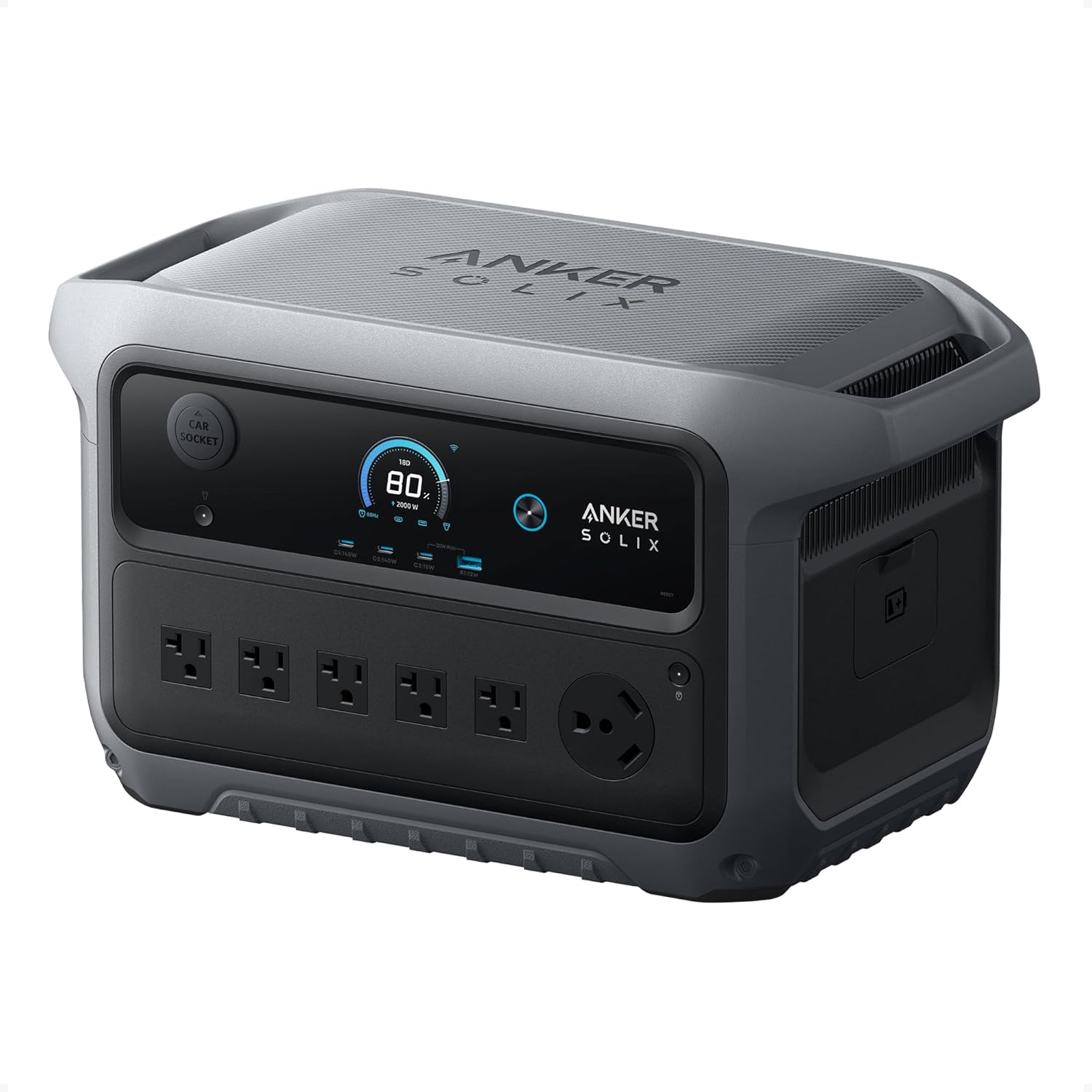
A refrigerator needs a station with at least 2,000 Wh if you want a full day of backup, and the Anker SOLIX C2000 Gen 2 is our first pick: 2,048 Wh x 0.85 inverter efficiency / 86 W for a cushioned 26 cu ft side-by-side = about 20 hours, and adding its expansion battery stretches that to about 40 hours. Starting the fridge is the easy part, since every pick below is rated for 3,000 W or more of surge against a typical compressor start of 400 to 2,000 W.


Quick Comparison
The hours columns use the formula from how long a power station will run a fridge: rated Wh x 0.85 / planning watts, rounded down. The planning watts come from ENERGY STAR listings with a 1.25 cushion for door openings and a warm kitchen: 55 W for a 20.0 cu ft top-freezer (385 kWh a year) and 86 W for a 26.0 cu ft side-by-side (605 kWh a year).
| Model | Capacity | Continuous / surge | Idle draw (maker) | Top-freezer, 55 W | Side-by-side, 86 W | Best for |
|---|---|---|---|---|---|---|
| Anker SOLIX C2000 Gen 2 | 2,048 Wh (about 4 kWh expanded) | 2,400 W / 4,000 W | 9 W | about 31 h | about 20 h (40 h expanded) | Fridge plus other loads, room to grow |
| Anker SOLIX S2000 | 2,010 Wh | 1,500 W / 3,000 W | 6 W | about 31 h | about 19 h | Fridge-first plans, lighter carry |
| BLUETTI FridgePower | 2,016 Wh (8,064 Wh expanded) | 1,800 W / 3,600 W | 4 W | about 31 h | about 19 h | Permanent spot behind the fridge |
| Jackery Explorer 2000 v2 | 2,042 Wh | 2,200 W / 4,400 W | not published | about 31 h | about 20 h | Moving between fridge and freezer |
| EcoFlow DELTA 3 Ultra | 3,072 Wh (11 kWh expanded) | 3,600 W / 7,200 W | not published | about 47 h | about 30 h | Fridge and freezer, multi-day |
| Jackery Explorer 1000 v2 | 1,070 Wh | 1,500 W / 3,000 W | not published | about 16 h | about 10 h | Overnight, small fridge |
| EcoFlow DELTA 3 Classic | 1,024 Wh | 1,800 W / 3,600 W | not published | about 15 h | about 10 h | Overnight with UPS takeover |
How We Chose
We started from the fridge’s three numbers: average watts set battery size, running watts set continuous output, and startup watts set surge. We research and compare; we do not run our own product trials. Specs come from manufacturer pages and manuals, cross-checked against published reviews and owner feedback, and ranked with help from the Yard & Grid Score, which is built from verified buyer ratings. More on the method at how we choose.
- Surge with headroom. Anker’s published planning range puts top-freezer starts at 400 to 1,200 W and French-door starts at 900 to 2,000 W, so we required at least 3,000 W of rated surge.
- A UPS switchover of 10 ms or close to it, so the station can sit between the outlet and the fridge and take over without a person present.
- LFP chemistry, because a fridge station cycles often and sits charged for months.
- Low idle draw where published, because idle watts run for every hour the fridge does.
Why Idle Draw Changes the Ranking
Idle draw is the power the inverter burns just to stay on, and on a fridge plan it never switches off. A gap of 3 W between two stations over a 30-hour outage is 3 W x 30 h = 90 Wh, about 1.6 more hours of a 55 W top-freezer. That is small next to battery size, so idle draw breaks ties between similar 2 kWh units rather than overriding capacity.
Maker runtime claims can be checked with the same math. Anker says the S2000 keeps a 700 L (about 24.7 cu ft) fridge running for up to 35 hours, based on its internal measurements at a 77°F room. Working backward, 2,010 Wh x 0.85 / 35 h = about 49 W average, close to the uncushioned label average of a 20 cu ft model. Our 86 W cushioned side-by-side figure gives about 19 hours instead, so plan with your own label number and treat the brand figure as a best case.
The Picks, Ranked
1. Anker SOLIX C2000 Gen 2
- 2,048 Wh LFP, 2,400 W continuous, 4,000 W peak, 9 W idle, 10 ms UPS switchover, per Anker.
- The BP2000 expansion battery brings it to about 4 kWh: 4,096 Wh x 0.85 / 86 W = about 40 hours of a side-by-side.
- 2,400 W leaves room to run a microwave or coffee maker briefly while the fridge stays on.
- 41.7 lb, and 4,000 cycles to 80 percent.
Best for: a household that wants the fridge covered for a day now and two days after adding one battery.
Avoid if: the fridge is the only load and you would rather trade output for the lowest idle draw.
2. Anker SOLIX S2000
- 2,010 Wh LFP with 6 W idle draw; Anker rates it at 6,000 cycles to 80 percent and backs it with a 5-year warranty.
- 1,500 W continuous and 3,000 W peak clear any fridge start in Anker’s own planning range.
- 35.7 lb is the lightest 2 kWh unit here.
- It does not support an expansion battery, so its ceiling is about 19 hours of a side-by-side.
Best for: one fridge, a router, and a lamp through a long overnight outage.
Avoid if: your outages commonly run past a day, or a 1,500 W microwave needs to share the station with the fridge.
3. BLUETTI FridgePower
- Built for one job: a slim 2,016 Wh LFP pack about 3 in deep that stands or wall-mounts beside or behind the fridge.
- BLUETTI lists 4 W standby, 1,800 W continuous, 3,600 W surge, and a switch to battery in under 10 ms.
- BlueCell 200 expansion batteries take it to 8,064 Wh: 8,064 x 0.85 / 86 W = about 79 hours, or a little over three days.
- At about 43.4 lb, per BLUETTI, and with far fewer buyer ratings than the others, its track record is shorter.
Best for: a kitchen where the station stays plugged in year-round on fridge duty and nobody wants it on the floor.
Avoid if: you want one station that also travels to camp or powers other rooms.
4. Jackery Explorer 2000 v2
- 2,042 Wh LFP, 2,200 W continuous, 4,400 W surge, 39.5 lb.
- About 1,735 usable Wh covers a cushioned side-by-side for about 20 hours.
- Cycle life is listed as 4,000 cycles to 70 percent; switchover in UPS use is listed at 20 ms or less, slower than the 10 ms units.
Best for: carrying the station between a kitchen fridge and a garage freezer as the day goes.
Avoid if: you need it to take over a fridge automatically with the shortest possible gap.
5. EcoFlow DELTA 3 Ultra
- 3,072 Wh LFP, 3,600 W continuous, 7,200 W surge, under 10 ms UPS, per EcoFlow.
- A side-by-side plus a chest freezer at a combined 130 W planning figure (a labeled example) still gets 2,610 / 130 = about 20 hours.
- Expands to 11 kWh; 800 W solar input for multi-day recharge.
- 72.1 lb, so it parks in one spot.
Best for: homes in hurricane or ice-storm regions keeping a fridge and a freezer cold for two days or more.
Avoid if: the station has to be carried, or a single fridge is the whole plan.
6. Jackery Explorer 1000 v2
- 1,070 Wh LFP, 1,500 W continuous, 3,000 W surge peak, 23.8 lb, per Jackery.
- 910 usable Wh / 55 W = about 16 hours of a top-freezer.
- Recharges from the wall in about an hour in Jackery’s app-enabled emergency mode.
Best for: an apartment top-freezer through an evening and overnight outage.
Avoid if: you own a side-by-side or French-door model and expect outages longer than about 10 hours.
7. EcoFlow DELTA 3 Classic
- 1,024 Wh LFP, 1,800 W continuous, 3,600 W surge, 10 ms UPS.
- About 870 usable Wh, so about 15 hours of a top-freezer and 10 of a side-by-side.
- Full wall recharge in about 60 minutes, per EcoFlow.
Best for: a small kitchen that wants automatic takeover for the short outages that happen a few times a year.
Avoid if: the fridge has to hold through a full day without the grid.
Cost of Ownership
A fridge station’s running cost is mostly the electricity it keeps topped up, plus any expansion battery. On UPS duty it holds a full charge and passes grid power through, so the battery cycles only when the grid drops.
- Idle cost on standby: a station idling at 6 W all year uses 6 W x 8,760 h = about 53 kWh, roughly the energy of 53 / 385 = 14 percent of the 20 cu ft fridge’s annual use. Check whether your model idles that low while passing through grid power.
- Expansion batteries: the C2000 Gen 2, FridgePower, and DELTA 3 Ultra accept them; each one usually costs a large share of the base unit.
- Warranty: Anker lists 5 years on the S2000; EcoFlow lists 3 years, extended to 5 with app registration.
- Battery life: LFP cells rated for thousands of cycles outlast most fridges’ outage needs; age and heat matter more than cycle count.
How to Choose a Station for Your Fridge
- What does your fridge use in a day? Take the annual kWh from its EnergyGuide label, then annual kWh x 1,000 / 8,760 x 1.25 = planning watts. The steps are in how many watts it takes to run a refrigerator.
- How many hours must it hold? Hours x planning watts / 0.85 = rated Wh. For 24 hours of the side-by-side: 24 x 86 / 0.85 = about 2,430 Wh, which puts you in the 3 kWh class or a 2 kWh unit with an expansion battery.
- Will the surge start it? Compare the station’s surge with the high end of your fridge type’s startup range; a French-door model can reach 2,000 W by Anker’s estimate. Background in running watts vs starting watts.
- Will it live behind the fridge? Then pick for UPS speed and idle draw over weight.
The station buys time, and the fridge itself helps: the CDC says food stays safe for about 4 hours in a closed refrigerator without power, so keeping the door shut cuts how often the compressor has to run. If you also need a sump pump or CPAP on the same plan, compare the wider list in the best portable power stations for home backup.
FAQ
What size power station do I need for a refrigerator?
About 1,000 Wh for an overnight outage with a top-freezer and about 2,000 to 3,000 Wh for a full day with a side-by-side. Run 24 x your planning watts / 0.85 for your exact number.
Can a power station run a fridge and a freezer together?
Yes, if the battery covers both averages and the surge covers one compressor starting while the other runs. Add both planning watts and divide: the DELTA 3 Ultra example above gives about 20 hours at 130 W combined.
Can I leave the fridge plugged into the station all the time?
Many stations with UPS mode are designed for this, passing grid power through and switching to battery in about 10 ms. Check your manual for long-term pass-through guidance; see what UPS mode on a power station does.
Is a solar generator for a fridge different from a power station?
Usually it is the same station sold with solar panels. The panels add daily energy for multi-day outages; the fridge math for the battery stays the same.
Changelog: October 2026: first published.