Voltage comes before watts: if your well pump runs on 240 V, only a station that can output 240 V will run it, and the EcoFlow DELTA Pro 3 is the one we rank first because it does that from a single unit with 4,000 W of continuous output. That clears Franklin Electric’s minimum generator rating for a 1/2 HP 2-wire submersible (3 kW) and for a 1 HP 3-wire motor (4 kW), with a licensed electrician making the connection to the house.


Quick Comparison
The last column checks each setup’s continuous rating against the minimum generator sizes in Franklin Electric’s AIM (Application, Installation, Maintenance) manual for submersible motors. Three of the five picks reach 240 V; the other two are 120 V only and belong on this list only for 120 V pumps.
| Model | Capacity | Continuous / surge | 240 V output | Largest Franklin motor covered | Best for |
|---|---|---|---|---|---|
| EcoFlow DELTA Pro 3 | 4,096 Wh | 4,000 W / 8,000 W | Yes, one unit | 1 HP 3-wire, 1/2 HP 2-wire | 240 V pumps up to 1 HP 3-wire |
| Jackery HomePower 3600 Plus | 3,584 Wh | 3,600 W / 14,400 W per linked pair | Yes, two units linked | Pair at 7,200 W: 1.5 HP 3-wire, 1 HP 2-wire | Larger 240 V pumps, phased buying |
| EcoFlow DELTA 3 Ultra | 3,072 Wh | 3,600 W / 7,200 W | No, 120 V only | 1/2 HP 3-wire or 2-wire (120 V pumps) | 120 V jet and shallow-well pumps |
| EcoFlow DELTA Pro | 3,600 Wh | 3,600 W / 7,200 W | Yes, two units plus hub | Pair at 7,200 W: 1.5 HP 3-wire, 1 HP 2-wire | Owners who already have one DELTA Pro |
| Anker SOLIX C2000 Gen 2 | 2,048 Wh | 2,400 W / 4,000 W | No, 120 V only | 1/2 HP 3-wire, 1/3 HP 2-wire (120 V pumps) | Small 120 V pumps, lighter carry |
Franklin’s minimums, from the generator section of its 2026 AIM manual: a 3-wire motor (starting parts in an above-ground control box) needs 1.5 kW at 1/3 HP, 2 kW at 1/2 HP, 3 kW at 3/4 HP, 4 kW at 1 HP, and 5 kW at 1.5 HP. A 2-wire motor (starting parts inside the motor down the well) needs half again as much: 2.25, 3, 4.5, 6, and 7.5 kW. Franklin writes those for engine-driven generators. No pump maker we found publishes an equivalent table for battery inverters, so we compare Franklin’s figure with each station’s continuous rating and ignore surge, which is the conservative reading.
How We Chose
We started from the pump, then worked back to the station. Every pick had to meet Franklin’s minimum for at least a 1/3 HP motor on its continuous rating, list a surge figure on the maker’s page or spec sheet, and use LiFePO4 (lithium iron phosphate) cells for long cycle life. Rank order puts 240 V capability first, because most deep-well submersibles that need backup are the ones a 120 V unit cannot reach.
Our sources are manufacturer spec sheets and manuals, Franklin Electric’s AIM manual, the EWEB utility generator-sizing chart, public reviews from verified buyers, and the Yard & Grid Score, which we build from those verified ratings. We research and compare; we do not run product trials of our own. The full method is on our how we choose page.
The Picks, Ranked
1. EcoFlow DELTA Pro 3
- 240 V from one box. EcoFlow lists 120 V and 240 V output from a single unit, up to 4,000 W total. EcoFlow’s spec table lists an L14-30R and a NEMA 6-20R outlet for the 240 V side, plus an 8,000 W surge rating.
- Franklin math. 4,000 W meets the 4 kW minimum for a 1 HP 3-wire motor and the 3 kW minimum for a 1/2 HP 2-wire motor. It falls short of 4.5 kW for a 3/4 HP 2-wire pump.
- Battery. 4,096 Wh, LFP rated for 4,000 cycles to 80 percent, expandable to 12 kWh with EcoFlow’s extra batteries.
- Weight. EcoFlow lists 113.5 lb (51.5 kg), so plan on it staying where the electrician puts the inlet.
Best for: a 240 V submersible up to 1 HP (3-wire) where you want one unit and one connection point.
Avoid if: your pump is a 2-wire motor of 3/4 HP or larger, or you need to carry the station up basement stairs.
2. Jackery HomePower 3600 Plus
- 240 V needs a pair. One unit is 120 V. Jackery says linking two units (with its Jackery Connector, sold separately) supplies 240 V for loads such as well pumps and dryers, with 7,200 W rated and 14,400 W surge across the pair.
- Franklin math for the pair. 7,200 W covers a 1.5 HP 3-wire motor (5 kW) and a 1 HP 2-wire motor (6 kW).
- Battery. 3,584 Wh and 3,600 W continuous per unit; Jackery says each unit expands to 21 kWh with up to five Battery Pack 3600 add-ons.
- Buying in steps. A household with a 120 V jet pump today can buy one unit, then add the second if the pump is later replaced with a 240 V submersible.
Best for: larger 240 V pumps, up to 1 HP on a 2-wire motor, where two units fit the budget and the floor space.
Avoid if: you only want to buy one station and your pump is 240 V, since a single unit will not reach it.
3. EcoFlow DELTA 3 Ultra
- 120 V only. EcoFlow’s US page lists 120 V output, 3,600 W continuous and 7,200 W surge, with four 20 A outlets and a 30 A TT-30 outlet. It will not run a 240 V pump.
- Franklin math at 120 V. Franklin’s 115 V motors stop at 1/2 HP (3/4 HP and up are 230 V only), and 3,600 W covers the 1/2 HP size in 3-wire (2 kW) or 2-wire (3 kW) form.
- Battery. 3,072 Wh LFP, expandable to about 11 kWh with two DELTA Pro 3 Extra Batteries, per EcoFlow.
- Weight. About 72 lb (32.7 kg) on EcoFlow’s spec list.
Best for: 120 V shallow-well jet pumps and small 120 V submersibles, plus a fridge on the same battery.
Avoid if: the label on your pump or control box says 230 V or 240 V.
4. EcoFlow DELTA Pro
- 240 V needs two units and a hub. EcoFlow’s Double Voltage Hub combines two DELTA Pro units for 240 V devices through NEMA 6-20 or L14-30 outlets, up to 7,200 W.
- Franklin math for the pair. Same as the Jackery pair: 7,200 W covers 1.5 HP 3-wire and 1 HP 2-wire motors.
- Battery. 3,600 Wh LFP per unit, 3,600 W continuous and 7,200 W surge, up to 10.8 kWh per unit with two Smart Extra Batteries.
- Weight. About 99 lb (45 kg) per unit, according to the manual.
Best for: households that already own one DELTA Pro and want to reach a 240 V pump by adding a second unit and the hub.
Avoid if: you are starting from zero, since the DELTA Pro 3 reaches 240 V with one unit.
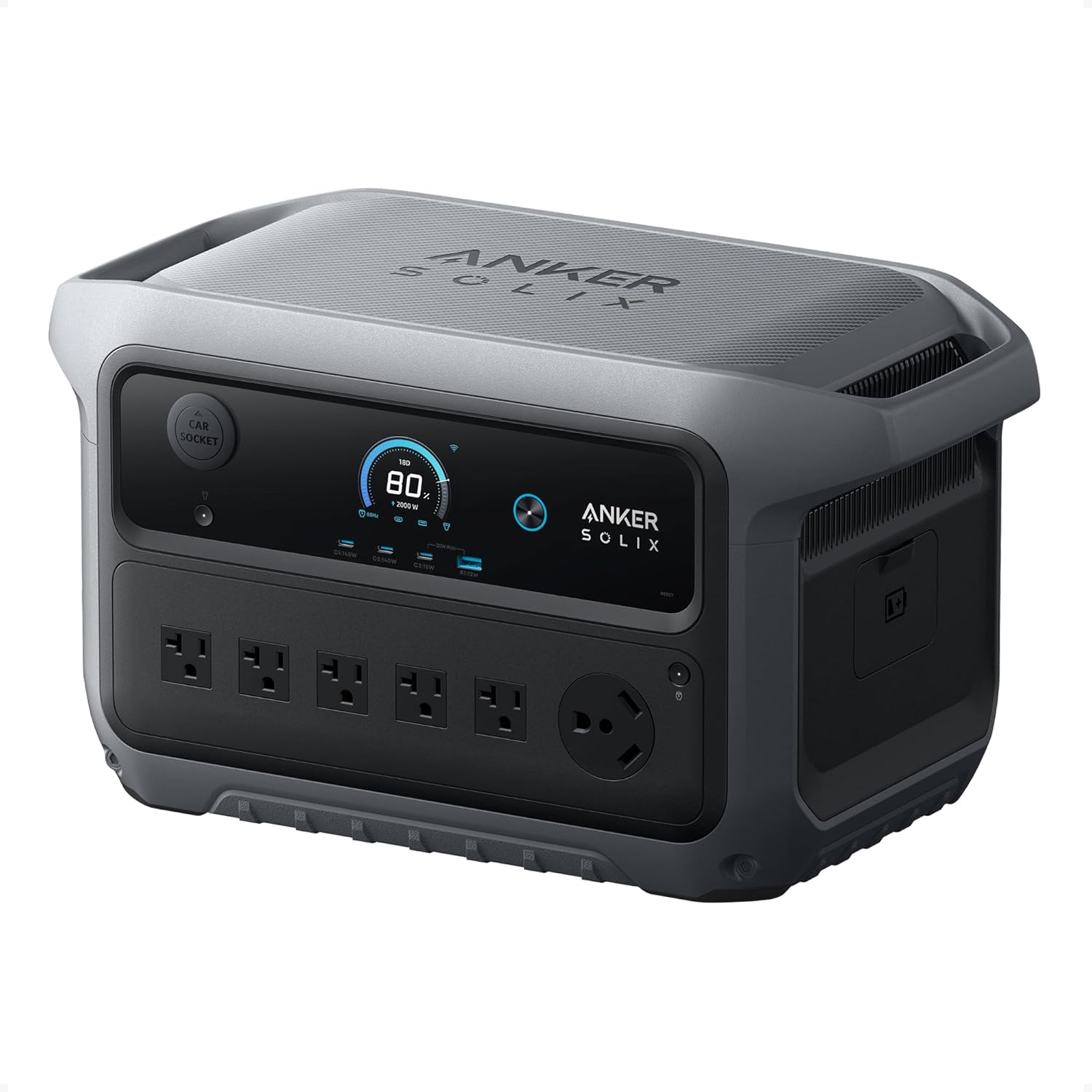
5. Anker SOLIX C2000 Gen 2
- 120 V only. Anker lists 2,400 W continuous and 4,000 W peak.
- Franklin math at 120 V. 2,400 W covers a 1/2 HP 3-wire motor (2 kW) and a 1/3 HP 2-wire motor (2.25 kW). A 1/2 HP 2-wire motor (3 kW) is out of range.
- Battery. 2,048 Wh LFP rated for 4,000 cycles to 80 percent, up to 4 kWh with one BP2000 Gen 2 battery.
- Size. 41.7 lb, the lightest pick here by a wide margin.
Best for: a 1/3 HP to 1/2 HP 120 V pump on a cabin or small house with modest daily water use.
Avoid if: your pump is 240 V or a 1/2 HP 2-wire motor, or you also want to run a furnace blower through a long outage.
Peak Check: The Pump and a Fridge Together
Starting watts on a utility chart are an add-on, not a total. EWEB lists a 1/3 HP well pump at 1,000 running watts plus 2,000 additional starting watts, and a refrigerator at 700 running plus 2,200 additional. Assuming only one motor starts at a time:
- Running total: 1,000 W + 700 W = 1,700 W.
- Largest single starting add: the fridge at 2,200 W.
- Peak to plan for: 1,700 W + 2,200 W = 3,900 W.
Every pick clears 1,700 W continuous. On surge, the C2000 Gen 2’s 4,000 W peak covers 3,900 W with only 100 W to spare, so on that unit let the pump finish a cycle before the fridge kicks on, if you can. Chart figures are averages; your pump’s nameplate amps and its manual are the final word, and motors can pull harder when they are worn or cold. The two kinds of watts are explained in running watts vs starting watts.
Runtime: Gallons Decide the Battery Budget
A well pump uses energy only while it refills the pressure tank, so start with water use. Pump energy per day = gallons per day / pump flow in gallons per minute / 60 x running watts. The EPA’s WaterSense program puts average family use at more than 300 gallons a day at home; with a pump that moves 10 gallons a minute (check your pump’s rating) and runs at 1,000 W:
- Normal use: 300 gal / 10 gpm = 30 minutes, so 1,000 W x 0.5 h = about 500 Wh a day.
- Outage habits (short showers, no laundry, about 100 gallons): 100 / 10 = 10 minutes, so 1,000 W x (10 / 60) h = about 170 Wh a day.
- Add a fridge: read the yellow EnergyGuide label. A 600 kWh per year fridge uses 600,000 Wh / 365 = about 1,640 Wh a day.
At normal water use, pump plus fridge is about 500 + 1,640 = 2,140 Wh a day. Usable energy is rated Wh x 0.85, a common planning figure for inverter loss:
| Setup | Usable Wh (rated x 0.85) | Days at 2,140 Wh a day |
|---|---|---|
| DELTA Pro 3 | 4,096 x 0.85 = about 3,480 | about 1.6 |
| HomePower 3600 Plus, one unit | 3,584 x 0.85 = about 3,050 | about 1.4 |
| HomePower 3600 Plus, pair | 7,168 x 0.85 = about 6,090 | about 2.8 |
| DELTA 3 Ultra | 3,072 x 0.85 = about 2,610 | about 1.2 |
| DELTA Pro, pair | 7,200 x 0.85 = about 6,120 | about 2.9 |
| C2000 Gen 2 | 2,048 x 0.85 = about 1,740 | about 0.8 (roughly 19.5 hours) |
Cutting water use to outage habits saves about 330 Wh a day, which on the DELTA Pro 3 stretches the same battery from about 1.6 to about 3,480 / 1,810 = 1.9 days. A sump pump on the same circuit changes the math; see the best power stations for a sump pump.
Cost of Ownership
The station is only part of the bill for a hard-wired pump. A well pump has no plug, so the station reaches it through transfer equipment, an inlet, or a maker’s home panel such as EcoFlow’s Smart Home Panel 2, which EcoFlow says requires installation before use. Franklin’s manual says a transfer switch must be used any time a generator backs up a home connected to utility lines, and the same logic applies to a battery. Have a licensed electrician choose the equipment, pull the permit, and make the connection; the concepts are in transfer switch basics.
- Second unit or hub. The Jackery and DELTA Pro routes to 240 V double the station cost, and the DELTA Pro also needs the Double Voltage Hub.
- Recharging from the grid. Refilling 4,096 Wh at a 0.9 charging efficiency (a planning figure) takes 4,096 / 0.9 = about 4.55 kWh. At the EIA’s August 2026 residential average of 18.16 cents per kWh, that is about 4.55 x 18.16 = about 83 cents.
- Warranty. EcoFlow lists 5 years on the DELTA Pro 3 (3 standard plus 2 with app registration), and Jackery lists 5 years on the HomePower 3600 Plus when bought from jackery.com. Anker covers the C2000 Gen 2 for 5 years.
The common alternative is a 240 V gas or dual fuel generator. It runs longer per refill but brings carbon monoxide risk: the CPSC says to run portable generators outdoors only, at least 20 ft from the home, far from windows, doors, and vents, with the exhaust pointed away from the home, and to keep CO alarms on every level and outside sleeping areas. Follow the generator maker’s manual and local rules. Generator sizing for the same pump is in what size generator for a well pump.
How to Choose a Station for Your Well Pump
- What voltage is the pump? Check the motor paperwork or the label in the control box or pressure switch area. If it says 230 V or 240 V, cross off the DELTA 3 Ultra and the C2000 Gen 2.
- Is it 2-wire or 3-wire, and what horsepower? A separate control box above ground usually means 3-wire. Then read your Franklin minimum from the table above and compare it with the station’s continuous watts.
- What else starts while the pump runs? Add running watts, then add only the largest single starting figure, as in the 3,900 W example.
- How many gallons will you use? Run the gallons formula with your pump’s flow rate, then size the battery for the outage length you plan around.
- Who will connect it? Budget for a licensed electrician before you buy; the station does nothing for the pump until the transfer equipment is in.
Worked example: a 1/2 HP 240 V 3-wire submersible needs 2 kW by Franklin’s table, so on watts alone any pick would do, but voltage leaves only the DELTA Pro 3, a HomePower pair, or a DELTA Pro pair. Whole-home options beyond portable stations are compared in the best large power stations for home backup.
FAQ
Can a solar generator run a well pump?
Yes, if the station supplies the pump’s voltage and its continuous rating meets the pump’s starting needs. A 1/2 HP 2-wire motor needs about 3 kW by Franklin’s table, which rules out most 1,000 Wh class stations rated at 1,500 to 2,000 W.
Can I plug a 240 V well pump into a 120 V station?
No. A 240 V motor needs 240 V at its terminals, and a 120 V station cannot provide it at any wattage. Pick a station that outputs 240 V, alone or as a linked pair.
How long will a power station run a well pump?
Pump alone at 300 gallons a day, 10 gpm, and 1,000 W uses about 500 Wh, so the DELTA Pro 3’s 3,480 usable Wh covers about 3,480 / 500 = 7 days of pumping before anything else is plugged in.
Changelog: October 2026: first published.