


For most storm patches, a 12 x 16 ft tarp covers a damaged area up to about 5 ft wide and 10 ft down from the ridge once you add a 3 ft margin and a 3 ft wrap over the ridge. Pick the size from your measurements first, then weigh thickness and how the corners attach. Putting the tarp up means working on a damaged roof, so read the safety section before you buy.


Safety first: who puts the tarp up
- Falls from roofs and ladders are a recognized storm-recovery hazard. OSHA’s blue roof guidance for workers, as summarized by a facilities-management publication, says the roof’s capacity to support workers should be determined before tarp work.
- Do not climb on a wet, steep, or damaged roof, or while wind or lightning is active. The same OSHA guidance says a tarped roof is very slippery, especially when wet, and that tarped skylights and openings are not obvious to someone walking on the roof.
- OSHA’s construction fall-protection standard (29 CFR 1926.501) generally applies at 6 ft or more above a lower level and binds employers of workers, so a hired roofer works under it. If you lack harness training and roofing experience, hire a roofer or ask your county about help.
- If a power line is down or touching the house, stay away and call the utility. The CDC says never to touch a fallen power line.
A 2017 FEMA release describes Operation Blue Roof sheeting as designed to last 30 days, held by wood strips fastened with nails or screws. It was issued for Puerto Rico, and eligibility is set per disaster, so check current USACE and county information. The step-by-step is in how to tarp a roof after a storm.
Quick Comparison
| Tarp | Size | Material and thickness (listing) | Weight | Oz per sq ft | Corners | Best for |
|---|---|---|---|---|---|---|
| GUARD SHIELD 12×16 | 12 x 16 ft | Coated PE, 10 mil | 7.3 lb | 0.61 | Aluminum grommets every 3 ft | Typical single patch |
| AROIC 10×20 | 10 x 20 ft | PE, 16 mil | 9.9 lb | 0.79 | Metal grommets every 19.5 in | Longer slope run |
| Accompagner 7×12 | 7 x 12 ft | Polyester and PVC, listed 20 mil | 4.2 lb | 0.80 | Webbing loops, no grommets | Small patch, heat |
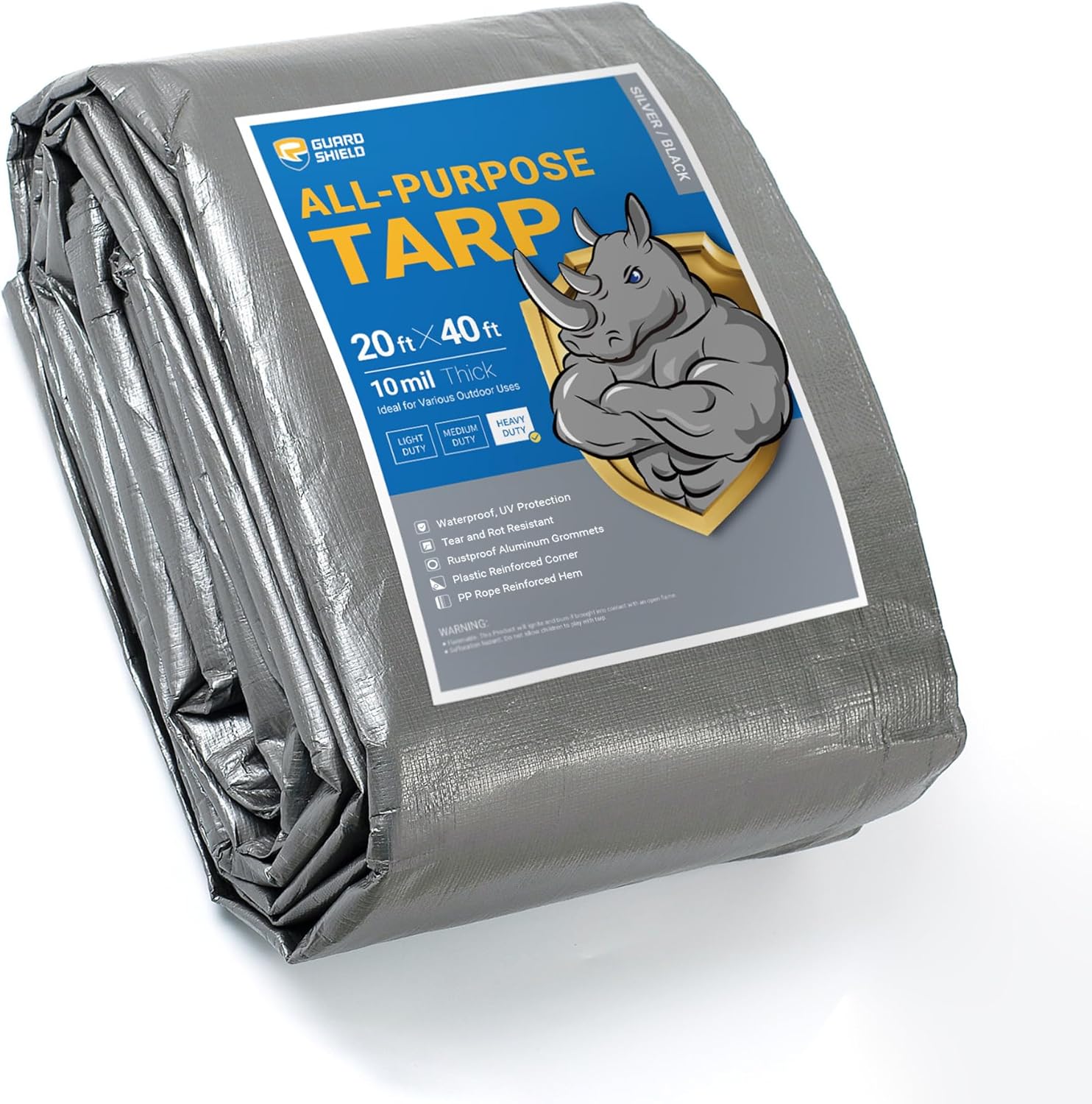
| GUARD SHIELD 20×40 | 20 x 40 ft | Coated PE, 10 mil | 29.1 lb | 0.58 | Aluminum grommets every 3 ft | Large damage |
Oz per sq ft is weight x 16 / area, from listing weights, so treat it as a rough density check. For the AROIC: 9.9 lb x 16 / 200 sq ft = 0.79.
How We Chose
We compared size, listed thickness, material, corner attachment, and weight from the listings, and rating data from verified buyers where it exists. These are researched picks: we do not use or review the products ourselves, and every figure is a seller claim unless an agency is named. Only four tarps in our catalog fit the roof use, so this is a short list. The scoring method is on how we choose.
GUARD SHIELD 12×16 ft
- 192 sq ft, 10 mil coated polyethylene with heat-sealed seams and a rope in the hem, per the listing.
- Grommets every 3 ft give plenty of anchor points, but grommets alone can tear out, so plan on wood strips.
- At about 7.3 lb it is lighter per square foot than the AROIC or the Accompagner, which matters when you carry it up a ladder.
Best for: a single patch under about 5 ft x 10 ft. Avoid if: the damage runs the full slope.
AROIC 10×20 ft
- 200 sq ft, 16 mil polyethylene with a 15×17 weave, per the listing. The thickest PE sheet here.
- The listing warns of a 2 to 3 inch size error, so measure the delivered tarp before cutting your plan around it.
- The 20 ft side runs up a long slope; the 10 ft width is narrower than the GUARD SHIELD, which may force a second tarp for wide damage.
Best for: damage that is narrow but long. Avoid if: you need more than 10 ft of width.
Accompagner 7×12 ft vinyl
- 84 sq ft in a polyester and PVC fabric of 210 grams per square meter, listed as 20 mil.
- Reinforced webbing loops instead of metal grommets, so you tie or strap through them. The listing says it resists heat deformation better than common PE.
- Only 81 reviews at the time of scraping, so the 4.8 rating rests on a small sample.
Best for: a small hole, a dormer, or a porch roof. Avoid if: you need the 3 ft margin on a mid-size patch, since 7 x 12 ft leaves little room.
GUARD SHIELD 20×40 ft
- 800 sq ft of the same 10 mil coated PE, silver and black, at roughly 29 lb. Hard to place alone on a roof.
- It can cover a large section or protect a stack of salvaged belongings on the ground.
Best for: large damage handled by a crew. Avoid if: one person will place it, because a wind gust on 800 sq ft is a hazard.
Cost of ownership
Budget for 1 x 2 or 1 x 3 wood strips, and screws or nails. Every fastener hole is a small leak your roofer will patch, so use as few as hold the sheet. A tarp is temporary; the FEMA 30-day design life for Blue Roof sheeting is a reminder to book the permanent repair. Keep photos and receipts for your insurer.
How to choose
- Measure the damage along the roof surface, not the ground.
- Add 3 ft on each side and enough to wrap over the ridge. This is a planning figure from this site, not a code.
- Buy the next size up and check the label.
Example: damage 5 ft wide, 10 ft below the ridge. Length: 10 + 3 + 3 = 16 ft. Width: 5 + 3 + 3 = 11 ft. The 12 x 16 ft GUARD SHIELD (192 sq ft against 176 needed) just fits; the 10 x 20 ft AROIC is 1 ft too narrow. Pair the tarp with the hurricane gear checklist and hurricane house prep before the season.
FAQ
How thick should a roof tarp be?
Listings range from 10 mil to 20 mil, but mil is not comparable across materials, so check seams and edges as well as the number. Thicker tarps weigh more to carry up a ladder.
How long can a tarp stay on a roof?
FEMA describes Blue Roof sheeting as designed for 30 days. Treat any retail tarp as short-term too, and schedule the repair.
Can I tarp the roof myself?
Only if the damage is low, the roof is dry and solid, and you can work with a spotter. Otherwise call a roofer.
Changelog: November 2026: first published.









