


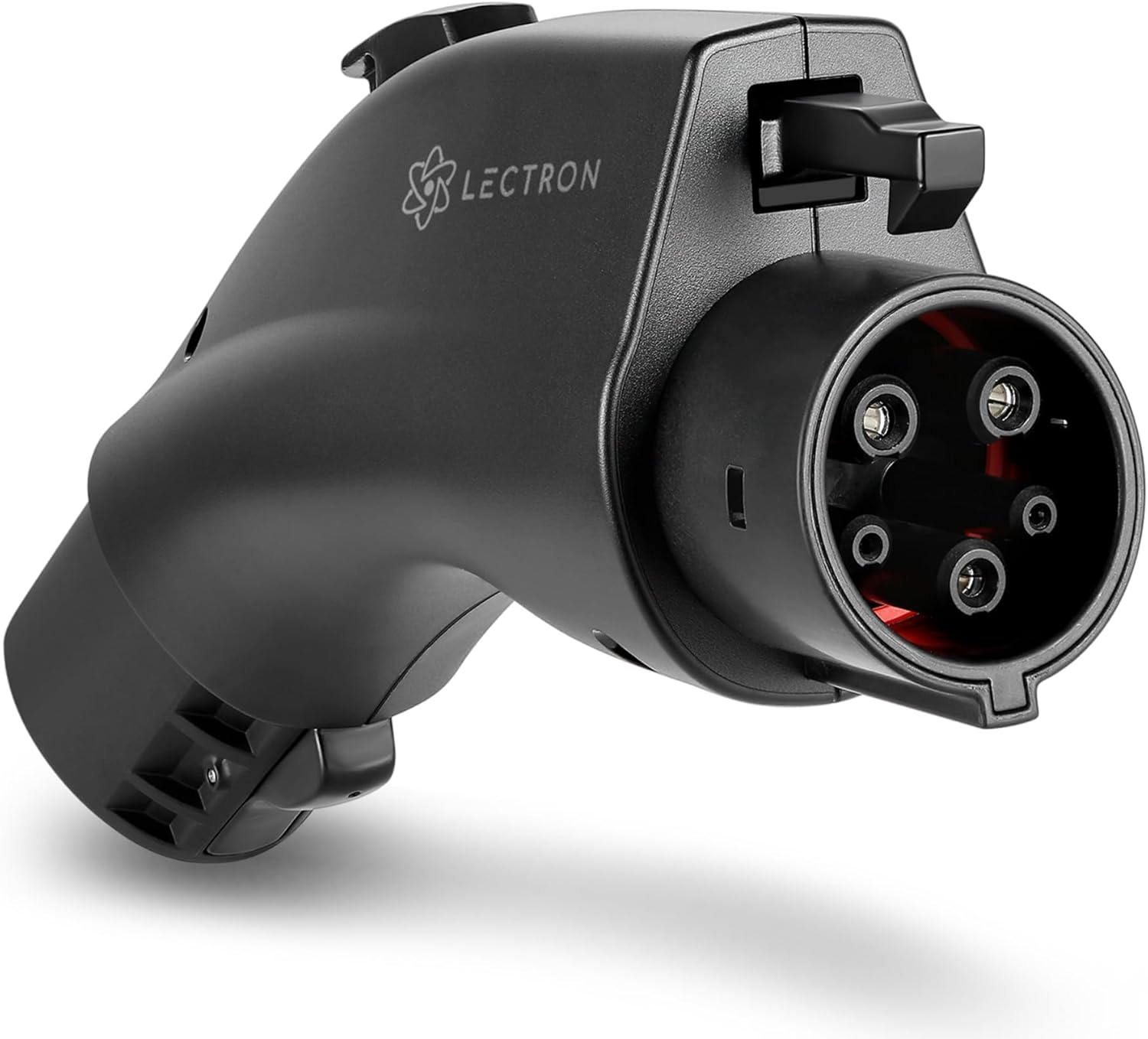
For most J1772 drivers who want to use a Tesla-style plug, the Lectron NACS to J1772 adapter is the first one to look at: its listing names UL 2252, an 80 A rating, and a 2-year warranty. The rating that matters is not the biggest number. Pick an adapter rated at or above what the charger delivers, then confirm your car model with the automaker.


Quick Comparison
| Adapter | Rating (listing) | Safety mark (listing) | Warranty (listing) | Best for |
|---|---|---|---|---|
| Lectron | 80 A, 240 V | UL 2252, temperature monitoring | 2 years | A named certification |
| Raylix | 80 A, 250 V | None named | 2 years | Buyers who want a stated temperature range |
| Seguma | 80 A, 250 V | None named | 1 year | Plain one-way adapter with clear use notes |
| EVDANCE 50 A | 50 A, 240 V | None named | 1 year | Locking design on a 40 A to 48 A charger |
| EVDANCE 80 A | 80 A, 250 V | None named | 1 year | Anti-drop lock, IP65 listed |
How We Chose
We compared the amp rating, the safety standard each listing names, warranty, locking design, and the Yard & Grid Score from verified-buyer ratings (see how we choose). The adapter specs here come from retail listings, which are a weak source, so a certification is “the listing says” until you see the mark on the product. We research and compare; we do not use or review the products ourselves.
Adapter Safety Rules
- Use it in the right direction only. These adapters take a NACS plug on the charger side to a J1772 port on the car. The Seguma and EVDANCE 50 A listings say they do not work the other way. AFDC notes that Tesla vehicles already come with a J1772 adapter for non-Tesla Level 2 chargers.
- Match the rating. This is our general caution, not a rule stated in the listings: the adapter’s amp rating should be at or above the charger’s output. A Tesla Gen 3 Wall Connector on a 60 A breaker delivers 48 A per Tesla’s manual table, so a 50 A or 80 A adapter covers it.
- Do not stack adapters or add extension cords. None of the listings we read addresses chaining, so this is our caution: one adapter between one charger and one car. The Seguma and EVDANCE 50 A listings say to fully seat both connectors and engage the locks first.
- Follow the automaker and the adapter maker. Listings disagree on which models work (the Raylix listing names the Chevy Bolt as unsupported, the EVDANCE 80 A listing names the Bolt as supported), so the car’s manual or the automaker decides.
- The Seguma listing advises stopping charging if you notice unusual heat, damage, or repeated interruptions. The Seguma and EVDANCE 50 A listings say not to force a stuck connector.
Lectron NACS to J1772 (80 A)
- Listing names UL 2252, IP67, built-in temperature monitoring, and a 2-year warranty.
- Listing says it works with Tesla Wall Connectors, Destination Chargers, and Mobile Connectors, not Superchargers.
- Its Yard & Grid Score is the highest of the five, with 4.7 stars across 150 ratings.
Best for: buyers who put a named standard first. Avoid if: your car is on the automaker’s unsupported list.
Raylix Tesla to J1772 (80 A)
- Listing: 0.53 lb, -22°F to 122°F, 2-year warranty, and a list of unsupported vehicles.
- Rated 4.5 from about 155 buyers.
- No safety standard is named in the listing text we reviewed.
Best for: cold-climate drivers who want a stated temperature range. Avoid if: you need a certification named on the page.
Seguma NACS to J1772 (80 A)
- Listing: one-way use from a NACS source to a J1772 car, and the adapter does not raise charging speed.
- Listing says it works with NACS AC Wall Connectors “configured to allow non-Tesla vehicles.”
- Rated 4.4 from about 260 buyers; 1-year warranty.
Best for: readers who want the plainest usage notes. Avoid if: you want more than a 1-year warranty.
EVDANCE NACS to J1772 (50 A)
- Listing text: 50 A, 240 V AC, security lock, 1-year warranty (its spec field says 80 A, so the listing disagrees with itself).
- Listing says charger access can depend on property settings and the adapter cannot open up restricted chargers.
- At 240 V x 50 A = 12 kW, it already exceeds a 48 A charger’s 11.5 kW.
Best for: a home 40 A to 48 A charger. Avoid if: a future charger will push more than 50 A.
EVDANCE NACS to J1772 (80 A)
- Listing: 80 A, 250 V, anti-drop lock, IP65, Tesla Mobile Connector Gen 1 and 2 and Wall Connector Gen 1 to 3.
- The listing names many unsupported cars; read it before ordering.
- Score is the lowest of the five; 1-year warranty.
Best for: a mixed fleet of J1772 cars with checked compatibility. Avoid if: your car appears on its exclusion list.
Cost of Owning One
The adapter is a one-time part with no fuel or batteries. What it can add is a missing charger: if you own a J1772 car, a Tesla-plug wall unit is not a standalone solution, and home charger choices are in best Level 2 EV chargers for home. For a cord you can carry, see best portable EV chargers. Any new 240 V circuit or hardwired unit is work for a licensed electrician; see permits for a home EV charger.
How to Pick
- Which way does the plug go? NACS charger to J1772 car needs this adapter; the reverse does not.
- What does the charger deliver? Volts x amps: 240 x 48 = 11.52 kW. Pick an adapter rated at least 48 A.
- What can the car take? A 7.2 kW onboard charger limits you to 7.2 kW, so a 60 kWh battery needs about 60 / 7.2 = 8.3 hours, before losses.
- Is the model approved? Ask the automaker, since listings conflict.
For plug standards in more depth, read J1772 vs NACS.
FAQ
Does an adapter make charging faster?
No. The Seguma and EVDANCE 50 A listings both say the charger, the car’s onboard charger, and the settings set the speed, not the adapter.
Can I use it at a Supercharger?
No. Every listing here says it is not compatible with Tesla Superchargers, and most also say AC only or no DC fast chargers.
Is a second adapter in a chain okay?
We advise against it. The listings we read do not address chaining adapters, so use one adapter and follow the instructions from the car maker and the adapter maker.
Changelog: November 2026: first published.









