


Almost every plug-in space heater sold for U.S. homes tops out at 1,500 W, which works out to 1,500 x 3.412 = about 5,100 Btu per hour, so the heater you pick changes how evenly and quietly that heat arrives, not how much of it there is. For a living room or home office on grid power, the Lasko 755320 ceramic tower is our first pick: oscillation, a digital thermostat, an 8-hour timer, and a remote in a 23 in tower that owners have rated in large numbers.



This guide covers electric heaters for use while the power is on. If you are planning for outages, see our separate guide to heaters for power outages.
Quick Comparison
Wattage and settings come from manufacturer pages where available and from retailer listings otherwise. All six draw about 12.5 A on high: 1,500 W / 120 V = 12.5 A.
| Model | Style | High / low | Oscillation | Timer | Weight | Best for |
|---|---|---|---|---|---|---|
| Lasko 755320 | Ceramic tower, 23 in | 1,500 W / lower setting | Yes | 1 to 8 h | 7.29 lb | Living rooms and home offices |
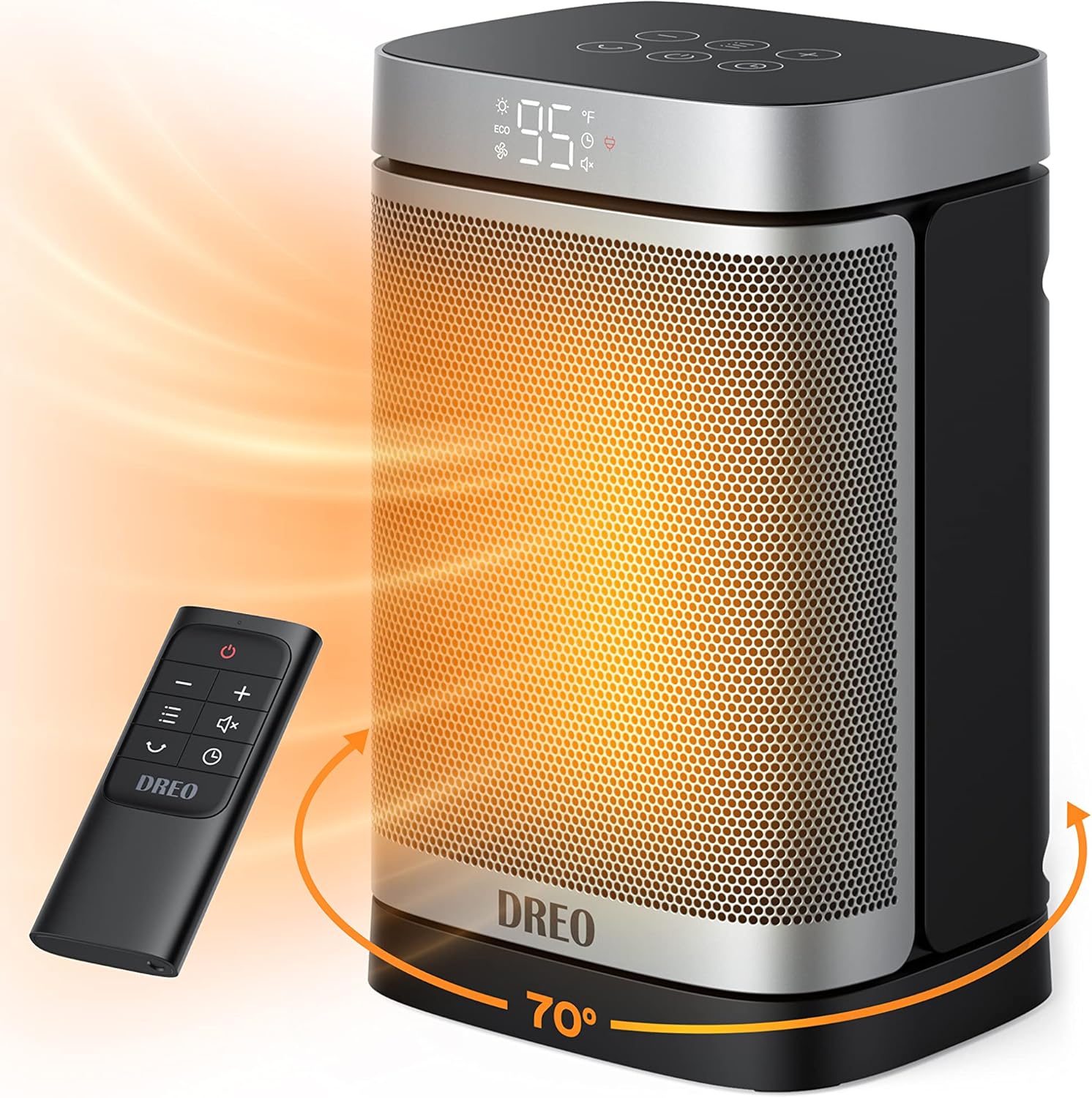
| DREO Atom One (DR-HSH004) | Compact ceramic | 1,500 W / about 1,000 W | 70° | 1 to 12 h | 3.8 lb | Bedrooms and desks |
| Dr Infrared DR-968 | Infrared quartz plus PTC cabinet | 1,500 W / lower setting | No | 12 h | 19 lb | Long, steady heat in one room |
| DREO Ceramic Heater 316 | Compact ceramic | 1,500 W / lower settings | No | 12 h | 3 lb | Quiet bedrooms, homes with kids |
| Amazon Basics Ceramic (DQ1927) | Mini ceramic | 1,500 W / 900 W | No | No | 3 lb | A simple second heater |
| GiveBest PTC-905 | Mini ceramic | 1,500 W / 750 W | No | No | 3 lb | Spot heat at a desk |
How We Chose
Because heat output is capped at the same 1,500 W, we ranked on the things that do differ between heaters.
- Thermostat control: a digital thermostat that cycles the element off saves more energy than any “eco” label.
- Safety features: overheat shutoff and tip-over shutoff, and a recognized listing mark such as ETL.
- Heat spread: oscillation or a radiant element for larger rooms.
- Low setting: a 750 W to 1,000 W setting cuts the draw by a third to a half once a room is warm (1,000 / 1,500 = two thirds; 750 / 1,500 = half).
- Owner feedback: our Yard & Grid Score, built from verified buyer ratings, weighted alongside the specs.
We work from spec sheets, manuals, CPSC guidance, and public owner reviews. We research and compare; we do not run our own product trials. More on how we choose.
The Picks
1. Lasko 755320 Ceramic Tower: first pick for a living room
- Two heat settings, 1,500 W high and a lower setting (we found no Lasko figure for its wattage), plus an auto mode driven by the adjustable thermostat.
- Widespread oscillation and a 23 in height push warm air across the room instead of only at floor level.
- Remote control with storage on the back, a 1 to 8 hour auto-off timer, overheat protection, and a cool-touch exterior; ETL listed, per the product listing.
- The listing does not call out tip-over shutoff, so place it where it cannot be knocked over.
Best for: a 150 sq ft living room or home office where you want one heater to warm the seating area.
Avoid if: you have pets or small children who might tip it, or you need a heater you can leave in a bathroom.
2. DREO Atom One: the bedroom heater
- DREO lists a digital thermostat from 41°F to 95°F in 1°F steps, the finest control on this list.
- DREO rates noise at 37.5 dB and lists 70° oscillation, three heat levels plus ECO and fan modes.
- Tip-over and overheat protection, a 1 to 12 hour off timer, a 6 ft cord, and a weight of 3.8 lb, per DREO.
- DREO’s product page lists a 12-month warranty.
Best for: bedrooms and offices of 100 to 150 sq ft where steady temperature and low noise matter.
Avoid if: you want one heater to cover an open living area of 300 sq ft or more.
3. Dr Infrared DR-968: heavy, even heat
- Combines an infrared quartz element with a PTC (positive temperature coefficient) ceramic element behind a blower, in a 19 lb wheeled cabinet.
- The listing rates it at “around 5,200 Btu,” close to what the math gives any 1,500 W heater: 1,500 W x 3.412 = about 5,100 Btu per hour. Its “60% more heat” line describes how the dual elements and blower deliver that heat; total output is still set by the 1,500 W draw.
- What it adds is spread and steadiness: a blower rated at 39 dB on the listing, a remote, a 12-hour timer, tip-over and overheat protection.
Best for: a den or basement family room where the heater stays put all season.
Avoid if: you move your heater between rooms every day, or you expect more heat than any other 1,500 W model.
4. DREO Ceramic Heater 316: quiet with a child lock
- DREO rates noise at 34 dB, the lowest rating published for any of these six, from a brushless DC fan.
- Thermostat from 41°F to 95°F in 1°F steps, power heat, ECO, and fan-only modes, a 1 to 12 hour timer, remote, and child lock, per DREO, which also lists a 12-month warranty.
- Tilt-detection tip-over shutoff, overheat protection, and ETL certification, per the listing.
- No oscillation; it throws heat forward through a funnel-shaped outlet.
Best for: a nursery or child’s room where buttons need locking and noise needs to stay low.
Avoid if: you need side-to-side coverage in a wide room.
5. Amazon Basics Ceramic Space Heater: the simple spare
- High 1,500 W, low 900 W, and fan only, with a thermostat dial, per the listing.
- Tip-over and overheat protection, 3 lb, about 7.5 in x 6.3 in x 9.5 in.
- The listing warns against bathrooms, laundry rooms, and other humid spaces.
Best for: a second heater for a guest room or a cold corner of the house.
Avoid if: you want a timer, a remote, or a digital temperature setting.
6. GiveBest PTC-905: spot heat at a desk
- 1,500 W and 750 W settings plus a fan mode, with an automatic thermostat, per the listing.
- Tip-over shutoff with an audible beep; the listing says it comes back on by itself when set upright, which is a reason to keep it clear of anything that can burn even after a tip.
- 6 ft cord with a two-prong plug and a 3 lb body.
Best for: warming your feet under a desk with the 750 W setting.
Avoid if: you want a heater for a whole room or one that stays off after it tips.
What It Costs to Run
The electricity costs far more over a winter than the heater itself. Every electric resistance heater turns essentially all of its electricity into heat, according to the DOE, so an “energy efficient” label on a plug-in heater points to its controls, such as the thermostat and ECO mode, rather than to more heat per watt.
- Daily use: 1,500 W x 8 hours x 0.5 thermostat duty (a planning figure; your room may differ) = 6,000 Wh, or 6 kWh.
- At EIA’s August 2026 U.S. residential average of 18.16 cents per kWh: 6 x 18.16 = about 109 cents a day.
- Over a 30-day month: 109 x 30 = about 3,270 cents, roughly thirty-three dollars. Your utility rate sets the real figure.
- Running on a 900 W low setting, as on the Amazon Basics, draws 900 / 1,500 = 60 percent of the high setting, a 40 percent cut, if the room holds temperature.
Other costs are small: a replacement filter on models that have one, and remote batteries. Our full breakdown is in how much electricity a space heater uses.
How to Choose the Right Heater
- How big is the room? A common planning figure for supplemental heat is about 10 W per sq ft with 8 ft ceilings. A 12 ft x 14 ft bedroom is 168 sq ft x 10 = 1,680 W, slightly above one heater on high, so close the door and expect it to run steadily on cold nights.
- What else is on the circuit? One heater on high draws 12.5 A. Add a 1,000 W hair dryer on the same 15 A circuit and the total is (1,500 + 1,000) / 120 = about 20.8 A, enough to trip the breaker, so give the heater a circuit with no other heavy loads.
- Do you need it to spread heat or aim it? Towers with oscillation suit seating areas; compact units suit a desk or bedside.
- Will it run near kids or pets? Look for tip-over shutoff, a cool-touch case, and a child lock.
Whatever you buy, follow the CPSC basics: plug the heater directly into a wall outlet, never an extension cord or power strip; keep it at least 3 ft from drapes, furniture, and bedding; and turn it off when you sleep or leave the room. If a plug, cord, or outlet feels hot, stop using it and have a qualified electrician look at the outlet.
FAQ
What is the most energy-efficient space heater?
Among plug-in electric heaters, none converts power to heat better than another; the DOE treats electric resistance heat as essentially fully converted. Savings come from a precise thermostat, a low setting, and heating only the room you are in.
What is the best space heater for a large room?
One 1,500 W heater supplies about 5,100 Btu per hour, enough for about 150 sq ft as supplemental heat. For a 300 sq ft room, an oscillating tower such as the Lasko helps spread the heat, but expect it to raise the temperature only a few degrees, or use two heaters on separate circuits.
Can I use these heaters during a power outage?
Only with a backup source, and only briefly from a battery. A 1,500 W heater drains a 1,024 Wh power station in about 1,024 x 0.85 / 1,500 = 0.58 hours, or 35 minutes; see can a power station run a space heater for the math.
Are infrared heaters better than ceramic heaters?
They feel different, not stronger. Infrared warms people and surfaces in its line of sight, while ceramic fan heaters warm the air. At the same 1,500 W, total heat is the same.
Changelog: October 2026: first published.









