The EcoFlow DELTA 3 Ultra is the large power station we recommend first for home backup: 3,072 Wh and 3,600 W continuous, expandable to about 11 kWh, which runs a 26 cu ft side-by-side fridge for about 1.5 days on the base unit alone (3,072 Wh x 0.85 inverter efficiency / 1,660 Wh a day = about 1.57 days). If you need 240 V output for a well pump or a dryer circuit, the EcoFlow DELTA Pro is the only model in this list that gets there, by pairing two units.
Every unit here holds at least 2,000 Wh, the point where a station stops being a phone-and-laptop charger and starts carrying a fridge through a night. We ranked them on three things together: how far the battery bank can grow, how much continuous output it gives, and what it takes to recharge.


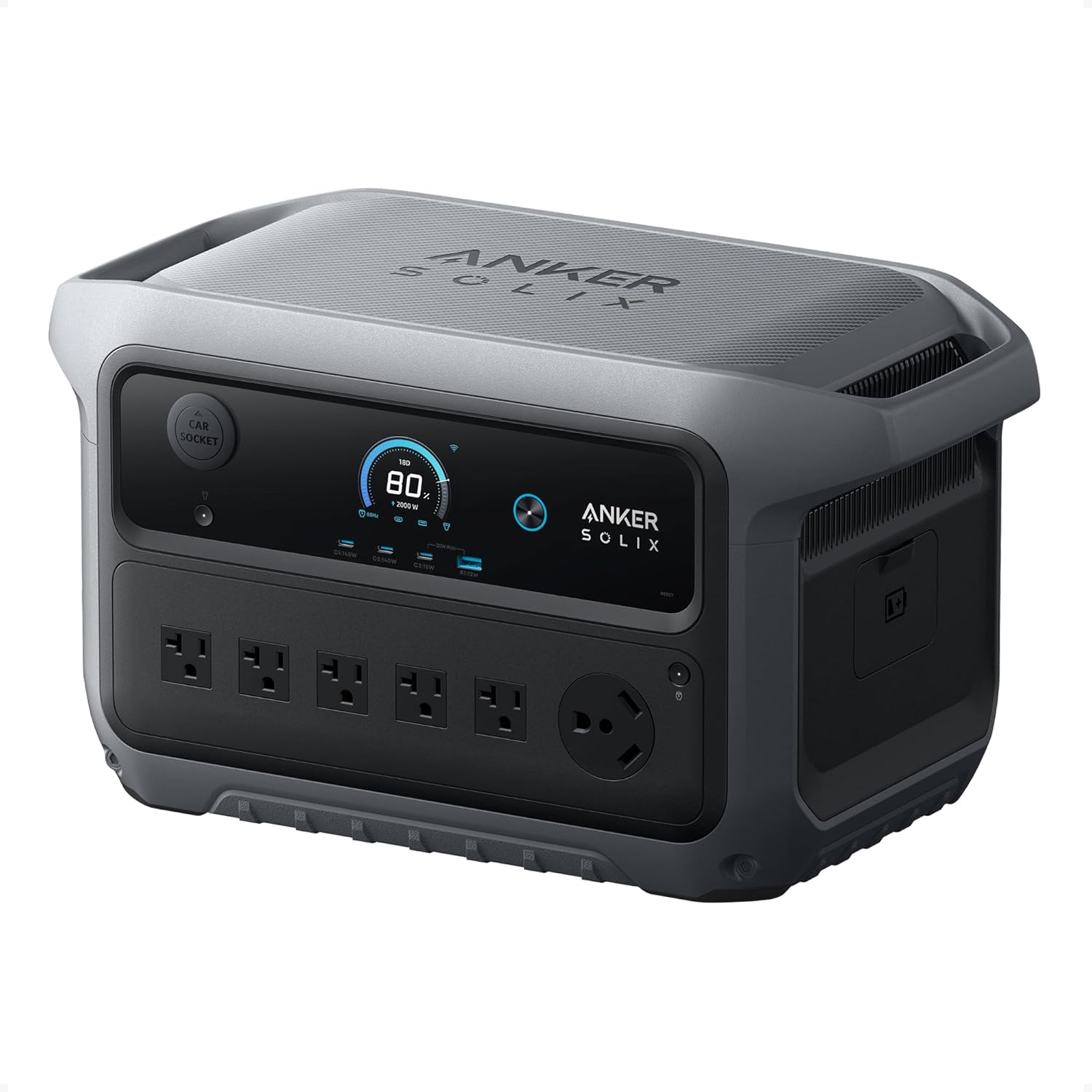


Quick Comparison
Capacity is in watt-hours (Wh), the size of the tank. Output is in watts (W), how much can run at once. The fridge column uses one ENERGY STAR listed 26 cu ft side-by-side model at 605 kWh a year, which is 605 / 365 = about 1.66 kWh a day, and the 0.85 inverter factor explained below.
| Model | Capacity | Continuous / surge | Max with add-on batteries | 240 V | Weight | Fridge days, base unit | Best for |
|---|---|---|---|---|---|---|---|
| EcoFlow DELTA 3 Ultra | 3,072 Wh | 3,600 W / 7,200 W | about 11 kWh | No | 72.1 lb | about 1.5 | Most homes, fridge plus a few circuits |
| EcoFlow DELTA Pro | 3,600 Wh | 3,600 W (4,500 W X-Boost) | 10.8 kWh per unit, 21.6 kWh with two | Two units with Double Voltage Hub | 99 lb | about 1.8 | Largest bank, 240 V loads |
| DJI Power 2000 | 2,048 Wh | 3,000 W | 22,528 Wh | No | about 48.5 lb | about 1.0 | High output in a mid-size unit |
| Anker SOLIX C2000 Gen 2 | 2,048 Wh | 2,400 W / 4,000 W | 4,096 Wh | No | 41.7 lb | about 1.0 | Fast recharge, one add-on battery |
| BLUETTI FridgePower | 2,016 Wh | 1,800 W / 3,600 W | 8,064 Wh | No | about 43.4 lb | about 1.0 | A dedicated fridge backup in the kitchen |
| Jackery Explorer 2000 v2 | 2,042 Wh | 2,200 W / 4,400 W | Not expandable | No | 39.5 lb | about 1.0 | Overnight outages, light to carry |
| Dabbsson 2000L | 2,048 Wh | 2,200 W (3,300 W Power Boost) | Not expandable | No | 41 lb | about 1.0 | A fixed 2 kWh plan |
| Anker SOLIX S2000 | 2,010 Wh | 1,500 W / 3,000 W | Not expandable | No | 35.7 lb | about 1.0 | Low idle draw, small loads |
How We Chose
We research and compare; we do not run our own product trials. We started from every station of 2,000 Wh or more in our product data, then checked capacity, continuous and surge output, expansion limits, solar input, and weight against each manufacturer’s product page or spec sheet. Retail listings filled gaps only where the maker’s page was silent, and we say so in the text. Public ratings from verified buyers, shown as the Yard & Grid Score on each card, were a tiebreaker rather than the ranking itself. The full method is on our how we choose page.
For runtime we use 0.85, a common planning figure for inverter efficiency, because the rated Wh is measured at the battery and some of it is lost turning DC into household AC. Your actual number will move with temperature and how hard the inverter works.
The Large Power Stations, Ranked
1. EcoFlow DELTA 3 Ultra
- EcoFlow rates it at 3,072 Wh LFP (lithium iron phosphate), 3,600 W continuous, 7,200 W surge, and up to 4,600 W in X-Boost mode for resistive loads.
- Expandable to about 11 kWh with two DELTA Pro 3 Extra Batteries: 11,000 Wh x 0.85 / 1,660 Wh = about 5.6 days of that fridge.
- A 30 A outlet sits among its AC ports, and UPS switchover is under 10 ms, so the fridge and router ride through the moment the grid drops.
- Solar input is 800 W on this model (1,600 W on the Ultra Plus); wall charging takes up to 1,800 W. Output is 120 V only.
- EcoFlow lists a 5-year warranty with app registration.
Best for: a fridge, chest freezer, router, and lights through a one to two day outage, with room to add batteries.
Avoid if: it has to go up and down stairs at 72.1 lb, or you need a 240 V well pump on backup.
2. EcoFlow DELTA Pro
- 3,600 Wh LFP with 3,600 W continuous, 4,500 W in X-Boost mode, and expansion to 10.8 kWh with two DELTA Pro Smart Extra Batteries, or 21.6 kWh across two linked units, per EcoFlow.
- Two units joined through EcoFlow’s Double Voltage Hub give 240 V output, and EcoFlow lists the pair at up to 7,200 W through the hub.
- EcoFlow’s MultiCharge combines inputs up to 6,500 W, with a full wall recharge in about 2.7 hours.
- It is the older generation in EcoFlow’s lineup and weighs 99 lb, so it is a roll-on-wheels unit, not a carry unit.
Best for: homes that want a battery bank they can grow toward 10 kWh and beyond, or that need 240 V from portable gear.
Avoid if: you want a single unit you can lift into a car.
3. DJI Power 2000
- 2,048 Wh LFP and 3,000 W continuous output, the most output per Wh in this list.
- DJI lists expansion with up to ten 2,048 Wh batteries for 22,528 Wh total.
- DJI rates the cells at over 80 percent capacity after 4,000 cycles and lists charging from 32 to 113°F (0 to 45°C).
- Solar and car charging go through DJI’s separate Solar/Car Super Fast Charger, rated up to 1,200 W of solar through its MC4 input.
Best for: running a microwave or a space heater on top of a fridge without hitting the output limit.
Avoid if: you want to plug panels straight into the station with no extra accessory.
4. Anker SOLIX C2000 Gen 2
- 2,048 Wh LFP, 2,400 W rated, 4,000 W peak, at 41.7 lb.
- One BP2000 Gen 2 expansion battery doubles it to 4,096 Wh, and that is the limit.
- Anker lists 1,800 W AC charging (about 88 minutes to full) and 2,600 W with AC plus solar (about 58 minutes).
- 800 W solar input at 11 to 60 V, 10 ms UPS, 4,000 cycles to 80 percent, and a 5-year warranty.
Best for: refilling fast between rolling outages, or from a short generator run.
Avoid if: you expect to want more than about 4 kWh in the bank.
5. BLUETTI FridgePower
- 2,016 Wh LFP, 1,800 W continuous and 3,600 W surge, in a slim case that can stand in a gap beside the fridge or mount on a wall.
- Up to three BlueCell 200 batteries add 2,016 Wh each: 4 x 2,016 = 8,064 Wh.
- BLUETTI lists a 4 W idle draw and UPS switchover under 10 ms.
- It has fewer buyer ratings than most others here, so its long-term record is thinner.
Best for: keeping one fridge on battery full time, with automatic switchover.
Avoid if: you need to run several large appliances at once; 1,800 W is the ceiling.
6. Jackery Explorer 2000 v2
- 2,042 Wh LFP with 2,200 W output and 4,400 W surge, per Jackery.
- At 39.5 lb it is among the lightest 2 kWh units here.
- Jackery does not list an expansion battery for it, so the base tank is the whole tank.
- Jackery bases its lifespan estimate on 4,000 charge cycles.
Best for: overnight outages in a smaller home where one person moves the unit.
Avoid if: you might want multi-day backup later.
7. Dabbsson 2000L
- 2,048 Wh LFP, 2,200 W continuous, and a 3,300 W Power Boost mode, at 41 lb.
- 800 W solar at 12 to 60 V, with combined AC plus solar input capped at 1,500 W.
- Dabbsson rates it at 4,000 cycles to 80 percent, and its spec pages list no expansion battery for it.
Best for: a set 2 kWh plan for a fridge and electronics.
Avoid if: you want to add batteries as your needs grow.
8. Anker SOLIX S2000
- 2,010 Wh, 1,500 W continuous and 3,000 W peak, at 35.7 lb.
- Anker lists a 6 W idle draw. Over a day, 6 W x 24 h = 144 Wh, against 9 W x 24 h = 216 Wh for the C2000 Gen 2’s listed standby.
- Solar input tops out at 400 W, so a sunny day adds about 400 W x 5 peak sun hours x 0.75 derate = about 1,500 Wh.
- Anker rates it at 10,000 cycles to 60 percent, with a 5-year warranty.
Best for: fridge, router, and CPAP loads that stay well under 1,500 W.
Avoid if: you plan to run a microwave or a space heater from it.
240 V Output: Who Needs It
You need 240 V only if a load on your backup list is wired for it: most deep well pumps, central AC, electric dryers, and electric ranges. A fridge, sump pump, furnace blower, and router all run on 120 V, so most essentials plans never touch 240 V.
Among the stations in our product data, only the DELTA Pro pair reaches 240 V. Newer models with native 120/240 V output, such as the EcoFlow DELTA Pro Ultra and Anker SOLIX F3800, were not in our product data; our Anker SOLIX F3800 Plus vs EcoFlow DELTA Pro Ultra comparison covers them. Getting 240 V from any station into house circuits takes transfer equipment installed by a licensed electrician, with a permit where your area requires one; our transfer switch basics page explains the concept.
Cost of Ownership
The station is the first purchase, not the last. Plan for these:
- Expansion batteries. Add-on batteries are a major purchase on their own and only fit their own product line, so decide your target kWh before you buy the base unit.
- Solar panels. A station that cannot refill turns a three-day outage into a one-day backup. Match panel voltage to the station’s solar input range.
- Transfer equipment. Feeding house circuits needs an inlet and a transfer switch or a maker’s home panel, installed by a licensed electrician.
- Generator recharging. If a gas generator refills the station, it produces carbon monoxide: run it outdoors only, at least 20 ft from the house, far from windows, doors, and vents, with the exhaust pointed away, as the CPSC advises, follow the manufacturer’s instructions and local rules, and keep battery-backed CO alarms on every level and outside sleeping areas.
- Warranty. Anker lists 5 years on the C2000 Gen 2 and S2000; EcoFlow lists 3 years plus 2 more with app registration on the DELTA 3 Ultra and DELTA Pro. Register the unit if the maker ties extended coverage to app registration.
How to Pick Your Size
Work out the energy you need first, then check output, then check recharge.
- How many kWh a day? Add each load’s watts x hours. Fridge 1,660 Wh, 15.7 cu ft chest freezer (ENERGY STAR listing: 277 kWh/yr) 760 Wh, router 4.5 W x 24 h = about 110 Wh, and a furnace blower at a 500 W planning figure for 8 hours = 4,000 Wh, for a total of about 6,530 Wh a day.
- How many days? Rated Wh needed = daily Wh x days / 0.85. For that list and two days: 6,530 x 2 / 0.85 = about 15,400 Wh. That rules out the non-expandable units and points to a two-unit DELTA Pro bank or a DJI Power 2000 bank.
- What starts at once? The EWEB generator sizing chart lists a 1/3 HP sump pump at 800 running watts plus 1,300 additional starting watts, so 2,100 W at startup. Add the fridge’s running watts and confirm the total stays under the surge rating.
- Can you refill it? Daily solar Wh = panel watts x peak sun hours x 0.75 derate. 800 W x 4 h x 0.75 = about 2,400 Wh, which covers the fridge and router but not the furnace blower.
If your list climbs past about 15 kWh a day, compare a wall battery or standby generator in our whole-home battery backup options guide. For more sizing math, see how many batteries it takes to power a house.
FAQ
Which portable power station has 240 V output?
In this list, only the EcoFlow DELTA Pro, and only as a pair through the Double Voltage Hub. Single units with native 240 V exist in EcoFlow’s DELTA Pro Ultra and Anker’s F3800 lines.
Is a 7,200 Wh DELTA Pro setup enough for whole-home backup?
For essentials, yes; for a normal day, no. Two DELTA Pro units hold 7,200 Wh x 0.85 = about 6,120 Wh usable, against the EIA’s 2022 average for a residential customer of 10,791 kWh / 365 = about 29.6 kWh a day. That is about 5 hours of normal use, or about a day of the 6,530 Wh essentials list above.
Can a large power station run a sump pump?
Every unit here lists a surge, peak, or continuous rating above a 1/3 HP pump’s 2,100 W start. Energy is the real limit: 800 W x (10 / 60) x 24 h = about 3,200 Wh a day if it cycles 10 minutes an hour, which uses the whole base tank of a 2 kWh unit in under a day.
How long does a 3,000 Wh station last in an outage?
Divide usable Wh by your load. A 3,072 Wh unit gives about 2,610 Wh at the outlet, so a 150 W average load runs 2,610 / 150 = about 17 hours. Our guide on how long a portable power station runs has more load examples.
Changelog: October 2026: first published.