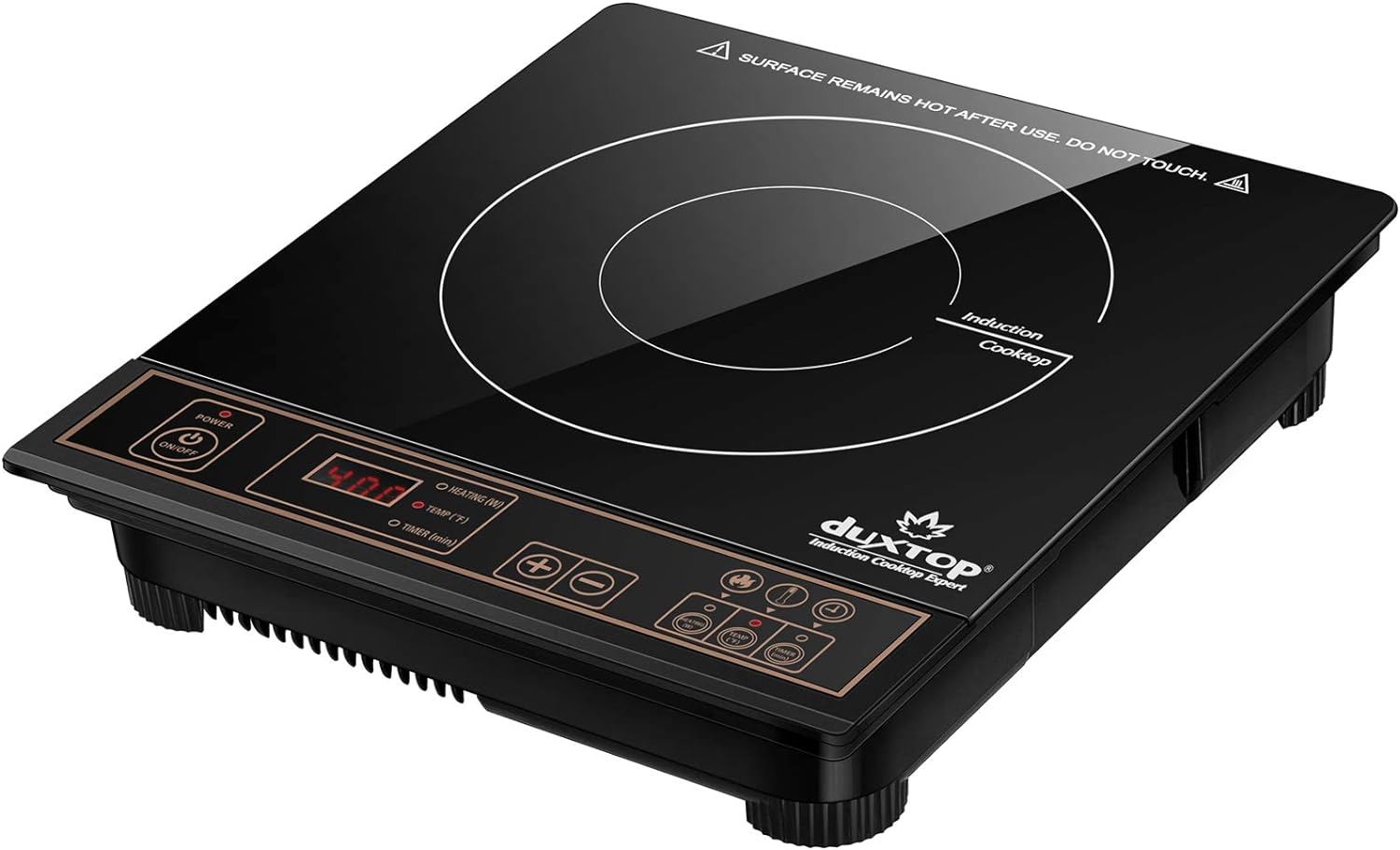
The emergency stove you can use inside a home is an electric one, and for most households that means a portable induction plate such as the Duxtop 8100MC running from a battery power station. It makes no carbon monoxide (CO), its maker lists 10 power levels from 200 to 1,800 W, and a 15-minute meal on its 1,200 W default setting takes about 1,200 x 0.25 / 0.85 = 350 Wh from the battery. We also read what the makers of the five best-rated portable butane stoves in our product catalog allow: none approves cooking with them inside a house or apartment, so they appear below only as outdoor options.
Every flame makes CO. The CDC tells households never to use a portable gas camp stove indoors, and Ready.gov lists camp stoves among the devices to use outdoors only during an outage. Never use any stove or oven to heat a room, keep a battery-powered CO alarm on every level of the home and outside sleeping areas, and if it sounds, get everyone outside and call 911.


Quick Comparison
All three plates top out at 1,800 W on 120 V. The figure that matters on a power station is the lowest setting and the step sizes, because they decide how gently you can cook on a smaller battery.
| Induction plate | Power levels | Temperature settings | Pan size | Weight | Warranty | Best for |
|---|---|---|---|---|---|---|
| Duxtop 8100MC (BT-180G3) | 10 levels, 200 to 1,800 W (maker) | 140 to 460°F | Magnetic base at least 5 in across | 5.8 lb (listing) | 2 years (maker) | Most homes, and long simmers on battery |
| Amazon Basics 1800W Induction Cooktop | 8 levels, 300 to 1,800 W (listing) | 160 to 440°F | 5.7 to 8.2 in, flat bottom | About 6 lb | Not stated in listing | Small pans and a child lock |
| Rosewill RHAI-13001 | 8 levels, 300 to 1,800 W (manual) | 150 to 450°F | 12 to 26 cm (about 4.7 to 10.2 in) base | 5.1 lb (manual) | 1 year (listing) | Households with no induction pot yet; one is included |
How We Chose
We set one rule before looking at a single stove: a product makes this list only if it is approved for use inside a home. Induction plates clear it because nothing burns. We then ranked them on the lowest watt setting and step sizes, pan size limits, safety shutoffs, and maker documentation, using the maker’s manual or product page first and the listing only where no maker document was available. For butane stoves we read each maker’s product page or manual, and none cleared the bar.
- Manufacturer wording first. Retailer copy that says “indoor” did not count when the maker’s own words limit indoor use to commercial kitchens.
- Related manuals as context. Iwatani’s US manual for a sister cassette stove, the ZA-3HP, lists it as a camp stove and a food service appliance, warns never to use it “in an enclosed space such as a camper, tent, car or home,” and says it may not be used in apartments or other confined areas.
- Public health guidance from the CDC, Ready.gov, and the CPSC on CO during outages.
- Yard & Grid Score, built from verified buyer ratings, as a tiebreaker among products that passed the safety rule.
We research and compare; we do not run product trials of our own. Our how we choose page explains the method, and our guide to whether you can use a butane stove indoors covers how to read your own stove’s label.
The Induction Plates
1. Duxtop 8100MC Portable Induction Cooktop
- Secura, Duxtop’s maker, lists 10 power levels from 200 to 1,800 W and 10 temperature settings from 140 to 460°F; the manual sets level 5, 1,200 W, as the default. The listing says 15 levels, so go by the manual.
- The 200 W bottom step is the lowest here, which lets a long simmer use less of the battery. It switches on at the 1,200 W default, so the station must handle that from the start.
- A 170-minute timer, ETL approval, and a 2-year warranty, per Secura. The listing adds that it shuts off after 60 seconds with no pan detected.
- More than 17,000 buyer ratings, by far the most in this group.
Best for: most homes, and the best match for a station rated 1,500 W continuous, where the low steps stretch the battery.
Avoid if: your only pots are aluminum, glass, or copper; it needs a magnetic base.
2. Amazon Basics 1800W Portable Induction Cooktop
- The listing gives 8 power levels from 300 to 1,800 W, temperatures from 160 to 440°F, a 3-hour timer, a child lock, overheat protection, and a voltage warning.
- It takes flat-bottomed induction cookware 5.7 to 8.2 in across and says aluminum will not work, so a large stockpot is out.
- The listing itself says it is not recommended for slow or low-temperature cooking. Plan on boiling and frying, not long simmers.
Best for: a household with children, or anyone cooking for one or two in small pans.
Avoid if: you want to simmer beans or soup for an hour on a battery.
3. Rosewill RHAI-13001 Induction Cooker
- Rosewill’s manual lists 8 power levels (300, 500, 700, 1,000, 1,200, 1,400, 1,600, and 1,800 W), with 1,200 W as the default, and 8 temperature settings from 150 to 450°F.
- The listing includes a 3.5 qt stainless steel pot with a glass lid, which solves the cookware question on day one.
- The manual calls for a pan base 12 to 26 cm (about 4.7 to 10.2 in) across, an individual outlet, and 4 in of clearance around the unit, and it stops after about 2 hours with no button press.
- The 1,400 W step is a clean ceiling for a station rated 1,500 W.
Best for: a first induction plate in a home with no magnetic pots.
Avoid if: you need a setting below 300 W.
What Each Butane Maker Allows
These are the five butane stoves buyers most often shortlist for an emergency kit. None is approved for cooking inside a home, so read them as outdoor options. “Indoor commercial” means a restaurant setting with commercial ventilation, not a home kitchen.
| Stove | Fuel | Rated output | What the maker allows | Home indoor use | Best for |
|---|---|---|---|---|---|
| Iwatani 35FW | Butane, 8 oz canister | 15,000 Btu/h | “Outdoor use and indoor commercial use” | Not approved | Outdoor cooking on a patio, well away from the house |
| Chef Master 90019 | Butane, 8 oz canister | 15,000 Btu/h | Sold for indoor commercial use by restaurant suppliers; no home approval found | Not approved | Outdoor cooking that needs high heat |
| Coleman Classic 1-Burner Butane | Butane, 8.8 oz canister | 7,650 Btu/h | Marketed for camping and outdoor cooking | Not approved | A light outdoor stove with a long warranty |
| Gas One GS-1000G | Butane, 8 oz canister | 7,650 Btu/h | “Outdoor use only” | No | A budget outdoor backup |
| Gas One GS-3400P | Butane or 16.4 oz propane cylinder | 8,000 Btu/h | “For Outdoor Use Only” | No | Households that already stock 1 lb propane cylinders |
- Iwatani’s product page lists the 35FW at 15,000 Btu per hour, about 55 minutes per canister at maximum, and 4.2 lb, and calls it a stove “for outdoor use and indoor commercial use.” Its cassette stove manuals warn against cookware that covers the canister compartment, and the ZA-3HP manual says that model is not for use below 32°F.
- The Chef Master 90019 spec sheet gives 15,000 Btu per hour; restaurant suppliers list it for indoor commercial use, and we found no Chef Master statement approving home use.
- The Coleman Classic listing gives 7,650 Btu per hour, up to 1.25 hours on high per 8.8 oz canister, and a three-year limited warranty.
- Gas One lists the GS-1000G at 7,650 Btu per hour with a one-year warranty and says, in capitals, outdoor use only. Gas One says the same of the dual-fuel GS-3400P, rated 8,000 Btu per hour.
- Propane cylinders belong outdoors when not in use; the CPSC’s generator guidance tells households to store fuel, including propane, outside living areas.
The Indoor Option: Electric Cooking on a Power Station
An induction plate or electric kettle plugged into a battery power station cooks indoors with no flame and no CO. The trade-off is battery capacity, and the math is short: energy used = appliance watts x hours, then divide by inverter efficiency.
- Match the setting to the station. The station’s continuous output rating must exceed the watts you select. On a station rated 1,500 W continuous, the 1,200 W default on the Duxtop or Rosewill fits; stay at or below 1,400 W (Duxtop level 7, Rosewill’s 1,400 W step) to leave headroom.
- Work out energy per meal: 1,200 W x (15 / 60) h = 300 Wh at the plate.
- Divide by inverter efficiency, using 0.85, the factor Jackery builds into its published runtime formula: 300 / 0.85 = about 350 Wh from the battery.
- Divide the station’s capacity by that figure: a 1,070 Wh station covers 1,070 / 350 = about 3 meals like that before it needs recharging. A 20-minute simmer at the Duxtop’s 500 W step takes 500 x (20 / 60) / 0.85 = about 200 Wh.
Use a pot that works on induction: if a fridge magnet sticks firmly to the base, it will heat. Lids shorten boiling time, and lower settings stretch the battery further. Our guide to portable power stations for home backup lists continuous output and capacity for each station, so you can size one for cooking plus a fridge.
Cost of Ownership
Fuel planning works the same way for any stove: canisters needed = days x hot meals per day x minutes per meal / burn time per canister. Round up, then add spares, because cold canisters and long simmers cut into burn time.
- Iwatani 35FW at maximum: 3 days x 2 meals x 15 minutes = 90 minutes. 90 / 55 = 1.6, so 2 canisters, plus 2 spares.
- Coleman Classic on high: 90 / 75 = 1.2, so 2 canisters, plus 2 spares.
- Electric: about 350 Wh per 15-minute meal at 1,200 W, recharged from the wall before the storm or from solar panels during a long outage. The plates’ warranties run 1 year (Rosewill, per its listing) to 2 years (Duxtop).
Store canisters in a cool, dry place away from heat sources and direct sun, as stove manuals direct; Iwatani’s ZA-3HP manual says to keep them below 104°F. Iwatani’s manual also calls for Iwatani-brand fuel for that model, so check your stove’s fuel rule before stocking up. Butane stove warranties run from one year (Gas One GS-1000G, per its listing) to three years (Coleman, per its listing).
How to Choose
Work through these questions in order. The first one usually decides it.
- Do you have a safe outdoor spot? A detached patio or driveway away from windows, doors, and vents can take a flame stove. A balcony, an enclosed porch, or a garage cannot; the CDC lists garages and basements among places never to use a camp stove. Apartment dwellers should plan on electric.
- How many hot meals a day? Two 15-minute meals a day for three days is 90 minutes of cooking. Size canisters or battery capacity from that number, not from a guess.
- Do you already own a power station? If its continuous output exceeds the plate setting you will use, an induction plate turns it into an indoor stove. To stretch a smaller battery, pick the Duxtop for its 200 W bottom step. Check your pots with a magnet before the storm.
- Is anyone in the home sensitive to CO? Mr. Heater’s propane heater manual, for example, lists pregnant women and people with heart or lung disease or anemia as more sensitive to CO. That is another reason to keep every flame outside.
Our walk-through of how to cook without power covers no-cook meals and grills, and carbon monoxide safety during power outages covers every other CO source in an outage. A stove and fuel are one line in the larger home emergency kit plan.
FAQ
Is a butane cassette stove safe in a kitchen with a window open?
Not by the makers’ rules we found. Iwatani approves the 35FW for indoor commercial use, and its ZA-3HP manual allows indoor use only in a restaurant with a properly equipped ventilation hood and rules out homes and apartments. An open window does not change the label, and the CDC says never to use a camp stove indoors.
Can I warm the kitchen with the stove while I cook?
No. Never use any stove, oven, or burner for heat. Ready.gov warns against heating a home with a gas stove or oven. For safe heat during an outage, see our guide to heaters for power outages.
Is it safe to cook in the garage with the door open?
No. The CDC lists the garage among places never to use a camp stove, and an open door does not clear CO reliably. Cook outside, away from the house.
Does a smoke alarm warn about CO from a stove?
Only if it is a combination smoke and CO alarm. A smoke-only alarm does not detect CO, so add a CO alarm with battery power or battery backup on every level and outside sleeping areas, as the CPSC advises.
Printable Checklist
- Indoor cooking plan is electric: induction plate or kettle, power station with enough continuous output for the setting you use
- Pots pass the magnet check, or the plate came with one
- Meals counted: days x meals x minutes, converted to Wh or canisters, plus spares
- Any flame stove used outdoors only, away from windows, doors, and vents
- Canisters stored cool and dry, away from heat and sun; propane cylinders outdoors
- Battery-powered CO alarm on every level and outside sleeping areas, checked before storm season
- No stove or oven ever used to heat the house
Changelog: November 2026: first published.