


Under $1,000, the EcoFlow DELTA 3 Classic kit refills the most of its battery from its own panel, tied with the DELTA 3 Plus: 220 W x 5 peak sun hours x 0.75 derate = 825 Wh, about 81 percent of its 1,024 Wh on one clear day. Every kit here is a 1 kWh power station sold with a panel, which is what “solar generator” means in this guide; our explainer has the background.



Quick Comparison
“One-day refill” is our own calculation: panel watts (capped by the station’s port limit) x 5 x 0.75, divided by battery Wh.
| Kit | Battery | AC output | Included panel | One-day refill | Max solar input | Best for |
|---|---|---|---|---|---|---|
| EcoFlow DELTA 3 Classic + 220W | 1,024 Wh | 1,800 W | 220 W | about 81% | 500 W | Fastest refill per panel |
| EcoFlow DELTA 3 Plus + 220W | 1,024 Wh | 1,800 W | 220 W bifacial | about 81% | 1,000 W | Adding panels and batteries later |
| Anker SOLIX C1000 Gen 2 + PS200 | 1,024 Wh | 2,000 W | 200 W bifacial | about 73% | 600 W | Highest output, 5-year warranty |
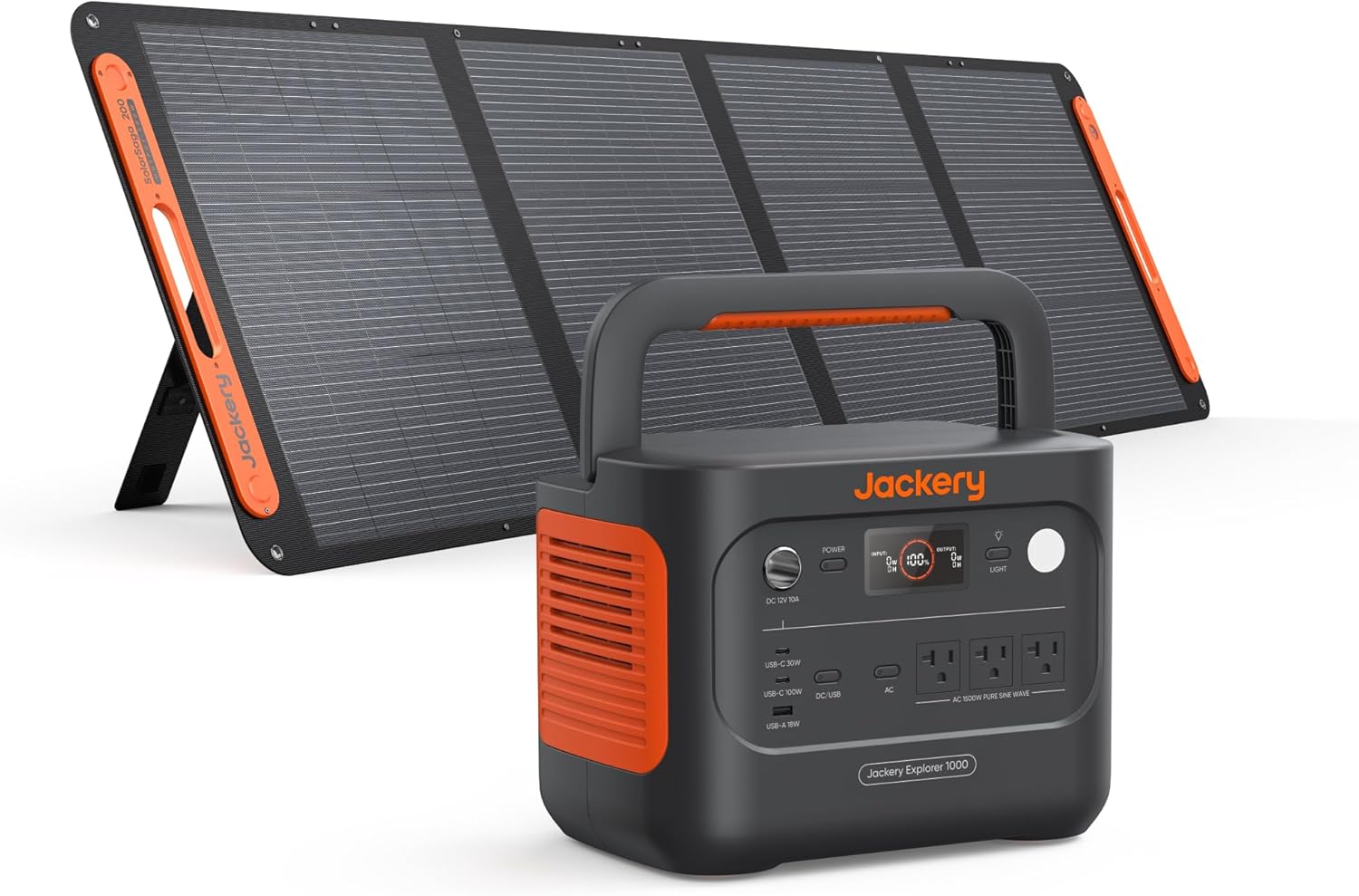
| Jackery Solar Generator 1000 v2 | 1,070 Wh | 1,500 W | 200 W | about 66% | 400 W | Lightest to carry |
| BLUETTI AC180 + 200W | 1,152 Wh | 1,800 W | 200 W | about 65% | 500 W | Most stored energy |
How We Chose
We kept bundle listings that carry a price under $1,000 when we pulled data and a 1 kWh-class LiFePO4 station, and ranked on one-day refill, output, and warranty. We left out a BLUETTI Elite 100 V2 bundle because its listing shows no verified ratings. We research and compare; we do not run our own product trials. Station specs come from maker pages and manuals; see how we choose. For battery-only picks, see portable power stations under $1,000.
The Kits, Ranked
1. EcoFlow DELTA 3 Classic with 220W Panel
- EcoFlow lists 1,800 W continuous, 3,600 W surge, and a 10 ms UPS switchover; solar input is 500 W.
- The listing quotes 5.8 hours to full with the 220 W panel. A 500 W ceiling leaves room for a second panel.
- EcoFlow’s US page lists no add-on battery, so treat 1,024 Wh as the limit. EcoFlow lists a 3-year warranty plus 2 after registration.
Best for: a fridge-and-router plan that needs most of the battery back from one panel in a day.
Avoid if: you want to add battery capacity later.
2. EcoFlow DELTA 3 Plus with 220W Bifacial Panel
- EcoFlow lists two 500 W solar inputs (1,000 W total) and a 5-year warranty, with 1 to 5 kWh of capacity through add-on batteries.
- With the same 220 W panel as the Classic, one day gives the same 825 Wh. The extra value is headroom: 1,000 W of panels would refill 1,024 Wh in 1,024 / (1,000 W x 0.75) = about 1.4 hours of full sun. EcoFlow’s 1,000 W figure is 2 x 500 W, and its manual limits total short-circuit current (Isc) across both inputs to 15 A, so a real array may deliver less.
Best for: a setup you plan to grow into a larger solar array.
Avoid if: you will stay with one panel; the Classic gives the same refill for less.
3. Anker SOLIX C1000 Gen 2 with PS200
- Anker lists 2,000 W continuous, 3,000 W peak, 600 W solar at up to 60 V, 4,000 cycles to 80 percent, and a 5-year warranty.
- The PS200 bifacial panel is rated 200 W; with the 0.75 derate, one clear day returns 750 Wh.
- Panel and station ship in two packages, per the listing.
Best for: homes running a 1,500 to 2,000 W appliance, such as a kettle, during the day.
Avoid if: you want expansion batteries; the C1000 Gen 2 is not expandable.
4. Jackery Solar Generator 1000 v2
- Jackery lists 1,070 Wh, 1,500 W continuous, 3,000 W surge, 400 W solar at 12 to 60 V, and 23.8 lb, the lightest here.
- Jackery quotes about 7.5 hours with one SolarSaga 200W panel, whose 11.5 A is capped at the port’s 10.5 A, or about 189 W. Cycle life is 4,000 to 70 percent.
- The listing text says 5 years of warranty while its spec field says 2; Jackery’s site lists 3+2.
Best for: a unit carried between rooms or to a campsite.
Avoid if: you plan to run an 1,800 W heater; it is above the 1,500 W rating.
5. BLUETTI AC180 with 200W Panel
- BLUETTI lists 1,152 Wh, 1,800 W (2,700 W power lifting), 500 W solar at 12 to 60 V, and a 5-year warranty.
- The panel model is not named in the listing, which quotes 4.8 to 9.6 hours to refill.
- BLUETTI’s page lists 35.3 lb and its manual about 17 kg (37.5 lb); either way it is the heaviest here, and its UPS switchover of 20 ms or less is slower than the 10 ms units.
Best for: a fixed spot at home where the extra energy matters more than weight.
Avoid if: your router or desktop cannot ride through a 20 ms switchover.
Cost of Ownership
- Second panel: the main upgrade. The 500 W units take up to two 220 W panels; see best solar panels for power stations for voltage matching.
- Warranty: 5 years on Anker, BLUETTI, and DELTA 3 Plus; 3+2 on Jackery and the DELTA 3 Classic. Confirm current terms, and note panels often carry shorter terms.
- Cycles: 4,000 cycles x about 870 usable Wh = about 3,480 kWh over an Anker’s life, per its rating.
How to Pick Under $1,000
- Can the sun carry a fridge? A 55 W average fridge needs 55 W x 24 h = 1,320 Wh a day, or 1,320 / 0.85 = about 1,550 Wh at the panel. That takes 1,550 / (5 x 0.75) = about 410 W of panels in summer.
- What about December? NASA POWER data for a tilted panel in Chicago gives about 2.4 peak sun hours: one 220 W panel returns 220 x 2.4 x 0.75 = about 400 Wh, so plan for a battery-only fridge window or more panels.
- Will you add panels? Then compare the max solar input column.
For kits ranked by solar headroom, see best solar generators for home backup; on a smaller budget, solar generators under $500.
FAQ
Does the kit panel match the station?
Usually, but the AC180 listing does not name its panel, so check the plug and voltage there. Mixing in another brand’s panel needs the same check.
Can a solar generator power a whole house?
Not at this size. These kits carry selected loads through an extension cord; whole-home connection needs a licensed electrician.
Are bifacial panels worth it?
EcoFlow’s panel page says its bifacial panel collects up to 28 percent more energy (another line on the page says 25 percent) and gives no conditions for that figure. Treat that as an upper bound.
Changelog: November 2026: first published.









