


The Renogy 400W Solar Suitcase (RSP400LSC) is the 400 W panel to start with: Renogy lists 47.2 V open-circuit and 11 A short-circuit, a 3-year materials and workmanship warranty, and a 30.2 lb folded case. Before any 400 W panel, check one number: the station’s maximum solar input voltage must sit above the panel’s open-circuit voltage (Voc).



Quick Comparison
| Model | Rated W | Voc | Current | Weight | Warranty | Best for |
|---|---|---|---|---|---|---|
| Renogy 400W Solar Suitcase | 400 | 47.2 V | Isc 11 A | 30.2 lb | 3 years | Most stations |
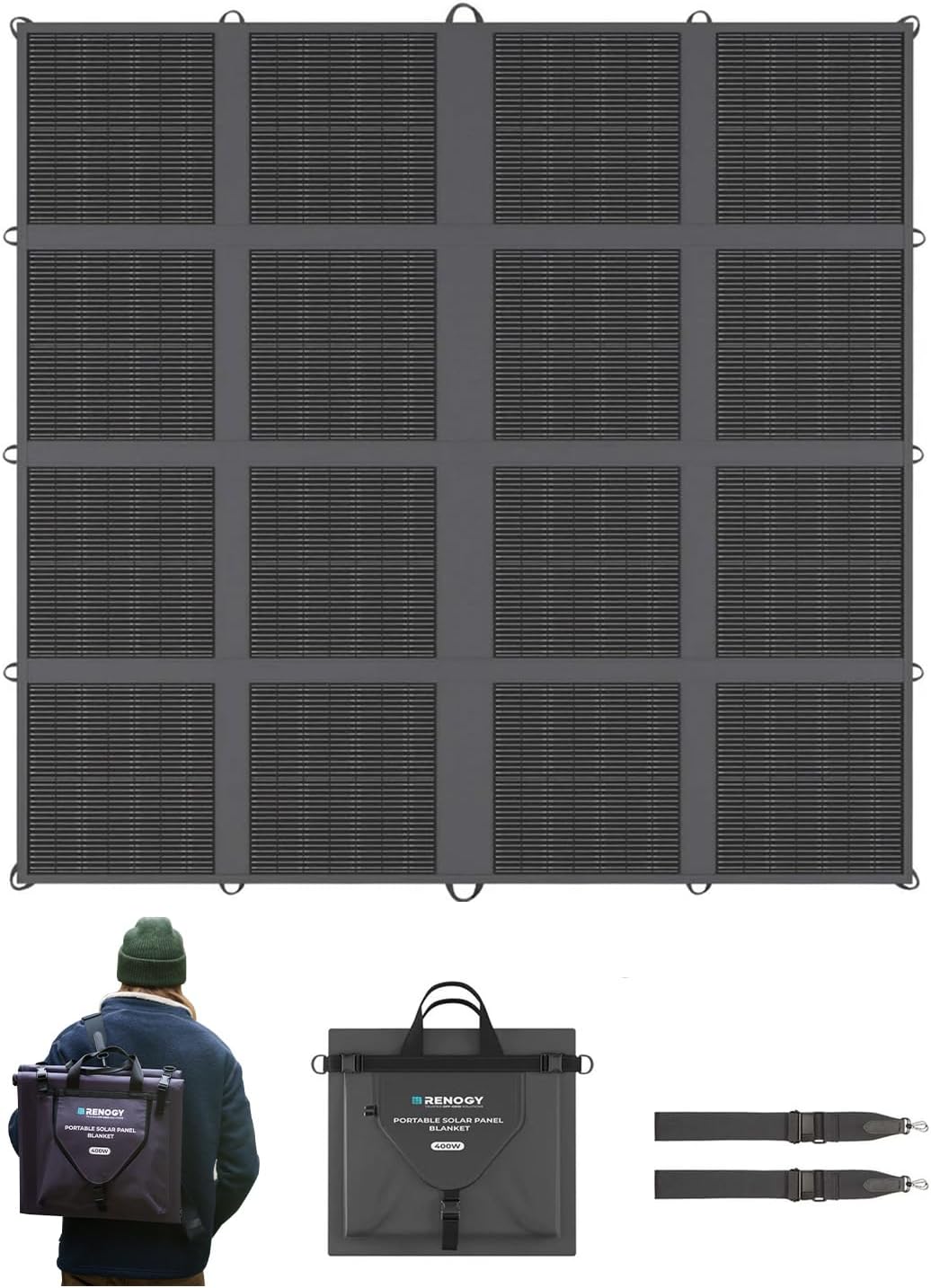
| Renogy 400W Solar Blanket | 400 | 39.2 V | Isc 13.1 A | 16.1 lb | 2 years | Carrying and storage |
| Ecosonique 400W (UC-400) | 400 | Not listed (40 V output, listing) | 10 A (listing) | 20 to 23 lb (listing) | 12 months | Light weight, tight budget |
| ZOUPW 450W (EZ450W) | 450 | 45.9 V (listing) | 12.4 A (listing) | 29.5 lb | 36 months | 2 kWh stations with 40 to 60 V input |
How We Chose
We research and compare; we do not run our own product trials. Electrical figures come from Renogy’s product pages and manual where they exist. Ecosonique and ZOUPW publish little beyond their Amazon listings, so their numbers are marked “listing” and rank lower for that reason. See how we choose for the Yard & Grid Score.
The Picks
1. Renogy 400W Solar Suitcase
- Renogy lists 40 V and 10 A at the optimum point (40 x 10 = 400 W), Voc 47.2 V, Isc 11 A, and asks for a station DC input that goes above 48 V.
- Folds to a 30.2 lb case with a kickstand; connectors are MC4 only, so a 4-in-1 adapter cable is a separate purchase.
- This panel has the clearest published specs of the four.
Best for: a house backup kit that stays in a closet and comes out for outages. Avoid if: you carry it far; 30.2 lb is nearly twice the blanket’s 16.09 lb.
2. Renogy 400W Solar Blanket
- Renogy’s manual lists Voc 39.2 V, Isc 13.1 A, optimum 33.6 V and 11.9 A (33.6 x 11.9 = about 400 W).
- 16.09 lb, folds to about 16.5 x 15.8 x 4.1 in, IP65 splash-proof, 2-year warranty.
- The blanket has a lower Voc but higher current than the suitcase.
Best for: vans, small cars, and anyone lifting it often. Avoid if: your station caps input current near 10 A; Renogy’s manual calls for a station limit above 13.1 A.
3. Ecosonique 400W (UC-400)
- Listing figures: 40 V, 10 A, 23.5% efficiency, 6-fold design, MC4 cable plus an adapter cable. No Voc is listed, and Voc always sits above the operating voltage, so confirm it with the seller.
- 12-month warranty, the shortest here.
- This panel matches the suitcase’s 40 V and 10 A on paper.
Best for: a lower-cost 400 W option you plan to check against your station manual. Avoid if: you want a brand that publishes its own datasheet.
4. ZOUPW 450W (EZ450W)
- Listing figures: Voc 45.9 V, 12.4 A, 29.5 lb, 36-month warranty.
- The listing says it is meant for stations with 40 to 60 V input and not for low-voltage units.
- This panel is the only one here above 400 W.
Best for: a 2 kWh station with a high input limit. Avoid if: your station caps solar at 400 W; the extra 50 W is wasted.
Cost of Ownership
A panel has no fuel or battery to replace. Costs are the adapter cable (MC4 to your station’s solar port), a longer extension cable if the sunny spot is far from the door, and warranty length: 12 months to 3 years across these four.
How to Choose
Three checks. First, station maximum input voltage above panel Voc. Jackery lists 12 to 60 V and 400 W max for the Explorer 1000 v2, and the BLUETTI AC180 manual lists 12 to 60 V, 500 W, 10 A. Second, station input current against the panel’s current. Third, the wattage cap: a 450 W panel into a 400 W input still delivers at most 400 W.
Then the runtime math. Apply a 0.86 derate (PVWatts’ default 14% system losses): 400 W x 0.86 = 344 W. A 1,070 Wh station fills in about 1,070 / 344 = 3.1 h at full sun, before charging losses. At an assumed 4 peak sun hours (your site’s typical-year average differs), 344 W x 4 = 1,376 Wh a day. Cloud, angle, and shade lower both numbers. More on sizing in watts of solar for a power station, choosing a panel, and MPPT explained. Smaller needs: 200 W panels.
FAQ
Will a 400W panel give me 400 watts?
Rarely. The rating is at standard conditions; with the 0.86 derate above, expect about 344 W in good sun, less with heat or shade.
Can I plug any 400W panel into my station?
No. Match connector, voltage window, and current limit from your station’s manual. See solar panels for power stations.
Does it work in rain?
Renogy rates the suitcase IP67 with IP68 connectors and the blanket IP65 splash-proof. Output still drops sharply under clouds, and a manual’s guidance on wet connectors applies.
Changelog: October 2026: first published.









