


Most low-cost battery testers are built for car starting batteries, so the honest pick for a deep cycle bank is the one that admits its limits. The Acclope BT60 PRO covers 2 to 120 Ah and 6V, 12V, and 24V lead-acid, and lists voltage and health checks for LiFePO4. No handheld replaces a timed discharge for true capacity.



Quick Comparison
| Model | Type | Voltages | Range (listing) | Best for |
|---|---|---|---|---|
| Acclope BT60 PRO | Conductance analyzer | 6V, 12V, 24V | 2 to 120 Ah, 100 to 3,000 CCA | Mixed lead-acid banks |
| KONNWEI KW208 | Digital analyzer | 12V | 100 to 2,000 CCA | Cheap 12V screening |
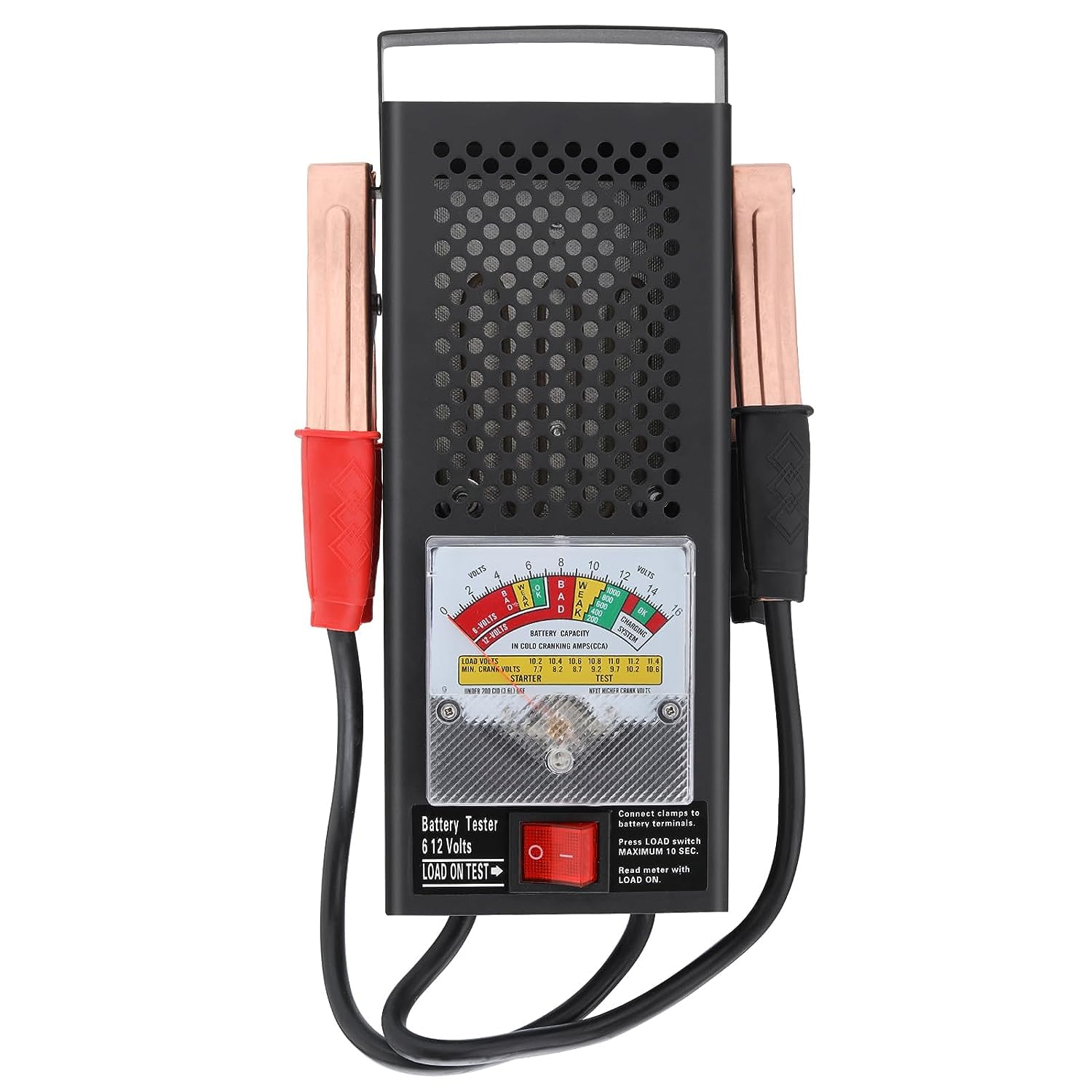
| OTC 3181 | 130 A load tester | 6V, 12V | 130 A load, 0 to 16 V dial | Garage load checks |
| Yaegoo load tester | 100 A load tester | 6V, 12V | Up to 1,000 CCA, 100 A (12V) | Low-cost load check |
| VDIAGTOOL BT500 | Digital analyzer | 6V, 12V, 24V | 5 to 3,000 CCA | Car batteries only |
Why Deep Cycle Is Different
CCA (cold cranking amps) measures a brief, high-current burst for starting an engine. A deep cycle battery is judged by stored amp-hours, so a CCA reading alone can look fine on a bank that cannot run your loads for long. Treat a handheld tester as a screen: it flags a weak battery, and a timed discharge confirms the capacity. Our guide to checking a deep cycle battery with a multimeter covers the do-it-yourself side, and what a deep cycle battery is explains the design.
How We Chose
We compared supported voltages, battery types, amp-hour range, the method (conductance or load), and the Yard & Grid Score built from verified-buyer ratings (see how we choose). We research and compare; we do not use or review the products ourselves, and every figure is per the listing. Accuracy percentages quoted on listings are marketing claims and we do not repeat them.
Acclope BT60 PRO
- Conductance method for flooded, AGM, EFB, and gel at 6V, 12V, and 24V; reads state of health, state of charge, voltage, resistance, and CCA.
- For LiFePO4, the listing says voltage and health checks only, with CCA not guaranteed. It is not for 48V systems.
- 2 to 120 Ah range, LED light, QR cloud report. 4.5 stars on 1,406 ratings.
Best for: lead-acid banks up to 120 Ah. Avoid if: you need a verified lithium capacity reading.
KONNWEI KW208
- 12V only, 100 to 2,000 CCA, for flooded, AGM, and gel; also a starter and alternator check.
- Clips connect to the battery, in or out of a vehicle, per the listing.
- 4.5 stars on 8,198 ratings.
Best for: quick screening of a single 12V battery. Avoid if: you run 6V or 24V banks.
OTC 3181
- A 130 A load tester for 6V and 12V, with a 0 to 16 V dial and zero adjust, per the listing.
- Clamps for top and side posts. Listing says results come in 10 seconds; 1-year warranty.
- A heavy 130 A load suits a starting battery; check the battery maker’s limits before loading a small deep cycle unit.
Best for: a garage with lead-acid starting and marine batteries. Avoid if: you own a small or lithium battery.
Yaegoo Load Tester
- 100 A load for 12V, 50 A for 6V, up to 1,000 CCA, voltage accuracy of 0.2 V, per the listing.
- Perforated case for cooling and rubber-gripped copper clips.
- 4.4 stars on 265 ratings.
Best for: a basic load check at a low cost. Avoid if: you want a readout of health or amp-hours.
VDIAGTOOL BT500
- 6V, 12V, and 24V, 5 to 3,000 CCA, with state of health and charge, per the listing.
- The listing states it is not available for lithium, deep-cycle, or golf cart batteries.
- 4.4 stars on 400 ratings.
Best for: car and truck starting batteries. Avoid if: your bank is deep cycle, which is the reason it ranks last here.
Cost of Ownership
Testers run on the battery under check or on their own cells, so there is no upkeep beyond clean clips. The real cost is a wrong decision, such as replacing a good battery or keeping a weak one. Pair any reading with an age and cycle record; see how long deep cycle batteries last.
How to Choose
- Match chemistry. For lead-acid deep cycle banks, only the Acclope listing names deep-cycle batteries; the others list 6V or 12V batteries generally, and VDIAGTOOL excludes deep-cycle. For LiFePO4, rely on the battery’s own BMS app and voltage checks.
- Match size. Acclope lists 2 to 120 Ah. A 200 Ah bank is above that range.
- Plan a timed discharge. Runtime = amp-hours x usable fraction / load amps. A 100 Ah AGM bank at 50 percent usable under a 25 A load should run 100 x 0.5 / 25 = 2 hours. If a screen says “good” but the bank quits at 1 hour, it has lost about half its capacity.
- Rest the battery. Disconnect loads and chargers, and let it sit before you read it; surface voltage misleads.
Wear eye protection, keep sparks away from lead-acid batteries, and follow the tester manual. Shopping for a replacement? See best deep cycle batteries.
FAQ
Can I use a car battery tester on a deep cycle battery?
Sometimes, for lead-acid, if the listing allows it. Treat the answer as a screen, not a capacity rating.
Is a load tester safe for lithium?
Ask the battery maker. A fixed heavy load can exceed a small battery’s discharge limit.
What is the cheapest reliable check?
A multimeter plus a timed discharge. See the multimeter guide.
Changelog: November 2026: first published.









