


For a house that wants its fridge, furnace blower, and sump pump covered in one outage, the WEN DF480iX is the generator under $1,000 we recommend first: 4,000 running watts and 4,800 starting watts on gasoline clear a typical essentials load of about 2,200 W running and 4,400 W at the worst startup moment, and it adds propane, electric start, and a CO shutoff sensor. If you need 240 V for a well pump circuit, the WEN DF680iX is the only pick here whose listing spells out a 240 V outlet.
All seven generators burn gasoline or propane and produce carbon monoxide. The CPSC advises running them outdoors only, at least 20 ft from the home, far from windows, doors, and vents, with the exhaust pointed away from the home, and never in a garage, basement, shed, porch, or carport. Put battery-backed CO alarms on every level of the home and outside sleeping areas, and follow the owner’s manual and local rules. The CPSC counts about 100 deaths a year in the US from portable generator CO.

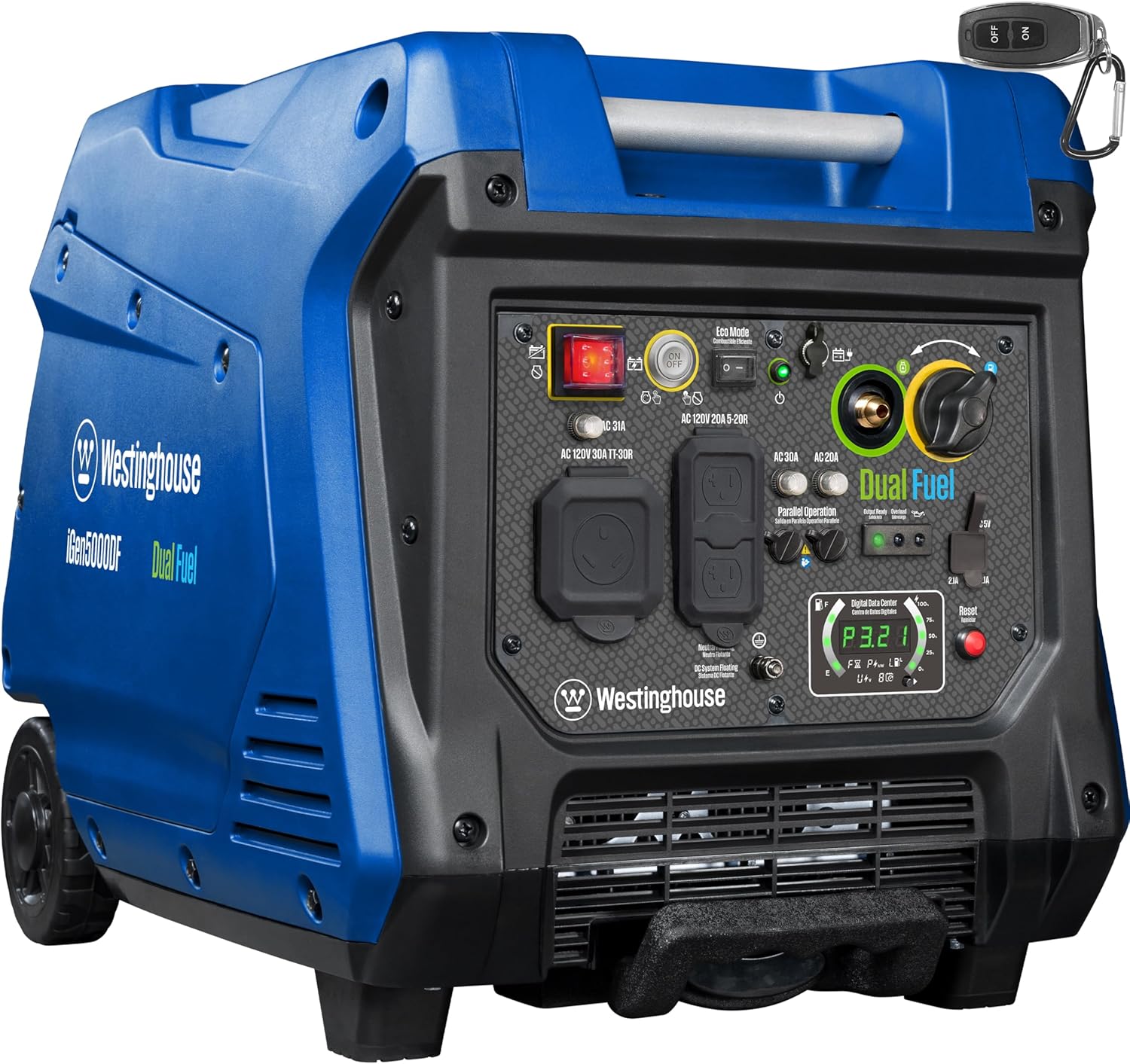


Quick Comparison
| Model | Gas running / starting W | Propane running / starting W | Tank | Weight | 240 V | CO shutoff | Start | Best for |
|---|---|---|---|---|---|---|---|---|
| WEN DF480iX | 4,000 / 4,800 | 3,600 / 4,320 | 1.9 gal | 78.5 lb | No | Yes | Electric and recoil | Fridge, furnace, sump |
| Westinghouse iGen5000DF | 3,900 / 5,000 | 3,500 / 4,500 | 3.4 gal | 104.7 lb | No | No | Remote, electric, recoil | Long overnight runs |
| WEN DF680iX | 5,100 / 6,800 | 4,500 / 6,000 | 2.9 gal | 99.2 lb | Yes | Yes | Electric and recoil | Larger loads, 240 V |
| Westinghouse iGen5000 | 3,900 / 5,000 | None | 3.4 gal | 104.7 lb | No | No | Remote, electric, recoil | Gas-only long runs |
| WEN 56477i | 4,000 / 4,800 | None | 1.9 gal | 72.7 lb | No | Yes | Recoil | Gas-only essentials |
| WEN DF360iX | 2,900 / 3,600 | 2,600 / 3,500 | 1.5 gal | 49 lb | No | Yes | Recoil | Fridge and furnace, no sump |
| GENMAX GM5500iHD | 3,800 / 5,500 | None | Not listed | 56.7 lb | Not stated | Yes | See listing | Quiet battery-only hours |
How We Chose
This tier is about whole-house essentials, not camping, so we kept inverter generators priced under $1,000 at our last check that could reasonably carry a fridge plus at least one motor load. Smaller suitcase units live in our generators under $500 guide. We compared running and starting watts on each fuel, tank size and published runtime, 240 V availability, CO shutoff, start method, weight, and warranty. Specs come from manufacturer pages and listings, retailer spec tables, public buyer reviews, and the Yard & Grid Score built from verified buyer ratings. We research and compare; we do not run our own product trials. Details are on our how we choose page.
We ranked on fit for a typical essentials load first, CO shutoff and warranty second, and buyer ratings third. A model with a high score but a load profile that misses the sump pump case ranks lower.
The Picks
1. WEN DF480iX: the essentials pick with propane and a CO shutoff
- Output: 4,000 running and 4,800 starting watts on gasoline; 3,600 running and 4,320 starting on propane.
- CO Watchdog: WEN’s sensor shuts the engine off when it detects dangerous CO levels.
- Panel: four 120 V household receptacles, a TT-30R RV outlet, 12 V DC, and two USB ports, plus a tool-free propane quick-connector.
- Fuel: 1.9 gal of gasoline, which WEN’s listing puts at up to 7 hours at half load. That is 1.9 gal / 7 h = about 0.27 gal per hour at roughly 2,000 W.
- Warranty: three years.
Best for: a house that needs a fridge, a furnace blower, a 1/2 HP sump pump, and lights through a winter outage.
Avoid if: you need 240 V for a well pump, or you want a full day of runtime without refueling.
2. Westinghouse iGen5000DF: the longest runtime per tank
- Output: Westinghouse rates it at 3,900 running and 5,000 peak watts on gasoline, and 3,500 and 4,500 on propane.
- Runtime: up to 18 hours on gasoline from a 3.4 gal tank and 22 hours on propane, both at 25 percent load; Westinghouse does not state the propane cylinder size behind that figure. On gasoline that is 3.4 gal / 18 h = about 0.19 gal per hour at about 975 W, roughly 4.5 gal over a 24 hour day.
- Noise: listed as low as 52 dBA, a best-case figure at light load.
- Gaps: Westinghouse’s spec table lists no CO sensor for this model; the CO-sensor version is sold separately as the iGen5000DFcv. At 104.7 lb dry, it rolls on wheels but is not a one-person lift into a truck.
- Warranty: 3-year limited residential.
Best for: overnight outages where you want to fill the tank at dusk and not touch it until morning.
Avoid if: you want a built-in CO shutoff, or you need to lift the generator up steps on your own.
3. WEN DF680iX: the listed 240 V pick
- Output: 5,100 running and 6,800 starting watts on gasoline; 4,500 and 6,000 on propane, per WEN’s listing.
- 240 V: an L14-30R 120/240 V receptacle and a voltage selector. WEN also markets the bonded-neutral 240 V output for low-power Level 2 EV charging.
- Starting headroom: 6,800 W covers the essentials load in the sizing example below with 6,800 W minus 4,400 W = 2,400 W to spare.
- Extras: CO Watchdog, electric start with recoil backup, and a 2.9 gal tank. It weighs 99.2 lb.
Best for: homes whose electrician plans a 240 V generator inlet, or loads that include a 240 V well pump circuit.
Avoid if: you will only ever run extension cords, where the 240 V outlet adds weight you will not use.
4. Westinghouse iGen5000: the same runtime, gasoline only
- Output: 3,900 running and 5,000 peak watts on gasoline.
- Runtime: Westinghouse lists about 18 hours at 25 percent load on a 3.4 gal tank, the same figure as the dual-fuel version.
- Panel: a 5-20R duplex, a TT-30R RV outlet, and two USB ports, plus an LED display showing fuel level, output, and remaining runtime.
- Gaps: no propane, and this is not the CO-sensor version, which Westinghouse sells as the iGen5000cv.
Best for: buyers who will only store gasoline and want the remote start and runtime of the iGen5000DF.
Avoid if: gas stations near you tend to lose power in storms, since there is no propane fallback.
5. WEN 56477i: the gas-only version of pick one
- Output: 4,000 running and 4,800 starting watts from a 224 cc engine.
- Safety: CO Watchdog shutdown sensor and fuel shutoff.
- Fuel: 1.9 gal, up to 7 hours at half load per WEN’s listing.
- Trade-off: recoil start only, and no propane, but it is about 6 lb lighter than the DF480iX at 72.7 lb.
Best for: the same fridge, furnace, and sump load as pick one, in a house that keeps only gasoline.
Avoid if: anyone who will start it in winter has trouble with a pull cord.
6. WEN DF360iX: the light dual-fuel option
- Output: 2,900 running and 3,600 starting watts on gasoline; 2,600 and 3,500 on propane.
- Weight: 49 lb, the easiest pick here to carry.
- Limit: the essentials example below needs about 4,400 W at the sump pump’s startup, which is more than its 3,600 W starting rating.
- Extras: CO Watchdog, TT-30R RV outlet, a 1.5 gal tank, and a three-year warranty.
Best for: a fridge, furnace blower, and lights in a house with no sump pump.
Avoid if: you have a 1/2 HP sump pump or well pump that must start while other loads run.
7. GENMAX GM5500iHD: a hybrid with a battery pack
- Output: 3,800 running and 5,500 peak watts. According to the listing, the peak figure relies on a detachable battery that assists the engine during surges.
- Battery: the listing describes a 144 Wh pack that can supply up to 300 W of AC or DC with the engine off. At a 30 W router and lights load, that is 144 Wh x 0.85 inverter efficiency / 30 W = about 4 hours of silent overnight power.
- Safety: CO sensor listed.
- Source caveat: it is a new model without a long service record, and the retail listing is the main spec source we found. The listing does not spell out the outlet panel, though it includes an L14-30P bonding plug, so check the panel photo if 240 V matters to you.
Best for: households that want a few quiet hours for a router and lights without running the engine.
Avoid if: you want a long track record and published runtime figures before you rely on it.
What It Costs to Own One
Fuel dominates. At the iGen5000DF’s quarter-load rate of about 0.19 gal per hour, a three-day outage uses 0.19 x 72 h = about 14 gal of gasoline, before any heavier hours. On propane, budget cylinders the same way: a 20 lb cylinder holds 4.7 gal (PERC), and the manual’s runtime per tank tells you how many to keep on hand. Our guide to generator gas use shows the math for other loads.
- Maintenance: a break-in oil change, then oil at the manual’s interval, and spark plug and air filter checks.
- Fuel storage: Honda says problems from deteriorating gasoline can show up in less than 30 days, and in as little as 15 days in some regions, so add stabilizer or run the fuel shutoff before storage.
- Cords and connection: outdoor-rated cords sized above the load, or a generator inlet and transfer switch or interlock kit put in by a licensed electrician. See interlock kit vs transfer switch for the concepts.
- CO alarms: needed whether or not the generator has a shutoff.
- Warranty: all WEN and Westinghouse picks list three years; the GENMAX listing also says three years.
How to Choose a Generator Under $1,000
Size to the worst startup moment, not the average. Add running watts, divide by 0.8 for headroom, then add the largest single motor’s extra startup draw to the running total and compare that with the starting rating.
Worked example: fridge, furnace, sump, lights
| Load | Running W | Extra at startup | Source |
|---|---|---|---|
| Top-freezer fridge | 250 | 950 | Anker estimate, high end |
| Furnace fan, 1/3 HP | 700 | 1,400 | EWEB chart |
| Sump pump, 1/2 HP | 1,050 | 2,200 | EWEB chart |
| Lights, router, phones | 200 | 0 | Planning assumption |
| Total | 2,200 | Largest: 2,200 |
Running target: 2,200 W / 0.8 = 2,750 W. Starting check: 2,200 W + 2,200 W = 4,400 W. On gasoline, the DF480iX (4,000 / 4,800), both Westinghouse units (3,900 / 5,000), the DF680iX, the 56477i, and the GENMAX pass both checks. On propane, the DF480iX’s 4,320 W starting rating falls 80 W short, so start the sump pump before the fridge cycles or switch to gasoline in sump season. The DF360iX fails the starting check on either fuel. Our generator sizing guide has a blank worksheet.
Do I need 240 V?
Only if a load you must run is 240 V, such as many deep well pumps, or your electrician plans a 240 V inlet. That connection is a licensed electrician’s job; never backfeed through a dryer or wall outlet, which the CPSC warns can electrocute line workers.
FAQ
Can a generator under $1,000 run central air?
Usually not alongside other essentials. Central air compressors are typically 240 V with a large startup draw, and only the DF680iX here lists a 240 V outlet. Check the condenser’s nameplate and ask a licensed electrician before planning on it.
Do these run on natural gas?
No. The dual-fuel picks run on gasoline or propane only. Our dual fuel generators explainer covers how output changes by fuel.
Where should the generator sit during a storm?
Outdoors, at least 20 ft from the home and far from windows, doors, and vents, with the exhaust aimed away from the home, per the CPSC. Never on a porch or in a carport or garage.
Changelog: November 2026: first published.









