


Pick the EcoFlow DELTA 3 Plus if you want 300 W more continuous output, 1,000 W of solar input, and the option to add batteries up to 5 kWh; pick the Jackery Explorer 1000 v2 if you want the lighter box with slightly more capacity, 1,070 Wh against 1,024 Wh, and you will never need to expand it.

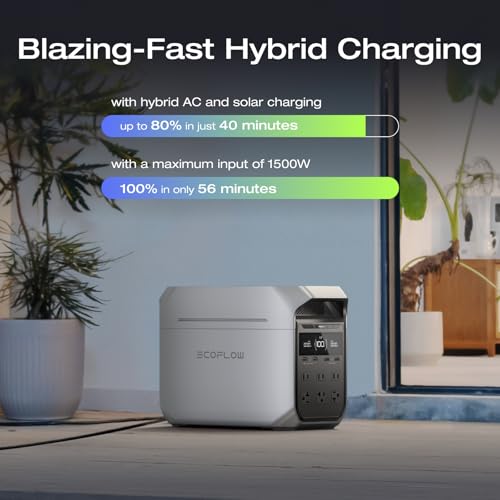
EF ECOFLOW Solar Generator DELTA 3 Plus with 220W


As an Amazon Associate we earn from qualifying purchases. Product prices and availability are accurate as of the date/time indicated.
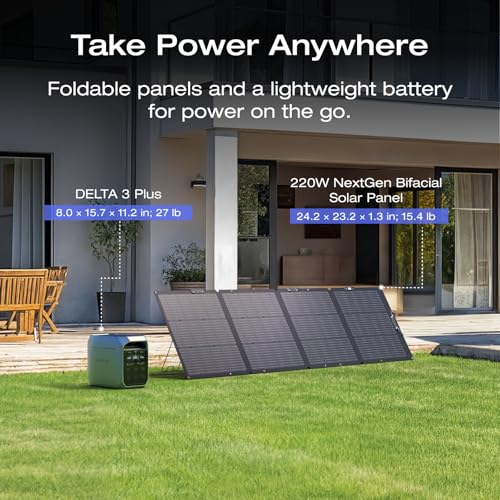
The DELTA 3 Plus card above is EcoFlow’s solar generator bundle: the station plus one 220W bifacial portable panel, which the listing says ship separately. One panel uses less than half of one 500 W solar input, and even at its full 220 W rating it would need 1,024 / 220 = about 4.7 hours of ideal sun to refill an empty battery, before charging losses and real-world output.

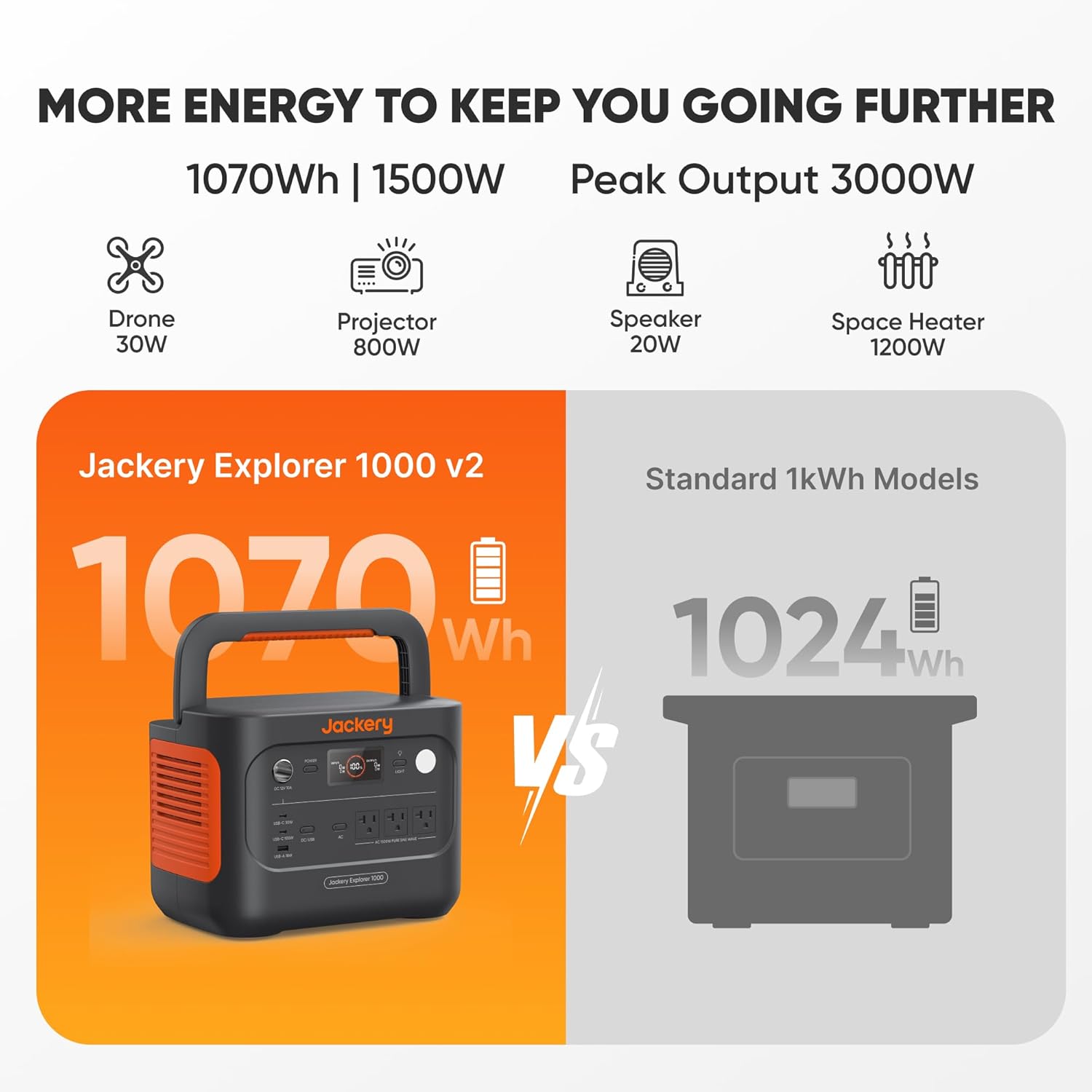
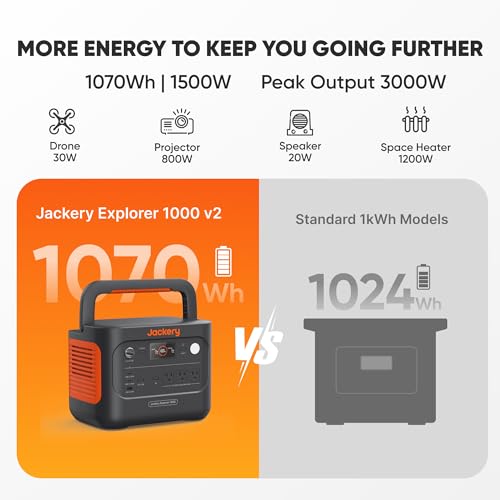
Jackery Explorer 1000 v2 Portable Power




As an Amazon Associate we earn from qualifying purchases. Product prices and availability are accurate as of the date/time indicated.
Specs Side by Side
Figures come from each maker’s product page or manual unless noted. The two stations sit in the same 1 kWh class, so the differences that matter are output, charging, expansion, and switchover time.
| Spec | EcoFlow DELTA 3 Plus | Jackery Explorer 1000 v2 |
|---|---|---|
| Capacity | 1,024 Wh, LFP | 1,070 Wh, LFP |
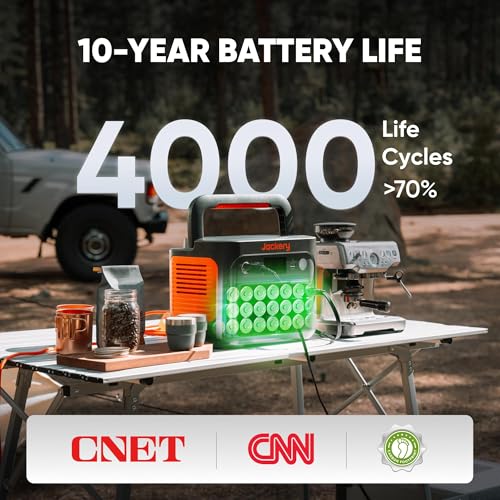
| Cycle rating | 4,000 cycles to 80% | 4,000 cycles to 70% |
| AC output, continuous / surge | 1,800 W / 3,600 W | 1,500 W / 3,000 W |
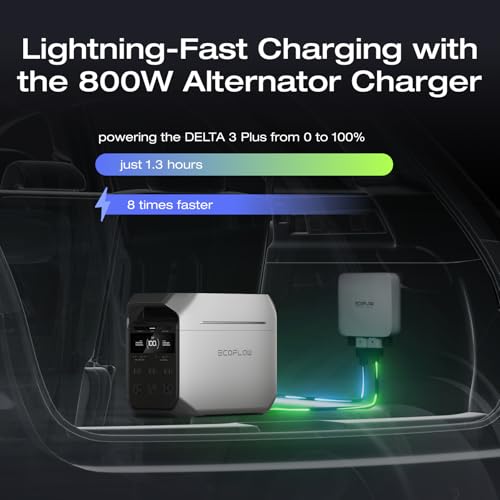
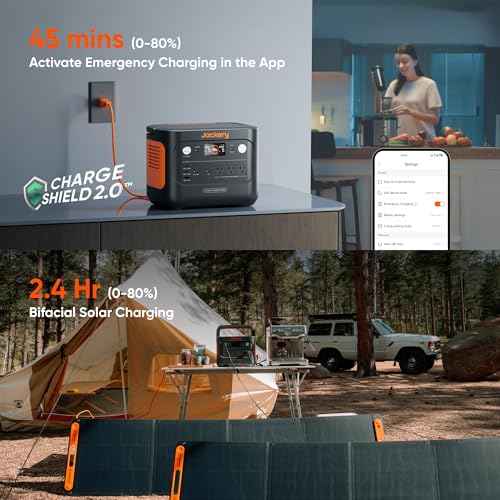
| AC charging | 1,500 W input, full in 56 min | 1.58 h default, 1 h with emergency mode in the app |
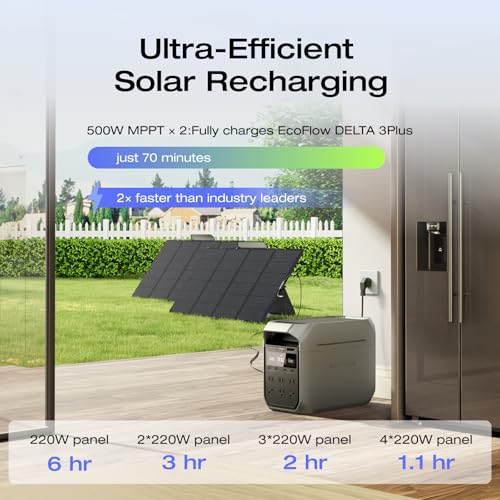
| Solar input | 2 inputs, 11 to 60 V, 500 W each, 1,000 W total | 2 DC8mm inputs, 12 to 60 V, 400 W total |
| UPS switchover | under 10 ms (product page), 10 ms (manual) | 20 ms or less (Jackery AU page) |
| Expansion | Up to 5 kWh with an extra battery | None listed |
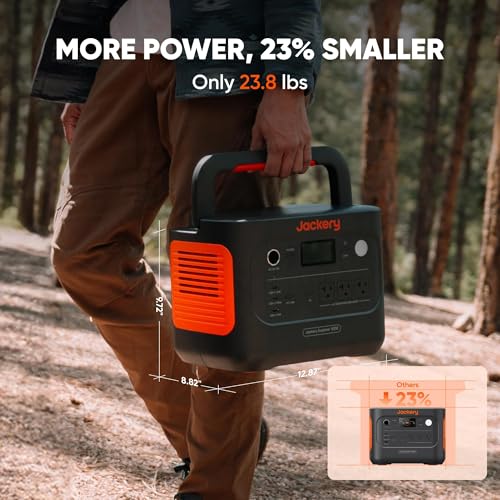
| Weight | 27.6 lb | 23.8 lb |
| Size | 15.7 x 8.0 x 11.2 in (398 x 202 x 283.6 mm) | 12.87 x 8.82 x 9.72 in |
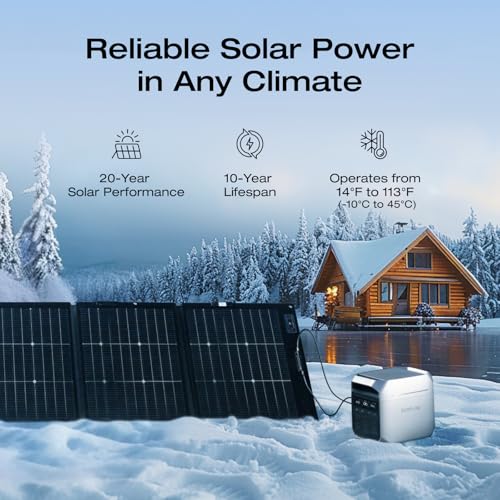
| Operating range | Charge 32 to 113°F, discharge 14 to 113°F | Charge 32 to 113°F, discharge 14 to 113°F |
| Warranty | 5 years | 3 years plus 2 when bought on jackery.com |
Rated capacity is not what reaches the outlet. Using 0.85 as a common planning figure for inverter loss, the DELTA 3 Plus delivers about 1,024 x 0.85 = 870 Wh and the Jackery about 1,070 x 0.85 = 910 Wh. That 40 Wh gap is about 35 minutes of a 68 W average fridge load, too small to decide the purchase on its own.
The Four Differences That Matter
1. Continuous output: 1,800 W vs 1,500 W
The 300 W gap decides what runs on the edge of the rating. A 1,100 W microwave such as Panasonic’s NN-SU656WAWH draws 1,500 W from the outlet by Panasonic’s own figure, which puts the Jackery at 1,500 / 1,500 = 100 percent of its continuous rating and leaves the DELTA 3 Plus 300 W for a router and lights. The same applies to a 1,500 W space heater, which would also drain either battery in about 870 / 1,500 = 0.6 hours, roughly 35 minutes.
Surge matters for motors. A fridge compressor start fits under either surge rating in most cases, but the DELTA 3 Plus has 3,600 W of headroom against 3,000 W on the Jackery. More in running watts vs starting watts.
2. Solar charging: 1,000 W vs 400 W
Hours of full sun to refill = rated Wh / (maximum solar watts x 0.75), where 0.75 is a planning derate for heat, panel angle, and wiring loss. The DELTA 3 Plus needs 1,024 / (1,000 x 0.75) = about 1.4 hours; the Jackery needs 1,070 / (400 x 0.75) = about 3.6 hours.
On a clear day with 5 peak sun hours, the Jackery’s ceiling is 400 x 5 x 0.75 = about 1,500 Wh, enough to refill once. The DELTA 3 Plus could harvest about 3,750 Wh, which only matters if you add an extra battery to hold it. Reaching 1,000 W on the EcoFlow means two separate arrays of up to 500 W, one per input, and EcoFlow’s manual asks that total short-circuit current stay within 15 A. Jackery’s inputs accept 12 to 60 V, at 8 A below 16 V and 10.5 A from 16 to 60 V. Panel sizing is covered in how many watts of solar to charge a power station.
3. Expansion: up to 5 kWh vs none
Start with the load. A fridge with a 600 kWh per year EnergyGuide label uses 600,000 / 365 = about 1,640 Wh a day, or about 68 W on average. Either base unit runs it for about half a day: 870 / 68 = about 12.8 hours on the DELTA 3 Plus, 910 / 68 = about 13.4 hours on the Jackery.
EcoFlow lists expansion up to 5 kWh with a DELTA 3 Extra Battery or other compatible DELTA packs. At that size, 5,000 x 0.85 / 1,640 = about 2.6 days for the same fridge. Jackery lists no expansion pack for the Explorer 1000 v2, so its ceiling stays at 1,070 Wh. For multi-day plans, compare larger units in the best portable power stations for home backup.
4. UPS switchover: under 10 ms vs 20 ms or less
Both can sit between the wall and a device and take over when the grid drops. EcoFlow quotes under 10 ms on the product page and 10 ms in the manual; StorageReview measured just over 8 ms. Jackery’s AU product page quotes 20 ms or less. A router or a laptop does not care; a desktop PC or network storage box rides through only a brief gap, so the shorter figure gives more margin. The feature is explained in what UPS mode on a power station means. Jackery’s support page says its stations are not recommended for medical devices or life-support equipment.
Which One to Choose
Choose the EcoFlow DELTA 3 Plus if
- You want to run 1,500 W kitchen appliances with room left for other loads.
- You plan a solar setup above 400 W or want to add a battery later.
- A desktop computer or network storage sits on the UPS outlet.
Best for: an outage plan that may grow from a fridge for half a day to two or more days with an extra battery.
Avoid if: you carry the station up stairs often and the extra 3.8 lb and bigger footprint matter.
Choose the Jackery Explorer 1000 v2 if
- Your loads at any one time stay under about 1,500 x 0.8 = 1,200 W, keeping 20 percent of the rating as headroom: fridge, router, lights, phones.
- You want the smaller box: about 12.87 x 8.82 x 9.72 = 1,100 cubic inches against about 15.7 x 8.0 x 11.2 = 1,410 for the DELTA 3 Plus.
- One 200 W to 400 W solar setup covers your charging plans.
Best for: overnight outages and camping, where 1,070 Wh and a 23.8 lb carry weight fit the job.
Avoid if: you expect to need more than about 13 hours of fridge runtime, or you run a 1,500 W heater or microwave regularly.
FAQ
Is the DELTA 3 Plus the same as the DELTA 3?
No. EcoFlow sells them as separate models with the same 1,024 Wh capacity. The DELTA 3 Plus has two 500 W solar inputs, 1,000 W total, while the DELTA 3 listing we reviewed shows 500 W of solar input. Check the exact model name before you compare prices.
Which charges faster from a wall outlet?
The DELTA 3 Plus, at 56 minutes by EcoFlow’s figure. The Jackery defaults to 1.58 hours to protect the battery and reaches 1 hour only with emergency charging turned on in the app.
Which battery lasts longer?
Both are rated for 4,000 cycles, but to different floors. After 4,000 cycles the DELTA 3 Plus would hold 1,024 x 0.80 = about 820 Wh and the Jackery 1,070 x 0.70 = about 750 Wh, based on each maker’s rating. At one full cycle a week, 4,000 cycles is about 77 years, so calendar age will matter first. See LiFePO4 vs NMC batteries for why both use LFP.
How does the Anker SOLIX C1000 Gen 2 compare?
It matches the DELTA 3 Plus at 1,024 Wh and has the highest continuous output of the three, 2,000 W. The details are in Anker SOLIX C1000 Gen 2 vs Jackery Explorer 1000 v2.
Changelog: November 2026: first published.









