


The Midland ER310 is the emergency radio we would put in a home kit first: it charges from a hand crank, a solar panel, or USB, it scans all seven NOAA weather channels and sounds an alert, and it takes six ordinary AA cells as a backup, the largest disposable reserve on this list, for the day its own battery is flat and the sky is gray. If keeping phones alive matters more than anything else, the Mesqool CR1030 is listed with a 12,000 mAh battery: 12,000 / 2,000 = 6 times the bank in the pocket-size FosPower A1.
This guide covers portable, multi-power radios: the kind you grab, crank, and carry from room to room or out to the car. If you want a radio that sits on the nightstand and wakes you only for a warning in your county, that is a different device with SAME programming, and we cover it in our guide to the best NOAA weather radios.

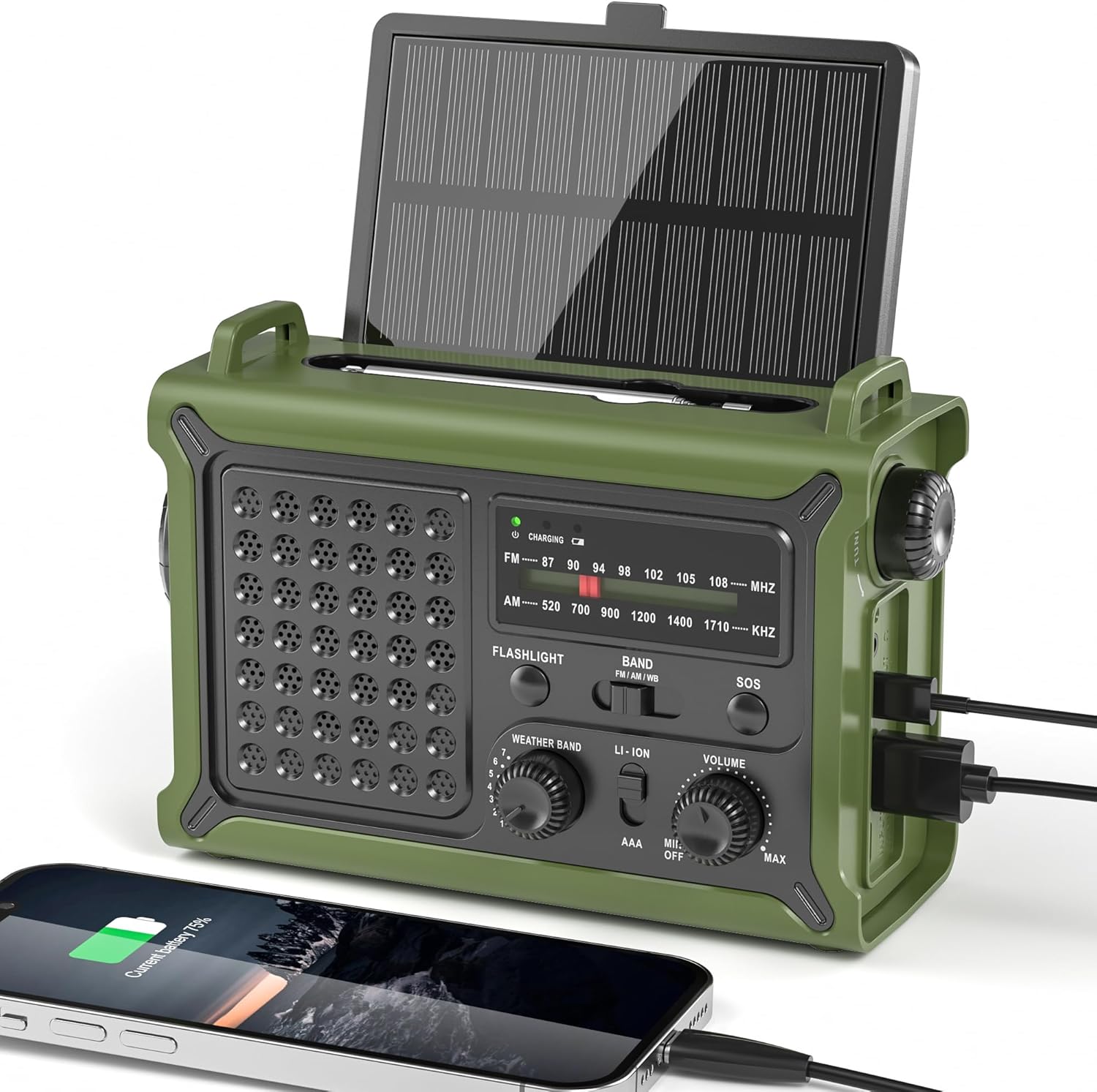


Quick Comparison
The table lists what each radio can draw power from and what it gives back. Battery figures are the maker or listing rating; usable phone charge is lower, as the math further down shows.
| Model | Built-in battery | Ways to recharge | Disposable backup | Bands | NOAA alert alarm | Best for |
|---|---|---|---|---|---|---|
| Midland ER310 | Li-ion, 2,600 or 3,500 mAh (Midland pages differ) | Crank, solar, USB | 6 AA | AM, FM, 7 NOAA channels | Yes, no SAME | A home kit that has to work after a week of clouds |
| Mesqool CR1030 | 12,000 mAh (listing) | Crank, solar, USB-C | 3 AAA (listing) | AM, FM, NOAA | Not listed | Keeping two or more phones charged |
| Eoxsmile NOAA Weather Radio (hand crank, shortwave) | 5,000 mAh (listing) | Crank, solar, USB | 3 AAA | AM, FM, shortwave, 7 NOAA channels | Yes, 9-second alarm (listing) | Long listening sessions and distant stations |
| RunningSnail Emergency Crank Radio (MD-090 upgrade) | 4,000 mAh / 14,800 mWh (listing) | Crank, solar, USB | None listed | AM, FM, NOAA | Not listed | A bedroom radio with a motion-sensor night light |
| FosPower A1 | 2,000 mAh / 7,400 mWh (listing) | Crank, solar, USB | 3 AAA (manual) | AM, FM, NOAA | Not listed | A go bag or car glove box |
How We Chose
We ranked radios on four questions, in this order. First, can the radio still play after several days with no grid power and weak sun? Second, does it receive the NOAA weather band, the seven VHF channels from 162.400 to 162.550 MHz that the National Weather Service uses for its 24-hour broadcasts? Third, how much phone charge can it hand back? Fourth, how well is the model documented by its maker?
We read Midland’s product page and user guide, the published specifications and manuals for the other models where they exist, the Amazon listing details for each, and patterns in public owner reviews, then weighed the Yard & Grid Score, which is built from verified buyer ratings. We research and compare; we do not run product trials of our own. Our How We Choose page explains the method and the score.
One caution applies to the whole category. Some listings describe their radios as certified or approved by the National Weather Service, but the Weather Service states that it does not endorse any make or model of receiver. Treat that wording as marketing. None of the crank radios here carries SAME county coding, which is the reason a home also needs a desktop alert radio.
1. Midland ER310
- Three rechargeable routes (hand crank, solar panel, USB) plus a compartment for 6 AA alkaline cells, sold separately. That fourth route is what keeps it on our first line: stored AA cells do not care about cloud cover or a tired arm.
- NOAA Weather Scan steps through the seven weather channels and locks onto the strongest one, and the radio sounds an alert when your local transmitter sends one. Midland notes that alerts are not customizable, so it reacts to every alert on that channel, including the routine weekly signal.
- Midland’s current product page lists a 3,500 mAh lithium-ion battery and up to 45 hours of normal use; its user guide and FAQ give 2,600 mAh. Plan around the lower figure until your unit’s label confirms which version you have.
- Extras that matter in a dark house: a Cree LED flashlight with low and high settings, an SOS Morse code beacon, a USB output for a phone, and an ultrasonic dog whistle meant for search and rescue teams.
- At about 8.0 x 3.4 x 2.4 in, it is the longest radio on this list, which is the trade for the AA bay.
Best for: a household kit that may sit through a multi-day winter outage with short, cloudy days and no other way to recharge.
Avoid if: you want a radio that alerts only for your county overnight, since it has no SAME filtering, or you need it to fit a small go bag.
2. Mesqool CR1030
- The listing rates the battery at 12,000 mAh, the largest here, and stresses that the figure is real capacity; we treat it as the seller’s rating, since we found no independent spec sheet.
- Its solar panel is listed at 8,500 square millimeters, about 13 sq in. That is larger than most crank radios carry, but the math below shows it is still a trickle charger.
- Two lights: a flashlight the listing rates at up to 260 ft of throw, and a frosted fold-up reading lamp, each with two brightness levels.
- The listing describes a 3-year replacement or refund policy for quality problems, longer than the 1-year terms on most generic crank radios.
- The listing’s power-source line includes 3 AAA cells as a fifth option, though it does not say more about the bay. It weighs about 1.6 lb per the listing. The same CR1030 model number appears under a second brand name on Amazon, so we list it once.
Best for: a family that relies on phones for outage maps and check-ins and wants close to two phone charges stored in the radio.
Avoid if: you prefer a brand with a published manual and spec sheet, since every figure here comes from the seller’s listing.
3. Eoxsmile NOAA Weather Radio (hand crank, shortwave)
- The only pick with a shortwave band (listed at 7 to 19 MHz) on top of AM, FM, and the NOAA band, plus a 3.5 mm headphone jack for listening without waking anyone.
- When the weather band carries an alert, the listing says the radio sounds a 9-second alarm and flashes a red light. That is useful, but it is not SAME, so it reacts to the whole transmitter area.
- A 5,000 mAh battery with a listed 13 hours of FM play on a full charge, and a bay for 3 AAA cells as a fallback.
- A 3 W side flashlight and a 2.5 W, 6-LED reading lamp under the solar panel, plus a 116 dB SOS alarm, per the listing.
- Its listing shows more than 12,000 buyer ratings, a large base of owner reviews to read before buying.
Best for: someone who will listen for hours each day of a long outage and wants news from stations beyond the local AM and FM dial.
Avoid if: you need a maker manual and a named warranty provider, since the seller handles support directly through Amazon.
4. RunningSnail Emergency Crank Radio (MD-090 upgrade)
- RunningSnail describes this as the upgraded version of its MD-090, with a 4,000 mAh (14,800 mWh) battery that can charge a phone.
- A motion-sensor reading lamp acts as an automatic night light, which is handy on a bedroom dresser or a hallway shelf during an outage.
- Four ways to power it, per the listing: USB, solar, crank, and the built-in battery. The listing names both a micro USB input and a USB-C cable, so check the port on arrival and store the matching cable with it.
- The listing rates the speaker at 1 W, the smallest output here, so it suits a bedroom more than a busy kitchen.
Best for: a second radio for a bedroom or a grandparent’s room, where a self-triggering night light helps with trips down the hall.
Avoid if: you need a loud speaker for a full room.
5. FosPower A1
- A 7,400 mWh (2,000 mAh) bank in a radio about 6.2 in long and 310 g (about 11 oz), small enough for a car glove box.
- The manual lists 3 AAA cells as a backup to the lithium-ion battery (the Amazon listing says 4; go by the bay), so the radio still plays if the crank and sun are not an option.
- A 4-LED reading light and a 1 W flashlight, plus an SOS alarm.
- FosPower lists a limited lifetime warranty, the longest stated term on this list.
Best for: a go bag, a car kit, or a second radio for a teenager’s room.
Avoid if: you expect to charge a phone more than once from the radio, because the small bank covers less than one full charge for most phones.
What the Crank and the Solar Panel Really Deliver
Treat the built-in battery as the real fuel tank, and the crank and panel as ways to keep the radio playing. The numbers explain why.
Battery to phone. Battery banks are rated at the cell voltage, so convert to watt-hours (Wh), the size of the tank: mAh x 3.7 V / 1,000. FosPower’s own figure shows the convention: 2,000 mAh x 3.7 V = 7,400 mWh, or 7.4 Wh. Some of that is lost stepping up to the 5 V USB output and in the cable; we assume about 60 percent reaches the phone, a conservative planning estimate rather than a measured figure. So:
- FosPower A1: 7.4 Wh x 0.6 = about 4.4 Wh to the phone.
- RunningSnail (MD-090 upgrade): 14.8 Wh x 0.6 = about 8.9 Wh.
- Eoxsmile: 5,000 mAh x 3.7 V / 1,000 = 18.5 Wh x 0.6 = about 11 Wh.
- Mesqool CR1030: 12,000 mAh x 3.7 V / 1,000 = 44.4 Wh x 0.6 = about 27 Wh.
Divide by your phone’s battery size in Wh, which is printed in the phone maker’s specifications. For a phone with a 15 Wh battery, the Mesqool gives back 27 / 15 = about 1.8 full charges, and the FosPower 4.4 / 15 = about a third of one.
Solar panel to battery. Panel ratings assume full sun of about 1,000 W per square meter. The Mesqool’s 8,500 sq mm panel is 0.0085 square meters. Assuming 20 percent cell efficiency, our planning estimate for monocrystalline cells (the listing gives no wattage): 0.0085 x 1,000 W x 0.20 = about 1.7 W at best. Over a good day of 5 peak sun hours with a 0.75 derate for angle and heat, that is 1.7 W x 5 h x 0.75 = about 6.4 Wh. Filling the 44 Wh battery from empty would take 44 / 6.4 = about 7 sunny days, and longer once charging losses are counted. This is a rough estimate; on a gray winter day, plan on far less.
That is enough to keep a radio playing for a news hour each day, because receiving uses little power: the Eoxsmile’s listed 13 hours of FM on 18.5 Wh works out to 18.5 / 13 = about 1.4 W. It is not enough to recharge phones from the windowsill. Crank power follows the same pattern; owner reviews regularly describe cranking as a way to get a few minutes of radio or light, not to fill a phone.
Cost of Ownership
After the purchase, three things matter:
- Backup cells. Buy the disposable cells your radio takes and store them beside it, outside the battery bay, so a slow leak does not corrode the contacts: 6 AA for the Midland ER310, 3 AAA for the Eoxsmile, FosPower, and (per its listing) the Mesqool.
- The built-in battery. Lithium-ion packs slowly lose capacity with age even when stored. Charge the radio fully when you change the clocks in spring and fall, and play it for a few minutes to confirm it works. The crank and panel give you a way to run the radio after the pack has aged.
- Warranty. Terms vary widely: Midland lists a 1-year limited warranty on its Amazon listing, FosPower a limited lifetime warranty, the Mesqool listing a 3-year replacement policy, and RunningSnail 1 year.
How to Choose an Emergency Radio
Answer these in order, and the list narrows quickly.
How long could your outage last?
Count listening hours, not days. Two hours of news a day for a five-day ice storm is 2 h x 5 days = 10 hours of play. The Eoxsmile’s listed 13 hours covers that on one charge. For a longer plan, pick a radio with a disposable-cell backup so the count never runs to zero.
Is the radio your phone charger too?
If yes, run the phone math above for each phone in the house. Two phones at 15 Wh each need 30 Wh delivered, more than any radio here hands back on one charge; the Mesqool comes closest at about 27 Wh. If you already own a small power station, the radio’s bank matters less; our list of portable power stations under $500 covers that route.
Do you also need overnight warnings?
A crank radio is off most of the time, so it will not wake you for a tornado warning at 3 a.m. Ready.gov’s basic kit lists both a battery or hand-crank radio and a NOAA Weather Radio with tone alert, and we agree with that pairing. Our explainer on what a NOAA weather radio does covers SAME codes and the alert tone.
FAQ
Will a hand crank radio pick up NOAA weather broadcasts where I live?
Usually, if you are inside a transmitter’s coverage. The Weather Service runs more than 1,000 transmitters, and local Weather Service offices describe reception as usually within about 40 miles of the antenna, sometimes more, depending on terrain. Tune each of the seven weather channels at home before an emergency and note which one comes in clearly.
Can an emergency radio replace a weather alert radio?
Not for overnight warnings. Some crank radios sound an alarm when the weather band carries an alert, but none on this list filters by county with SAME, and they must be left on and charged to listen. A plug-in SAME radio with battery backup handles standby duty.
How long does it take to charge a phone by cranking?
Longer than most people expect. FosPower’s manual says one minute of cranking gives about 15 minutes of radio or 20 minutes of light, and other makers describe a few minutes of cranking as enough to wake a radio or a phone, not to fill it. Charge the internal battery from the wall before a storm and save the crank for topping up.
Printable Checklist
- Charge the radio fully from the wall when it arrives.
- Find the clearest NOAA weather channel at home and write it on the radio.
- Store the matching disposable cells and the charging cable beside it.
- Run the phone math for every phone in the house.
- Recharge and play it for a few minutes each spring and fall.
- Pair it with a plug-in SAME alert radio for overnight warnings.
For where the radio fits in the rest of your supplies, see our home emergency kit checklist and the order of tasks in the first 24 hours of a power outage.
Changelog: October 2026: first published.









