


If your bedrooms are on the second floor, the Kidde KL-2S (13 feet) is the best-documented ladder here; if anyone sleeps on a third floor, the Kidde KL-3S (25 feet) is the one that reaches. A ladder is the backup route, not the plan: NFPA tells families to find two ways out of every room, and warns that a fire can leave as little as one or two minutes to escape once the smoke alarm sounds.
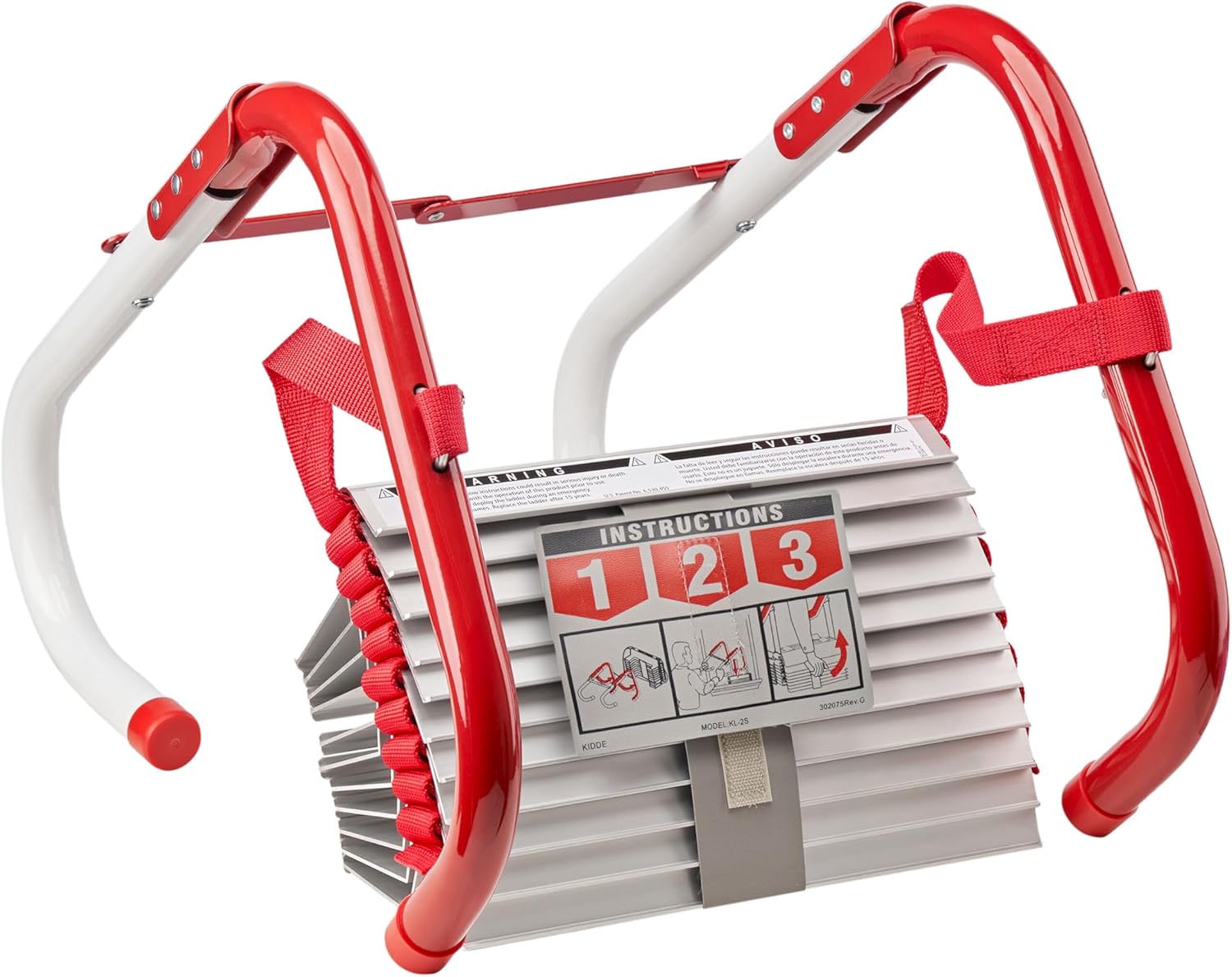


Quick Comparison
| Model | Length | Rated load | Window sill | Maker warranty | Best for |
|---|---|---|---|---|---|
| Kidde KL-2S, 2-story | 13 ft | 1,000 lb | 5.5 to 11 in deep, 16 in wide minimum | 5 years, limited | Second-floor bedrooms |
| Kidde KL-3S, 3-story | 25 ft | 1,000 lb; 750 lb on one rung (listing) | 5.5 to 11 in deep, 16 in wide minimum | 5 years, limited | Third-floor bedrooms |
| First Alert EL52-2, 2-story | 14 ft | 375 lb | 6 to 10 in | 1 year, limited (maker page) | Steel-rung ladder, ASTM-listed by the maker |
| Hausse 2-story, retractable | 13 ft | 1,000 lb (listing) | Not published | Not published | Aluminum, compact bag |
How We Chose
We compared maker pages, NFPA escape-planning guidance, the Yard & Grid Score from verified buyer ratings, and public owner reviews. We research and compare; we do not run product trials, and we do not climb ladders for you. We ranked on documented load, a stated window fit, a maker warranty, and clear one-use rules. One Kidde ladder per height is listed because the 2-story and 3-story models serve different homes. The How We Choose page explains the score.
1. Kidde KL-2S Two-Story Fire Escape Ladder
- Kidde’s page gives 13 feet and a 12.25 inch width. It hooks over sills 5.5 to 11 inches deep and at least 16 inches wide.
- Kidde’s page says it supports up to 1,000 pounds. No product standard is named on the page.
- Kidde says its ladders are for one-time use only: discard after use. Replacement is part of the cost.
Best for: Second-floor bedrooms with standard sills. Avoid if: Your window frame is deeper than 11 inches or narrower than 16.
2. Kidde KL-3S Three-Story Fire Escape Ladder
- Kidde’s page gives 25 feet and a 1,000 pound load rating; the listing adds 750 pounds on one rung and a 12 pound weight. The one-time-use rule applies.
- The Amazon listing for this ASIN carries copy-paste errors (a “KL-2S” item name, a 16-ounce load capacity). Go by Kidde’s pages, not those fields.
- Extra length does not help a two-story house; a ladder that is too long is just heavier to store.
Best for: A third-floor bedroom or attic suite. Avoid if: Your highest sleeping floor is the second.
3. First Alert EL52-2 Two-Story Escape Ladder
- First Alert’s page gives 14 feet, 12.8 pounds, steel construction, sills 6 to 10 inches wide, and says it meets ASTM standards.
- The rated load is 375 pounds, well below the Kidde and Hausse figures. The listing’s 1,125 pound line conflicts with the maker; go by 375.
- The maker page shows a one-year limited warranty, while the listing says six years; go by the maker.
Best for: A buyer who wants a stated ASTM claim and a sill of 6 to 10 inches. Avoid if: A heavier climber, or a climber carrying a child, could approach 375 pounds.
4. Hausse 2-Story Retractable Fire Escape Ladder
- The listing says 13 feet, aluminum, 9.6 pounds, 1,000 pounds, and a red bag for under-bed storage. There is no maker page in our research, so every figure is the listing’s.
- The listing asks you to extend the retractable hooks fully and to replace the ladder every three years.
- Sill size, warranty, and any standard are not published.
Best for: A lighter, compact option when you can confirm fit yourself. Avoid if: You want documented sill limits or a warranty.
Cost of Ownership
Budget one ladder for each upstairs bedroom whose second way out is a window: NFPA says every family member must be able to escape from second-floor rooms and advises storing the ladder near its window. Kidde ladders are single use, so any ladder you deploy gets replaced. The Hausse listing suggests replacing every three years. Check the label or manual for your model’s guidance.
How to Choose and Plan
- Length: Measure from the sill to the ground. A sill 11 feet up needs a ladder of at least 11 feet; a 13 foot ladder leaves 13 minus 11 = 2 feet of margin. A sill above the ladder’s length rules it out.
- Load: Add climber plus anything carried. A 190 pound adult carrying a 50 pound child is 190 + 50 = 240 pounds, inside 375 with 375 minus 240 = 135 pounds to spare.
- Window fit: Measure sill depth and opening width, then compare to the maker’s range. Windows that do not open fully or have bars do not work.
- Practice: Kidde designs its ladders for one use, so rehearse the steps (opening the window, pulling the ladder out, locating the hooks) without climbing down from an upper floor. NFPA advises practicing setting up the ladder from a first-floor window, and says children should practice only with an adult and only from a first-story window. With a one-use ladder, that means a spare for practice.
- Everything else: Working alarms come first; see our smoke and CO detectors, the extinguishers, and the emergency kit checklist. For kitchen fires, see fire blankets.
FAQ
Where should I store a fire escape ladder?
Near the window it is for, such as under the bed, where everyone in that room can reach it. A ladder in a garage is no help at night.
Should I use the ladder before the stairs?
No. Use the door and stairs when they are clear; the ladder is the second way out. Make sure windows can open and are not blocked, as NFPA advises.
Can children or older adults use these?
Many cannot climb a rope-style ladder unaided, and the makers do not describe a rescue method. Plan the primary route first and ask your local fire department about your household.
Changelog: November 2026: first published.









