


For most homes, the Temp Stick is the best freezer alarm because it measures temperature itself and sends a phone alert when the freezer drifts above your limit, which is the number that decides whether food is safe. Pair any monitor with a plan: CDC says a freezer should be at 0°F or below, and CDC says a full freezer holds its temperature about 48 hours with the door shut, so an alert at 2 a.m. still leaves you a day or more to act.



Quick Comparison
| Model | What it measures | Alert reaches you by | Needs Wi-Fi | Best for |
|---|---|---|---|---|
| Temp Stick | Temperature and humidity | Text, email, app (listing: no subscription) | Yes, 2.4 GHz only | Away from home, garage or basement freezer |
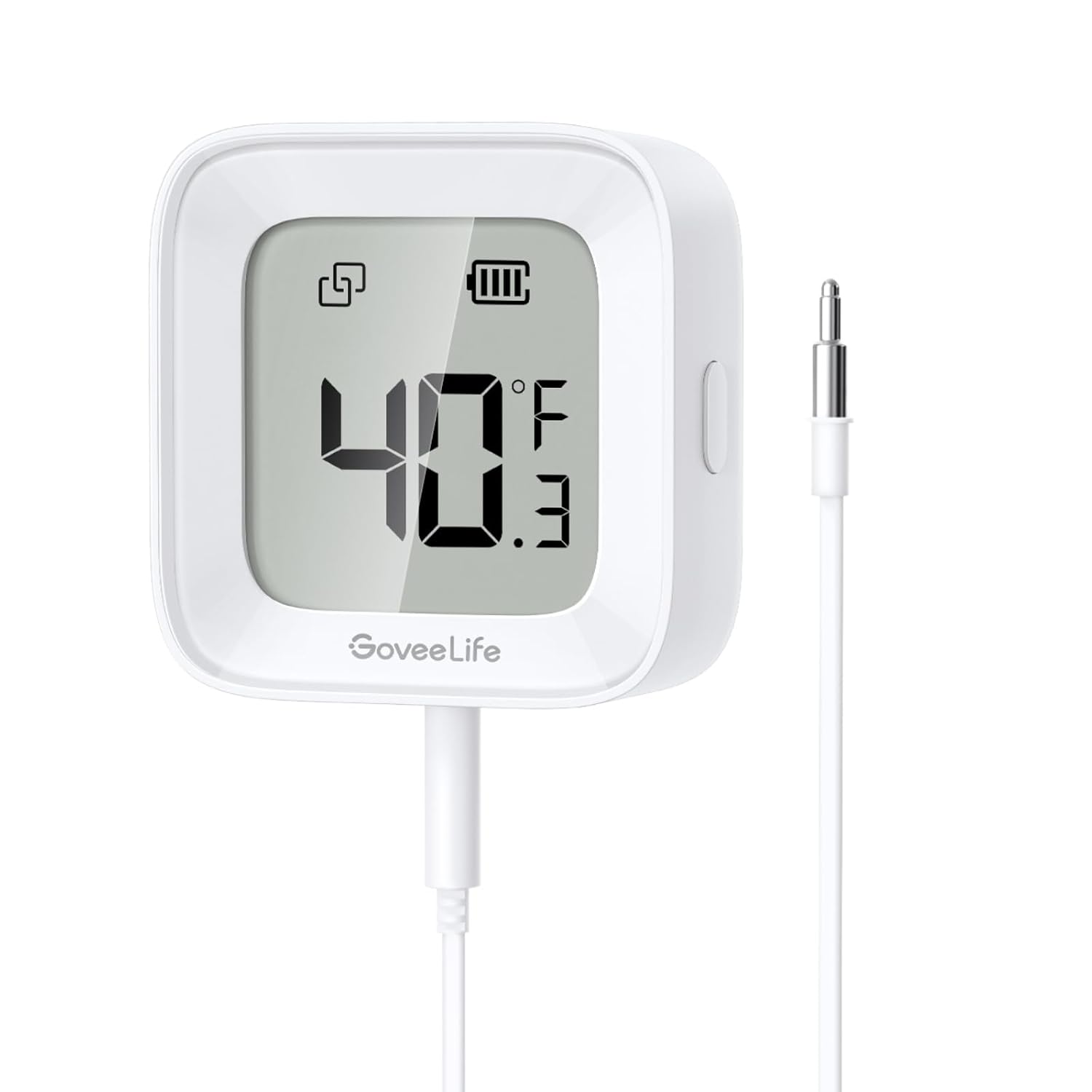
| GoveeLife H5108 | Temperature, wired probe | Phone app by Bluetooth; remote alerts need a separate Govee gateway (listing names H5151, H5042, H5043) | Only with the gateway | Chest freezer with a probe inside |
| AcuRite 00515M | Fridge and freezer temperature, two sensors | Beeping display with programmable alarms | No | Kitchen where someone is home |
| YoLink Power Fail Alarm kit | Whether AC power is present | 110 dB siren, app push, text, email (hub included) | Hub needs internet | Garage freezer on a circuit that can trip |
| MySpool Power Failure Detector | Whether AC power is present | Text and email to two phone numbers (listing) | Yes | Simple outage alert for a freezer outlet |
Different job from our guide to freeze alarms for pipes and unheated spaces; this one is about food.
How We Chose
We put temperature monitors above outage detectors, since a tripped breaker, a door left ajar, or a failing compressor all raise freezer temperature while the house still has power. We then compared how the alert reaches you, what happens when Wi-Fi drops, and battery life. We research and compare; we do not run our own product trials. Specs come from listings and any manufacturer pages we could open, and we flag listing-only claims. Scores come from verified buyer ratings (how we choose).
1. Temp Stick
- Battery sensor with Wi-Fi (2.4 GHz only, per retailer listings) on two AA batteries. Temp Stick’s site says about 1+ years of battery life depending on settings; the Amazon listing says 1 to 2 years.
- Temp Stick’s site lists text, app, and email alerts with no fees or subscription, plus internet lost and found alerts.
- Temp Stick’s site gives a -40 to 140°F range, which covers a home freezer.
Best for: a freezer in a garage or basement when you travel.
Avoid if: your router goes down in every outage and has no battery backup (see the router math below).
2. GoveeLife Bluetooth Refrigerator Thermometer (H5108)
- The listing gives a -40 to 158°F range, plus or minus 0.9°F, with a slim probe cable made to fit inside a freezer.
- Alerts after a delay you set from 1 to 10 minutes, which cuts false alarms when you open the lid.
- Bluetooth range is listed at 197 ft; for alerts when you are away, the listing says you need a Govee gateway such as the H5151, which is not included.
Best for: a chest freezer where the sensor must sit inside.
Avoid if: you do not want to buy a gateway for remote alerts.
3. AcuRite Digital Wireless Fridge and Freezer Thermometer (00515M)
- One display with two wireless sensors, one for the fridge and one for the freezer. The AcuRite listing says the display records highs and lows for each compartment and has programmable alarms.
- No internet needed. It sounds an alarm in the house only, so it fails if nobody is home.
- AcuRite’s listing recommends lithium batteries in the sensors below -4°F.
Best for: watching the fridge and freezer together in a kitchen.
Avoid if: the freezer is in a garage you rarely enter.
4. YoLink Smart Power Fail Alarm and Hub Kit
- Plugs into the freezer’s outlet and reports loss of AC power. The listing says the siren is 110 dB and alerts go out by push, text, or email.
- The kit includes the hub, which YoLink says has no battery backup, so in a whole-house outage the hub and router need a UPS for phone alerts.
- It tells you power is gone, not how warm the freezer is. A frozen compressor or an open lid will not trigger it.
Best for: a second layer next to a temperature probe.
Avoid if: it would be your only alarm.
5. MySpool Power Failure Detector
- Detects loss of power at its outlet and, per the listing, sends text and email to two phone numbers and up to five email addresses, plus a restoration alert.
- The listing suggests labeling the device “freezer alarm” so the message names the location.
- Same limit as the YoLink: it senses power, not temperature.
Best for: a simple outage message for a family member to see.
Avoid if: you need temperature data or a history.
Cost of ownership
Ongoing costs are batteries (AA or AAA, per listing, or lithium for cold) and, for the Govee, a gateway if you want remote alerts. Check each maker’s current terms for text messaging before you rely on it. Whatever you pick, keep an appliance thermometer in the freezer too: CDC says to keep appliance thermometers in the fridge and freezer, so you can read the temperature after an outage.
Which one should you choose?
- Is someone usually home? The AcuRite is enough.
- Do you travel? Choose a Wi-Fi monitor, then check the router.
- Where does the sensor sit? Inside a chest freezer favors the Govee probe.
- Can the circuit trip? Add a power-fail alarm.
Router check: a Wi-Fi sensor only reaches you while the router has power. A 20 W modem and router on an APC BE600M1 (78 Wh battery, per its datasheet) run about 78 x 0.6 / 20 = 2.3 hours on paper, using 0.6 as a planning factor for usable battery and conversion loss. See our modem and router UPS guide. Wi-Fi sensors that report loss of connection are worth the most, and our guide to power outage alarms covers the rest.
Set the freezer alert near 10°F, a planning choice that sits above CDC’s 0°F target but below thaw, and the fridge alert at 40°F. Use the alert delay if your device has one (the Govee listing allows 1 to 10 minutes) so opening the door does not trigger it. When the alarm sounds, keep doors shut and read how to keep food cold during a power outage. After the outage, follow our food-safety guide: CDC says food with ice crystals or at 40°F or below can be refrozen or cooked, and Ready.gov says to throw away food exposed to 40°F or higher for 2 hours or more.
FAQ
What temperature should a freezer alarm be set to?
CDC’s targets are 0°F or below for the freezer and 40°F or below for the fridge. A common choice is to set the freezer alert a few degrees higher to avoid nuisance alarms.
Is a power outage alarm enough?
It catches outages if its hub or router stays powered, but not a tripped breaker on a single circuit unless the alarm shares that outlet, and never a failing compressor or an open lid. A temperature probe covers those.
How long does food last in a freezer without power?
Ready.gov and CDC say about 48 hours for a full freezer if the door stays closed, and CDC gives about 24 hours for a half-full one.
Changelog: November 2026: first published.









