The Mr. Heater Portable Buddy is the indoor propane heater to start with for most homes: Mr. Heater certifies it for indoor use, its 9,000 Btu per hour high setting covers a room of about 225 sq ft, and one disposable 1 lb cylinder holds about 21,800 Btu, enough for roughly 2.4 hours on high or 5.4 hours on low. Size up to the Big Buddy only if the room you need to keep warm is closer to 450 sq ft.


Every heater on this list burns propane in the room with you, which means it can produce carbon monoxide (CO) and uses up indoor oxygen. Mr. Heater’s indoor rating comes with conditions: fresh-air openings, clearances, disposable 1 lb cylinders only, and never while anyone sleeps. Put a battery-powered CO alarm in the room, plus alarms on every level and outside sleeping areas as the CPSC advises, and check your state and local rules before you buy. No unvented heater is free of risk, and this guide does not claim otherwise.
Quick Comparison
All four picks are Mr. Heater Buddy models, because they are the propane heaters in our product data that the manufacturer lists as indoor safe. Ratings below come from mrheater.com; the runtime column shows the maker’s figure next to our fuel math.
| Model | Heat settings | Rated area | Fuel | Runtime per 1 lb cylinder | Indoor restrictions | Best for |
|---|---|---|---|---|---|---|
| Mr. Heater Portable Buddy (MH9BX) | 4,000 / 9,000 Btu/h | Up to 225 sq ft | One 1 lb cylinder | Maker: 3 h high, 6 h low; math: about 2.4 h and 5.4 h | Not MA or Canada; not dwellings in CA | One room of 150 to 225 sq ft |
| Mr. Heater Big Buddy (MH18B) | 4,000 / 9,000 / 18,000 Btu/h | Up to 450 sq ft | Two 1 lb cylinders | Maker: up to 11 h with two cylinders; math: about 10.9 h low, 4.8 h medium, 2.4 h high per pair | Not MA or Canada; not dwellings in CA | Living rooms of 300 to 450 sq ft |
| Mr. Heater Little Buddy (MH4B) | 3,800 Btu/h, one setting | Up to 95 sq ft | One 1 lb cylinder | Maker: 5.6 h; math: about 5.7 h | Not MA or Canada; not dwellings in CA | A small office or a bathroom |
| Mr. Heater Buddy FLEX (MH11BFLEX) | Up to 11,000 Btu/h, two settings | Up to 275 sq ft | One 1 lb cylinder | Maker: 2 h high, 3.5 h low; math: about 2.0 h high | Not MA or Canada; not dwellings in CA | A medium room plus camping use |
The fuel math uses EIA’s 91,452 Btu per gallon of propane and a common planning figure of 4.2 lb per gallon: 91,452 / 4.2 = about 21,800 Btu in a 1 lb cylinder. Divide that by the heater’s Btu per hour setting to get hours. The California line comes from Mr. Heater’s Buddy Series guidance, which restricts Buddy heaters from use in dwellings there.
How We Chose
We started with one filter: the manufacturer must list the heater for indoor use. That removed tank-top heaters such as the Mr. Heater 540-degree Tank Top, forced-air “torpedo” heaters, and patio heaters, which are built for outdoor or job-site use. Our explainer on whether a propane heater is safe indoors covers why those labels matter.
- Indoor certification from the maker, plus an oxygen depletion sensor (ODS), which shuts the heater off when oxygen in the room drops, and a tip-over shutoff.
- Heat output matched to a real room size, checked against the maker’s coverage claim.
- Hours per cylinder, from the maker and from our own fuel math, so you can plan cylinders per day.
- Room-by-room limits printed in the owner’s manual, such as the caps for bathrooms and bedrooms.
- Yard & Grid Score, built from verified buyer ratings, as a check on long-run owner satisfaction.
Our sources are Mr. Heater product pages, the MH9BX owner’s manual, CPSC guidance, and public owner reviews. We research and compare; we do not run our own product trials. The full method is on how we choose. The Midnight Series versions of the Portable Buddy and Big Buddy were left out because we could not match them to a Mr. Heater spec page.
The Picks
1. Mr. Heater Portable Buddy: the default for one room
- Mr. Heater rates it at 4,000 or 9,000 Btu per hour for up to 225 sq ft, with ODS, tip-over shutoff, piezo ignition, and a 3-year limited warranty.
- The manual is the most detailed in the Buddy line: a fresh-air opening of at least 9 sq in (for example 3 in x 3 in) near the ceiling and another near the floor, clearances of 30 in above, 24 in in front, and 6 in at the sides, and never while sleeping or unattended.
- It also caps heat by room for emergency home use: no more than 5,000 Btu per hour in a bathroom, so low setting only there, and no more than 10,000 Btu per hour in a bedroom.
- Runtime per cylinder is short on high. The spec table says 3 hours high and 6 hours low; the fuel math gives 21,800 / 9,000 = about 2.4 hours and 21,800 / 4,000 = about 5.4 hours, so plan with the lower numbers.
- Mr. Heater says runtime drops sharply below 20°F and the heater may shut off above 7,000 ft.
Best for: keeping a 150 to 225 sq ft room usable during waking hours of a winter outage.
Avoid if: you need heat overnight while everyone is asleep, or you live in Massachusetts, Canada, or a California home.
2. Mr. Heater Big Buddy: for a large living room
- Three settings, 4,000, 9,000, and 18,000 Btu per hour, rated for up to 450 sq ft, with ODS, tip-over shutoff, piezo ignition, and a 3-year limited warranty, per Mr. Heater.
- It holds two 1 lb cylinders. Mr. Heater’s Buddy Series guidance says a single 1 lb cylinder can run it only on low and medium; high needs both.
- Two cylinders hold about 43,600 Btu: 43,600 / 4,000 = about 10.9 hours on low, which fits Mr. Heater’s “up to 11 hours,” and 43,600 / 18,000 = about 2.4 hours on high.
- The 18,000 Btu high setting is above the 10,000 Btu per hour bedroom cap printed in the Portable Buddy manual. Read the Big Buddy manual’s room limits before you use it anywhere other than a large open room.
- Mr. Heater notes the fan has been removed from some MH18B units, so the listing you buy may not include one.
Best for: an open kitchen and family room of 300 to 450 sq ft where the household gathers during the day.
Avoid if: the room you need to heat is a bedroom or a small office, where the Portable Buddy or Little Buddy fits the room caps better. Our Buddy vs Big Buddy comparison goes deeper on the trade.
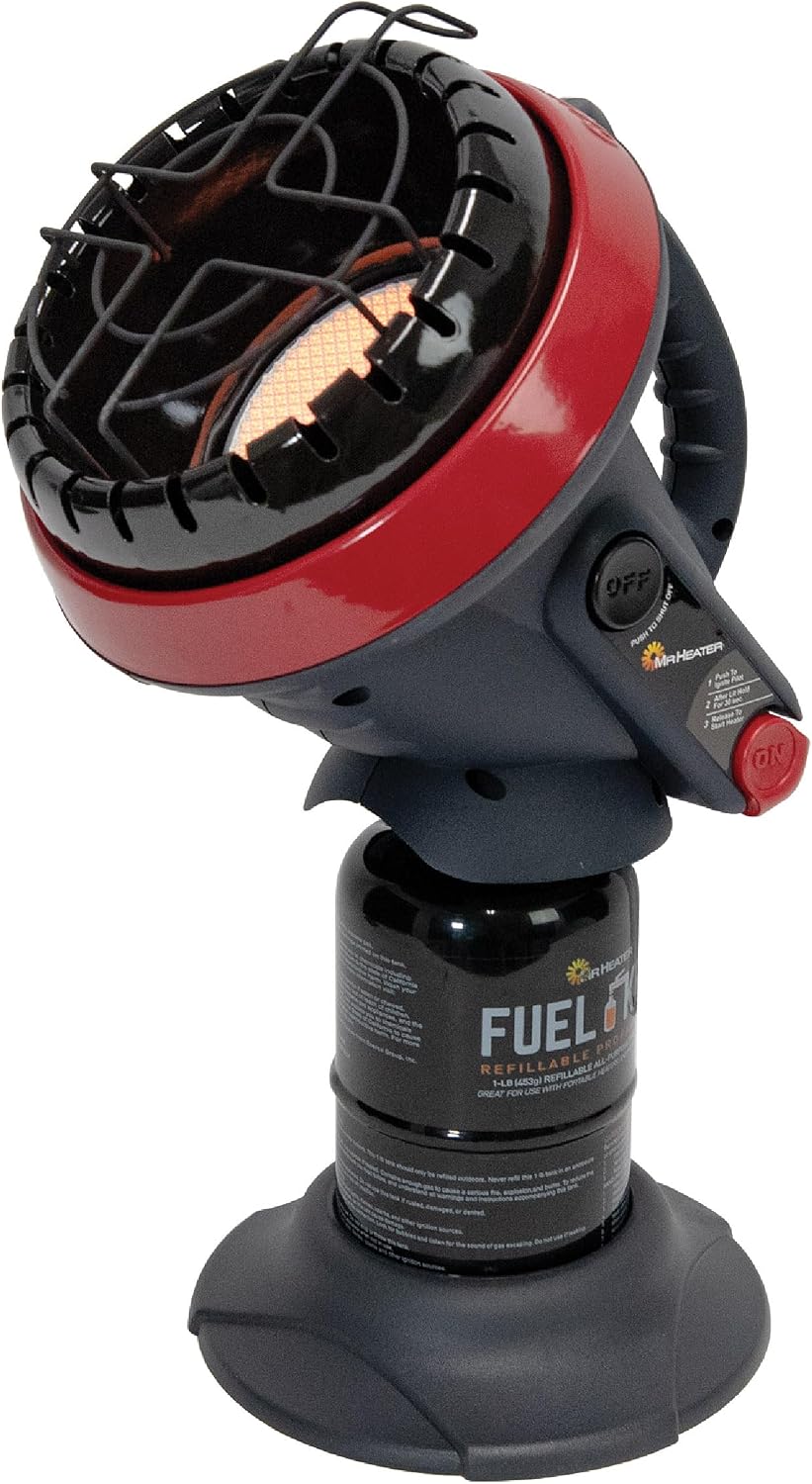
3. Mr. Heater Little Buddy: the small-room pick
- One fixed output of 3,800 Btu per hour, rated for up to 95 sq ft, with ODS, tip-over shutoff, one-button piezo ignition, and a 3-year limited warranty, per Mr. Heater.
- Mr. Heater lists 5.6 hours per 1 lb cylinder. The math agrees: 21,800 / 3,800 = about 5.7 hours.
- 3,800 Btu per hour sits under the 5,000 Btu bathroom cap in the Portable Buddy manual, which makes it the natural fit for keeping a bathroom or a small home office above freezing.
- There is no high setting, so it cannot catch up in a larger, colder room.
Best for: a bathroom, a small office, or a room under 100 sq ft that needs steady low heat.
Avoid if: you want one heater to warm the main living area of the house.
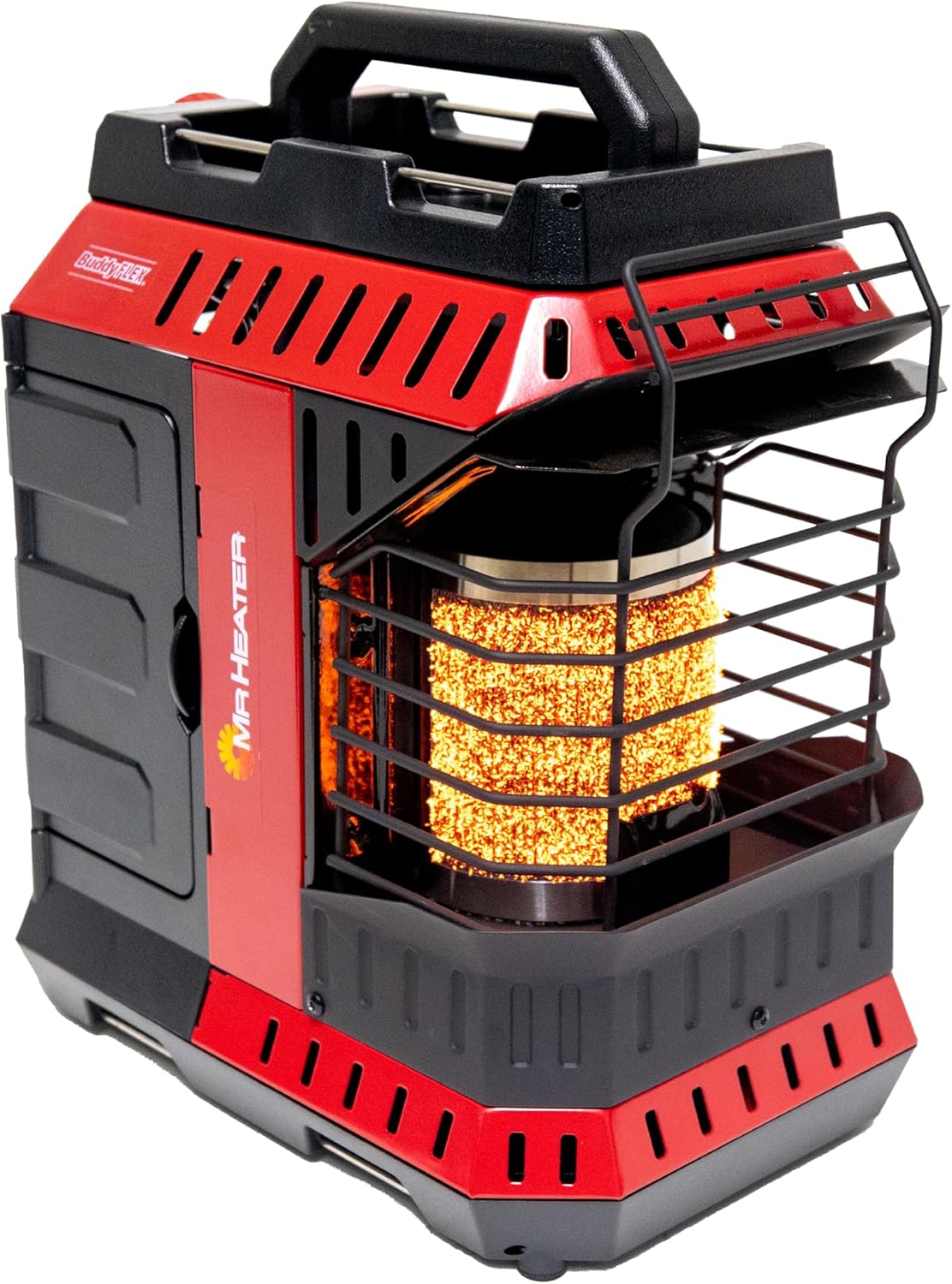
4. Mr. Heater Buddy FLEX: more heat, shorter runtime
- Mr. Heater rates it at up to 11,000 Btu per hour for up to 275 sq ft, with ODS, tip-over shutoff, electronic ignition, and a 3-year limited warranty.
- It is the hungriest per hour: Mr. Heater lists about 2 hours on high and 3.5 hours on low per cylinder, and 21,800 / 11,000 = about 2.0 hours on high confirms the first figure.
- Its 11,000 Btu high setting is above the 10,000 Btu per hour bedroom cap in the Portable Buddy manual, so check the FLEX manual before running it in a bedroom.
- It has far fewer verified ratings than the other three, which is why it ranks last here despite the extra output.
Best for: a 200 to 275 sq ft room that the Portable Buddy cannot keep up with, plus use at camp.
Avoid if: you want the most hours from a limited supply of 1 lb cylinders.
Ventilation, CO Alarms, and the Rules That Come With an Indoor Rating
An indoor rating is a list of conditions, and the heater is only rated when you meet all of them. Set up in this order before the first cold night.
- Install CO alarms first: one in the room with the heater and one on every level and outside sleeping areas, as the CPSC advises. Battery or battery-backup models keep working when the power is out.
- Open fresh air. The MH9BX manual calls for at least 9 sq in near the ceiling and 9 sq in near the floor. A 24 in wide window opened 1/2 in gives 24 x 0.5 = 12 sq in, enough for one of the two openings.
- Keep the clearances: 30 in above, 24 in in front, 6 in at the sides, per the same manual.
- Use disposable 1 lb cylinders only indoors. The manual says never bring a refillable cylinder, such as a 20 lb grill tank, into the house, and to store cylinders outdoors, not in a garage, shed, or other enclosed space.
- Shut it off before anyone goes to sleep, and never leave it running in an empty room.
The manual lists early CO warning signs as headache, dizziness, and nausea, and names higher-risk groups including pregnant women and people with heart or lung disease or anemia. If an alarm sounds or anyone feels those symptoms, turn the heater off, get everyone outside, and call 911. Our page on CO safety during power outages has the full checklist.
Permanent “vent-free” wall heaters that run on piped propane are a different category: they are installed by a licensed gas fitter under local code, and DOE notes that California and some cities and counties ban unvented natural gas heaters in the home. The portable Buddy models here are what most renters and homeowners can legally keep for an emergency, outside the restricted areas.
Cost of Ownership: Cylinders, Hoses, and Warranty
Fuel is the running cost, and it adds up in cylinders, not dollars per hour.
- Portable Buddy, mixed use: 4 hours on high and 6 hours on low is 9,000 x 4 + 4,000 x 6 = 60,000 Btu a day. 60,000 / 21,800 = about 2.8, so stock 3 cylinders a day, or 9 for a 3-day outage.
- Big Buddy on medium, 10 hours: 9,000 x 10 = 90,000 Btu. 90,000 / 21,800 = about 4.1, so plan on 5 cylinders a day.
- Little Buddy, 10 hours: 3,800 x 10 = 38,000 Btu. 38,000 / 21,800 = about 1.7, so 2 cylinders a day.
Mr. Heater sells hoses and fuel filters that connect Buddy heaters to a 20 lb cylinder, but the manual’s rule that refillable cylinders never come indoors keeps that setup outdoors. Every model here carries a 3-year limited warranty, per Mr. Heater, and the company warns that unauthorized accessories void it.
How to Choose the Right Size
Match the heater to the one room you plan to live in during an outage, then check the room caps. Mr. Heater’s coverage ratings all work out to the same density: 9,000 / 225 = 40, 18,000 / 450 = 40, 3,800 / 95 = 40, and 11,000 / 275 = 40 Btu per hour per sq ft.
- How big is the room? Multiply length by width, then by 40. A 14 ft x 16 ft family room is 224 sq ft, and 224 x 40 = about 8,960 Btu per hour, which is the Portable Buddy on high. Drafty older homes may need the next size up; well-sealed rooms often hold on low.
- Which room is it? Bathrooms are capped at 5,000 Btu per hour and bedrooms at 10,000 in the MH9BX manual, so the Little Buddy or the Portable Buddy suits those rooms, and the larger models belong in open living areas.
- How many cylinders can you store outdoors? Use the daily math above. If you cannot keep a few dozen 1 lb cylinders outside, a smaller heater on low may be the better plan.
- Do you need heat overnight? None of these may run while you sleep. For overnight warmth during a long outage, compare the electric and battery routes in our best heaters for power outages guide.
If you are weighing propane against kerosene for the same job, our kerosene heater guide runs the same numbers for wick heaters.
FAQ
Which propane heaters are approved for indoor use?
Only models the manufacturer certifies and labels for indoor use. The MH9BX manual lists certification to ANSI Z21.103 for unvented portable gas heaters, and Mr. Heater lists the Portable Buddy, Big Buddy, Little Buddy, and Buddy FLEX as indoor safe outside Massachusetts and Canada. Tank-top and forced-air heaters are not on that list.
Can I sleep with an indoor propane heater on?
No. The MH9BX manual says never to operate the heater while sleeping. Warm the room before bed, shut the heater off, and use blankets and closed doors to hold the heat overnight.
Can I hook an indoor propane heater to a 20 lb tank inside the house?
Not according to the MH9BX manual, which says never to bring a refillable cylinder indoors and limits emergency indoor heating to disposable 1 lb cylinders. Store all cylinders outside, away from the house’s openings.
How many 1 lb cylinders should I keep for an outage?
Work it out from your heater and hours. A Portable Buddy split between 4 hours on high and 6 on low uses about 60,000 Btu a day, or about 3 cylinders, so a 3-day outage needs about 9.
Do I still need a CO alarm if the heater has an oxygen sensor?
Yes. The ODS reacts to low oxygen, while a CO alarm reacts to carbon monoxide; they watch for different things. The CPSC advises CO alarms on every level and outside sleeping areas in any home with fuel-burning appliances.
Changelog: October 2026: first published.