


The DELTA 3 is a modest upgrade over the DELTA 2, not a new tier: both hold 1,024 Wh and rate 1,800 W continuous, and the DELTA 3 adds a higher surge rating (3,600 W against 2,700 W), a longer cycle rating (4,000 against 3,000, though one line on EcoFlow’s DELTA 3 page says 3,000+), faster AC input (1,500 W against 1,200 W), and a wider list of compatible extra batteries. If your DELTA 2 already covers your loads, the spec sheets give you no runtime reason to replace it.
A note on names: EcoFlow sells several models called DELTA 3. This page compares the DELTA 2 with the plain DELTA 3 (model EF-DL-H10-3, the version in the product card below). The Classic and Plus versions differ from it in ways covered near the end and in our DELTA 3 lineup guide.

EF ECOFLOW Delta 3 Portable Power Station


As an Amazon Associate we earn from qualifying purchases. Product prices and availability are accurate as of the date/time indicated.
Specs Side by Side
DELTA 2 figures come from EcoFlow’s Canadian product page, because the old US DELTA 2 page now redirects to the DELTA 3. DELTA 3 figures come from EcoFlow’s US page. Watt-hours (Wh) are the size of the tank; watts (W) are how fast you can pour from it.
| Spec | EcoFlow DELTA 2 | EcoFlow DELTA 3 |
|---|---|---|
| Capacity and chemistry | 1,024 Wh LFP | 1,024 Wh LFP |
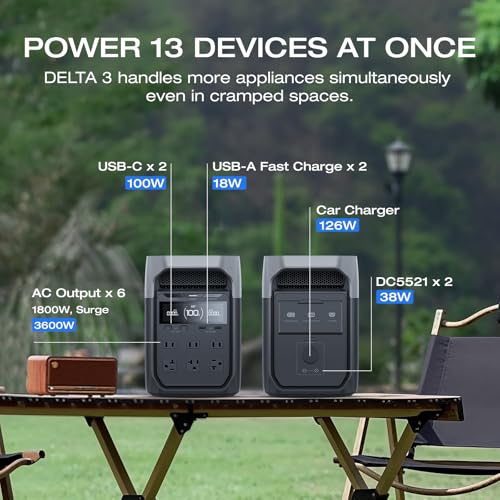
| Continuous AC output | 1,800 W | 1,800 W |
| Surge | 2,700 W | 3,600 W |
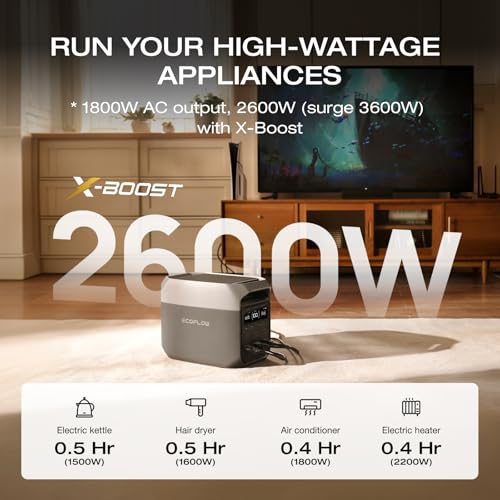
| X-Boost (resistive loads) | 2,200 W | 2,200 W |
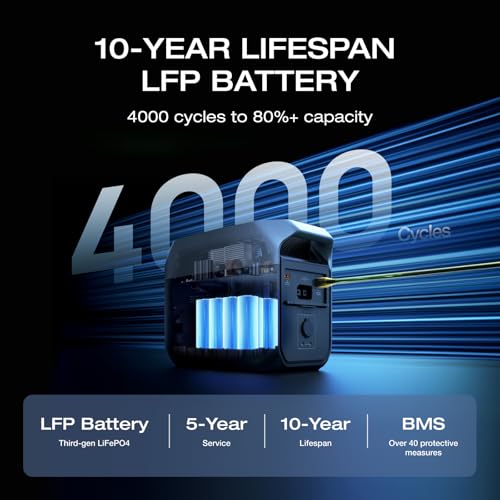
| Rated cycles | 3,000 to 80% or more | 4,000 to 80% or more (another line on the page says 3,000+) |
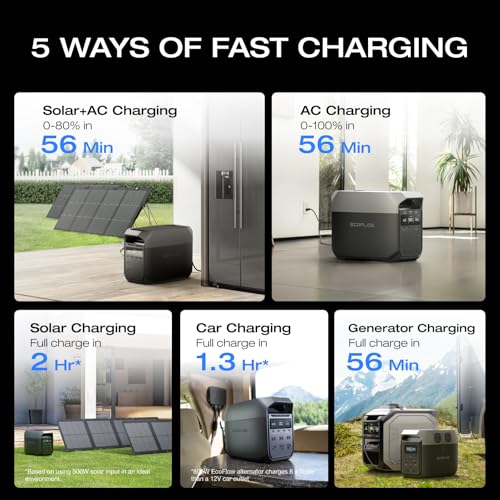
| AC input | 1,200 W max | 1,500 W |
| Solar input | 11 to 60 V, 500 W max (15 A) | 11 to 60 V, 500 W max |
| Car socket output | 12.6 V, 10 A (126 W) | 12.6 V, 10 A (126 W) |
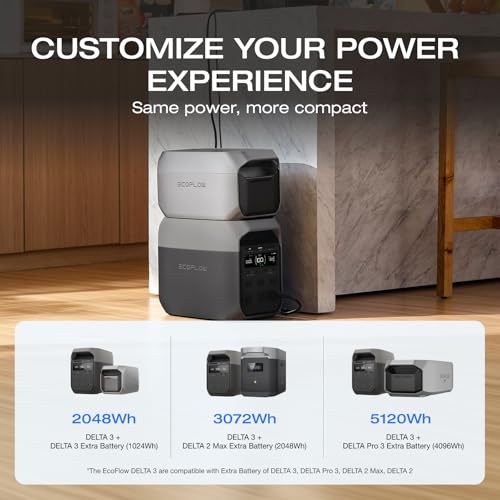
| Extra batteries | 1 to 3 kWh; EcoFlow notes the DELTA 2 extra battery is no longer available | 1 to 5 kWh with DELTA 3, DELTA 2, DELTA 2 Max, or DELTA Pro 3 extra batteries |
| UPS switchover | Not in the spec table | Under 10 ms in the spec table (10 ms in the feature text) |
| Weight | 27 lb (12 kg) | 27.6 lb (12.5 kg) |
| Size | 15.7 x 8.3 x 11 in | 15.7 x 8.0 x 11.2 in |
| Warranty | 5 years (Canadian page) | 5 years (US spec table) |
Capacity is a tie, so runtime is a tie. A fridge rated at 600 kWh a year averages 600,000 Wh / 8,760 h = about 68.5 W. Either unit then gives 1,024 Wh x 0.85 inverter efficiency / 68.5 W = about 12.7 hours, or roughly 13. The 0.85 is a common planning figure for conversion loss, not an EcoFlow number.
The Four Differences That Matter
1. Surge Rating: 2,700 W vs 3,600 W
Continuous rating decides whether a load keeps running. Surge rating decides whether a motor starts. Both units share the 1,800 W continuous rating, so the extra 900 W of surge only matters at the moment a compressor or pump kicks on.
Here is the arithmetic with made-up round numbers, not a specific appliance. Suppose the labels on a basement pump and a fridge add up to 600 W running, plus the largest single start adds 2,400 W. The peak is 600 + 2,400 = 3,000 W. That exceeds the DELTA 2’s 2,700 W and fits under the DELTA 3’s 3,600 W. Read your own labels first: many loads never come near either number. EcoFlow’s pages give the surge rating without a duration, so treat it as a short start-up allowance, not a working load.
2. Rated Cycles: 3,000 vs 4,000
EcoFlow lists 3,000 cycles to 80 percent or more for the DELTA 2 and 4,000 for the DELTA 3, though another line on the DELTA 3 page says 3,000+. Cycles matter when you drain and refill often, such as daily solar use at a cabin. At one full cycle a day: 3,000 / 365 = about 8 years, and 4,000 / 365 = about 11 years.
For an outage-only unit that cycles a few dozen times a year, the cycle rating is unlikely to be what decides when you replace it. That is why we rank this as a real but small difference.
3. AC Input: 1,200 W vs 1,500 W
The DELTA 2 accepts up to 1,200 W from the wall, the DELTA 3 up to 1,500 W. Dividing capacity by input gives a floor: 1,024 Wh / 1,200 W = about 51 minutes, against 1,024 / 1,500 = about 41 minutes. Real charging tapers near full, so neither figure is a promise. EcoFlow’s US page for the DELTA 3 lists 56 minutes from 0 to 100 percent at 1,500 W AC input.
This matters in storm country where power flickers back on for an hour between outage waves. In a long outage with a generator or solar doing the refilling, the gap shrinks.
4. Expansion and Availability
The DELTA 2 supports a DELTA 2 or DELTA Max extra battery, but EcoFlow’s page says that extra battery is no longer available. The DELTA 3 lists compatibility with DELTA 3, DELTA 2, DELTA 2 Max, and DELTA Pro 3 extra batteries, for 1 to 5 kWh. If you already own a DELTA 2 extra battery, EcoFlow’s DELTA 3 page lists it as compatible. Our expansion battery guide explains what an extra battery does and does not add.
What Did Not Change
Capacity, chemistry, continuous output, X-Boost, solar voltage window, car socket output, and weight (within 0.6 lb) are effectively the same. X-Boost is worth a caution on both: EcoFlow’s manuals describe it as more suitable for heating devices and not for loads that need strict voltage. A 1,500 W space heater on either unit draws 1,024 x 0.85 / 1,500 = about 0.58 hours, roughly 35 minutes, so a heater is not a good use of a 1 kWh battery in the first place.
The Classic and Plus Versions
The EcoFlow buying guide lists each model. In short, the DELTA 3 Classic weighs 26.7 lb, rates X-Boost at 2,600 W, carries a 3-year warranty plus 2 with app registration, and has no extra-battery support listed on EcoFlow’s US page. The DELTA 3 Plus adds a second 500 W solar input (1,000 W total) and keeps the 5-year warranty.
Choose the DELTA 2 If / Choose the DELTA 3 If
Choose the DELTA 2 if you already own one, your peak start-up draw sits well under 2,700 W, and you recharge from the wall or a generator rather than racing a short window. Replacing a working unit for a 900 W higher surge rating is rarely worth it. Avoid if runtime is your only goal for upgrading: both hold 1,024 Wh.
Choose the DELTA 3 if you are buying new (EcoFlow’s US DELTA 2 page redirects to it) or if you want the 3,600 W surge allowance and a 5 kWh expansion path. It is also the pick if you plan to cycle the battery often. For a brand-level view, see EcoFlow vs Jackery, and for runtime math on your own fridge see how long a power station will run a fridge. We research and compare; we do not run our own product trials. The method is on how we choose.
FAQ
Is the EcoFlow DELTA 3 the same as the DELTA 2?
No. EcoFlow’s old US DELTA 2 page now redirects to the DELTA 3. The DELTA 2 is 1,800 W with a 2,700 W surge, 27 lb, and 3,000 cycles to 80 percent or more. The DELTA 3 is 1,800 W with a 3,600 W surge, 27.6 lb, and 4,000 cycles (3,000+ in one line of its page).
Does the DELTA 3 run longer than the DELTA 2?
No. Both hold 1,024 Wh, so a given load runs for the same time on either one before any extra battery is added.
Can I use my DELTA 2 extra battery with a DELTA 3?
EcoFlow’s DELTA 3 page lists DELTA 2 extra batteries among the compatible options for 1 to 5 kWh. Check the current compatibility note on the DELTA 3 page before you buy, because EcoFlow updates it.
Is the DELTA 3 Classic better than the DELTA 2?
Not across the board. The Classic raises the surge rating to 3,600 W, but EcoFlow’s US page lists no extra-battery support, so 1,024 Wh is its ceiling.
Changelog: November 2026: first published.









