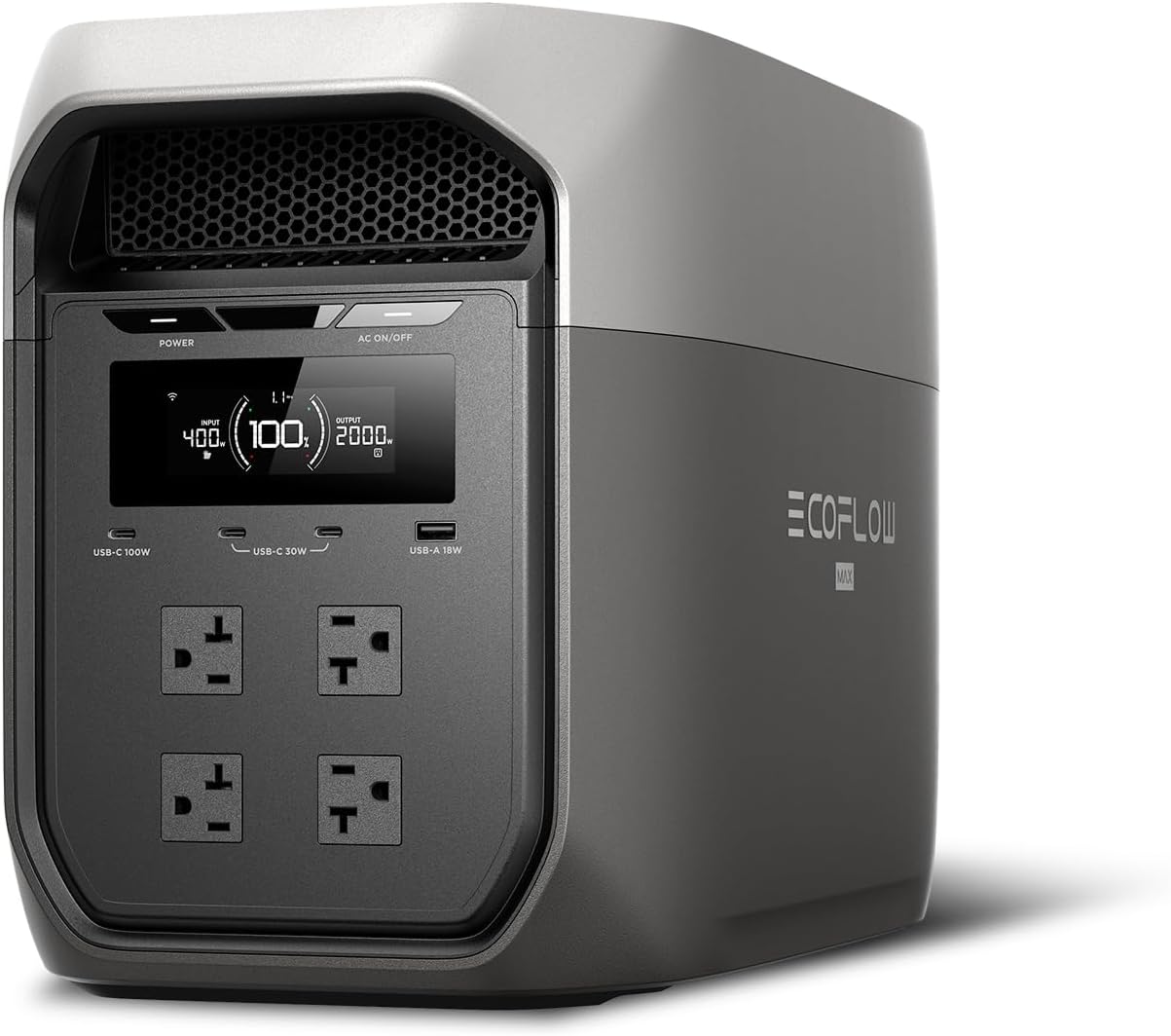
For most homes, the EcoFlow to buy is the DELTA 3 Max. Its 2,048 Wh battery keeps a fridge rated at 600 kWh a year running for about 25 hours (2,048 Wh x 0.85 inverter efficiency / 68.5 W average draw), and its 2,400 W continuous output leaves room for a 1,500 W microwave while the fridge runs. Buy smaller only if the station will travel more than it sits by the kitchen, and buy larger only if your outage plan includes a 240 V load or more than a day without recharge.


Quick Comparison
Fridge hours and CPAP nights are our calculations, not EcoFlow figures. Fridge hours = rated Wh x 0.85 / 68.5 W, where 68.5 W is a 600 kWh a year label spread over 8,760 hours. CPAP nights = rated Wh x 0.85 / 450 Wh, using ResMed’s 56.1 W typical figure for the AirSense 11 with heat on over an 8 hour night.
| Model | Capacity | Continuous AC | Expands to | Weight | Fridge hours | CPAP nights (heat on) | Best for |
|---|---|---|---|---|---|---|---|
| DELTA 3 Max | 2,048 Wh | 2,400 W | No | about 44.8 lb | about 25 | about 3.9 | Fridge through an overnight outage |
| DELTA 3 | 1,024 Wh | 1,800 W | 5 kWh | 27.6 lb | about 13 | about 1.9 | Start small, add batteries later |
| DELTA 3 Classic | 1,024 Wh | 1,800 W | No | 26.7 lb | about 13 | about 1.9 | Short, frequent outages |
| DELTA 3 Max Plus | 2,048 Wh | 3,000 W | 10 kWh | about 49 lb | about 25 | about 3.9 | Multi-day plans built in stages |
| DELTA 3 Ultra | 3,072 Wh | 3,600 W | 11 kWh | 72.1 lb | about 38 | about 5.8 | RVs and big 120 V loads |
| DELTA Pro 3 | 4,096 Wh | 4,000 W, 120/240 V | 12 kWh | 113.5 lb | about 51 | about 7.7 | 240 V well pumps |
| DELTA 3 Plus with 220 W panel | 1,024 Wh | 1,800 W | 5 kWh | 27.6 lb (station) | about 13 | about 1.9 | Solar-first camping and cabins |
| RIVER 3 Plus | 286 Wh | 600 W | 858 Wh | 10.4 lb | about 3.5 | about 4.3 hours | Router and CPAP for one evening |
| TRAIL 300 DC | 288 Wh | None (DC only) | No | about 5.7 lb | n/a | DC route only | Tent camping and day trips |
How We Chose
We started from four household jobs: keeping a fridge cold through an outage, running a CPAP overnight, carrying power to a campsite, and powering an RV weekend. Each EcoFlow model in our product catalog was sized against those loads, then ranked by how many of the four it covers well. Specs come from EcoFlow’s US product pages and manuals first, with Amazon listings and retailer spec sheets only where EcoFlow does not publish a figure, and we say so in the text. The Yard & Grid Score on each card comes from verified buyer ratings. We research and compare; we do not run our own product trials. The method is on how we choose.
Two catalog listings are left out on purpose. The original DELTA Pro has been replaced by the DELTA Pro 3, and its listing showed no buyer reviews when our catalog was built. The DELTA 3 Classic solar bundle is the same station as the Classic below with a panel added, so it would repeat a pick.
Four Homes, Four Different EcoFlows
The lineup makes more sense when you match it to a job. The four household plans below each use a load you can check on your own appliance labels.
- Fridge backup. A 600 kWh a year fridge averages 600,000 Wh / 8,760 h = about 68.5 W. Overnight from 6 p.m. to 8 a.m. is 14 hours: 68.5 x 14 / 0.85 = about 1,130 rated Wh. That rules out every 1 kWh model with no margin and points to the 2 kWh class.
- CPAP. Two nights with heat on at 450 Wh each is 2 x 450 / 0.85 = about 1,060 rated Wh. A 1,024 Wh unit falls just short; the DELTA 3 Max covers three nights with room left over.
- Camping. Weight decides. The TRAIL 300 DC and RIVER 3 Plus are the only EcoFlows here under 11 lb; everything else is 26 lb or more.
- RV weekend. An example day of a 12 V compressor fridge (360 Wh), a roof vent fan at 30 W for 8 hours (240 Wh), LED lights at 30 W for 5 hours (150 Wh), and phones and a laptop (100 Wh) totals 850 Wh. The question is less battery size than how fast you can refill it from the truck or the roof.
For the fridge math in more detail, see how long a power station will run a fridge.
The EcoFlow Lineup, Ranked
1. EcoFlow DELTA 3 Max
- 2,048 Wh LFP battery, 2,400 W continuous and 4,800 W surge, per EcoFlow.
- About 1,740 usable Wh: 1,740 / 68.5 W = about 25 hours of fridge, or 1,740 / 450 = about 3.9 CPAP nights with heat on.
- EcoFlow lists a 10 ms UPS switchover, so a fridge or router on the outlet keeps running when the grid drops.
- It weighs 20.3 kg, about 44.8 lb, roughly 46 Wh per lb. EcoFlow lists 0 to 80 percent in 68 minutes on AC and a 3 + 2 year warranty with app registration.
Best for: keeping a full-size fridge, a router, and lights running from dinner to breakfast without a recharge.
Avoid if: you expect to add batteries later; EcoFlow lists expansion on the Max Plus, not the Max.
2. EcoFlow DELTA 3
- 1,024 Wh, 1,800 W rated and 3,600 W surge, 27.6 lb, per EcoFlow’s US page, which lists both 3,000+ and 4,000 cycles.
- Expands to 5 kWh with compatible DELTA 3, DELTA 2, DELTA 2 Max, or DELTA Pro 3 extra batteries. At 5 kWh: 5,000 x 0.85 / 68.5 = about 62 fridge hours.
- Charging is where it suits an RV: 1,500 W AC for a full charge in about 56 minutes, 500 W of solar at 11 to 60 V, and 800 W from a vehicle through EcoFlow’s Alternator Charger (sold separately), which EcoFlow rates at about 1.3 hours to full.
- Car output is one 12.6 V, 10 A socket (126 W), enough for a 12 V compressor cooler.
Best for: a household that wants 1 kWh now and a path to a multi-day bank later.
Avoid if: you need to carry a fridge through a full night on day one; 1,024 Wh covers about 13 hours.
3. EcoFlow DELTA 3 Classic
- 1,024 Wh, 1,800 W continuous, 3,600 W surge, 26.7 lb, per EcoFlow.
- AC charging reaches 80 percent in about 45 minutes and full in about 60, which matters in areas where power flickers back on between storm bands.
- The Amazon listing states it does not work with DELTA 2 or DELTA 3 series extra batteries, so 1,024 Wh is the ceiling.
- X-Boost lifts its limit to 2,600 W, but EcoFlow’s manuals describe X-Boost as more suitable for heating devices and not for appliances with strict voltage requirements. Do not plan a fridge or pump around it.
Best for: apartments and homes with short, frequent outages and a reliable chance to recharge.
Avoid if: outages in your area run past one night.
4. EcoFlow DELTA 3 Max Plus
- Same 2,048 Wh as the Max, with 3,000 W continuous and 6,000 W surge, per EcoFlow.
- Expands from 2 kWh to 10 kWh. At 10 kWh: 10,000 x 0.85 / 68.5 = about 124 fridge hours, roughly five days.
- EcoFlow lists 0 to 80 percent in 43 minutes with generator charging and a 10 ms UPS switchover. EcoFlow’s UK page lists 1,000 W of solar input and a weight of 22.1 kg (about 49 lb).
Best for: homes in hurricane or ice-storm country that want to build a multi-day bank one battery at a time.
Avoid if: one night of backup is the whole plan; the Max does that for less weight.
5. EcoFlow DELTA 3 Ultra
- 3,072 Wh, 3,600 W continuous and 7,200 W surge, 120 V only, 72.1 lb, per EcoFlow.
- EcoFlow lists one 30 A outlet, the amperage class of many RV shore cords. Confirm the plug type against your RV’s cord before you count on it.
- RV weekend at 850 Wh a day: 3,072 x 0.85 / 850 = about 3 days with no recharge. With two DELTA Pro 3 Extra Batteries it reaches 11 kWh.
- 800 W of solar input and 1,800 W AC input.
Best for: an RV parked for a long weekend, or a home that wants a fridge, freezer, and microwave on one 120 V unit.
Avoid if: you have a 240 V well pump, or nobody in the house can roll 72 lb across a threshold.
6. EcoFlow DELTA Pro 3
- 4,096 Wh, 4,000 W, and both 120 V and 240 V output, with NEMA L14-30R and 6-20R outlets, per EcoFlow’s spec table.
- That 240 V output is why it is here: it is the only EcoFlow in our catalog with a 240 V outlet, which a 240 V well pump requires; the pump’s starting draw still has to fit. Sizing for that job is in power stations for a well pump.
- 12 kWh with two extra batteries. A fridge alone at 1,640 Wh a day uses 1,640 / (12,000 x 0.85) = about 16 percent of that bank daily.
- Feeding a home circuit from it requires a transfer switch or similar equipment installed by a licensed electrician.
Best for: rural homes on a 240 V well pump that want backup without fuel.
Avoid if: you want to move it often; at 113.5 lb it is a wheeled appliance, not a carry-along.
7. EcoFlow DELTA 3 Plus Solar Generator with 220 W Panel
- The DELTA 3 Plus station is 1,024 Wh, 1,800 W, 27.6 lb, expandable to 5 kWh, per EcoFlow. This bundle is the only DELTA 3 Plus listing in our catalog, which is why it is here instead of the bare station.
- The Plus takes two 500 W solar inputs, 1,000 W total by EcoFlow’s figure, double the DELTA 3; the manual limits total short-circuit current across both inputs to 15 A, so a real array may deliver less. That matters for off-grid use more than for home backup.
- The bundled 220 W panel: 220 W x 5 peak sun hours x 0.75 derate = about 825 Wh a day, close to the 850 Wh RV day above.
Best for: cabins and RVs that refill from the sun and want one panel in the box to start.
Avoid if: the station will live by the fridge in a house with reliable grid recharge; the bare DELTA 3 covers that.
8. EcoFlow RIVER 3 Plus
- 286 Wh, 600 W continuous, 1,200 W with X-Boost, 10.4 lb, per EcoFlow.
- Stacks to 858 Wh with an EB600 extra battery (286 + 572 Wh).
- CPAP with heat on: 286 x 0.85 / 56.1 W = about 4.3 hours, so a full night needs heat off or the extra battery.
- 220 W of solar or car input, with EcoFlow listing 3.3 hours to full from a car.
Best for: keeping a router, a lamp, and phones up for an evening, or a light camping kit.
Avoid if: a fridge is part of the plan; 286 Wh covers about 3.5 hours of one.
9. EcoFlow TRAIL 300 DC
- 288 Wh LFP, 300 W total, DC only: two 140 W USB-C ports, two USB-A, and a car outlet rated 120 W max, per EcoFlow’s UK spec page. EcoFlow’s US site had no product page for it when we checked.
- About 5.7 lb, the lightest EcoFlow here: 288 / 5.7 = about 51 Wh per lb.
- Solar or car input tops out at 110 W: 110 x 5 x 0.75 = about 410 Wh a day, more than the battery holds.
Best for: tent camping with a 12 V cooler, phones, and lights.
Avoid if: anything you need runs on a wall plug; there is no AC outlet.
Cost of Ownership
- Warranty: EcoFlow’s US pages list 3 years standard plus 2 more with app registration for the DELTA 3 Max, Max Plus, Ultra, and Pro 3. Register on day one.
- Expansion batteries: price one before you choose between the DELTA 3 Max and the Max Plus, because the Plus only pays off if you buy it; our expansion battery guide explains the tradeoff.
- Solar: panels are a separate line item except in the bundle. A 1,024 Wh station refilled in one sunny day needs 1,024 / (5 x 0.75) = about 273 W of panels.
- Grid recharge: refilling 2,048 Wh at a 90 percent charger efficiency (a planning figure) draws 2,048 / 0.9 = about 2.3 kWh from the wall.
How to Pick Your EcoFlow
- What is the longest load you must carry without recharge? Rated Wh needed = average watts x hours / 0.85. A fridge and a 10 W router for 14 hours: (68.5 + 10) x 14 / 0.85 = about 1,290 Wh. That is a 2 kWh station.
- Do you have a 240 V load? If yes, only the DELTA Pro 3 in this list has 240 V output.
- Will you ever add a battery? If yes, skip the Classic and the Max. Choose the DELTA 3 (to 5 kWh), Max Plus (to 10 kWh), Ultra, or Pro 3.
- Will it leave the house? The DELTA line sits between about 36 and 46 Wh per lb, so the real camping choice is a 1 kWh DELTA at about 27 lb or a 300 Wh unit at 6 to 10 lb.
- Is it for a medical device? Use the CPAP math above, then confirm the setup with your equipment supplier and doctor. Our CPAP power station guide covers it across brands.
Comparing brands before you commit? Our EcoFlow vs Jackery comparison lines up each tier side by side.
FAQ
What is the difference between the DELTA 3 and the DELTA 3 Plus?
Both are 1,024 Wh, 1,800 W, 27.6 lb, and expand to 5 kWh on EcoFlow’s US pages. The DELTA 3 takes 500 W of solar; the Plus takes two 500 W inputs for 1,000 W. Pick the Plus only if you will run more than 500 W of panels.
Is the DELTA 3 the same as the DELTA 2?
No. EcoFlow’s old US DELTA 2 page now redirects to the DELTA 3. The DELTA 2 itself is 1,800 W with 2,700 W surge, about 27 lb, and 3,000 cycles to 80 percent; the DELTA 3 is 3,600 W surge and up to 4,000 cycles.
Which EcoFlow is best for camping?
For a tent, the TRAIL 300 DC at about 5.7 lb. For car camping with an AC device, the RIVER 3 Plus at 10.4 lb. Our camping power station guide compares them with other brands.
Can an EcoFlow run my whole house?
Not on one unit. The DELTA Pro 3 at 12 kWh covers essentials for a day or two. Whole-home systems with a panel connection are installed by a licensed electrician.
Changelog: November 2026: first published.