


Pick the Jackery Explorer 1000 v2 if weight and motor starts matter; pick the BLUETTI AC180 if you want more continuous output, 500 W of solar input, and a flat 5-year warranty. At 1 kWh the two are close, and the split at 2 kWh is expansion: BLUETTI’s FridgePower grows to 8,064 Wh, and Jackery’s Explorer 2000 v2 does not expand.
Both brands sell several models, so this page pairs them by size. At about 1 kWh: Jackery Explorer 1000 v2 against BLUETTI AC180. At about 2 kWh: Jackery Explorer 2000 v2 against BLUETTI FridgePower.

Jackery Explorer 1000 v2 Portable Power


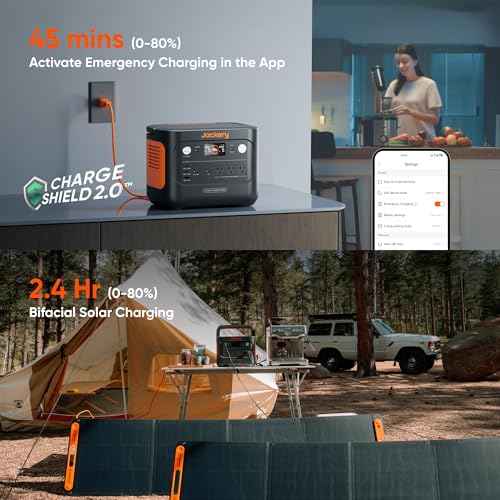


As an Amazon Associate we earn from qualifying purchases. Product prices and availability are accurate as of the date/time indicated.

BLUETTI Portable Power Station AC180


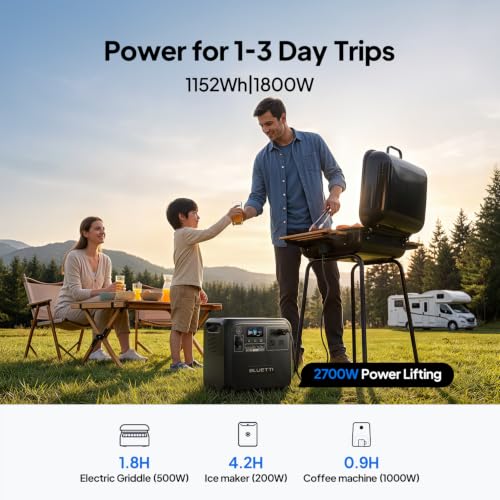
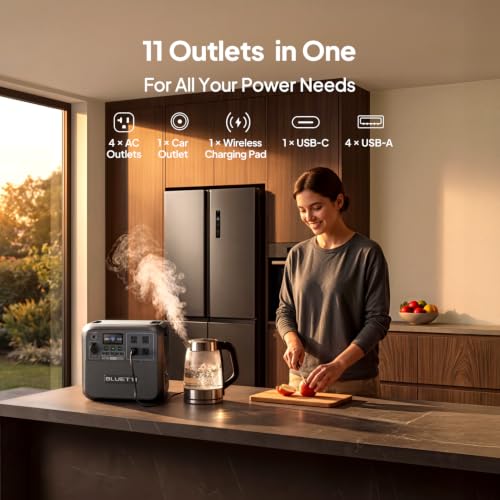
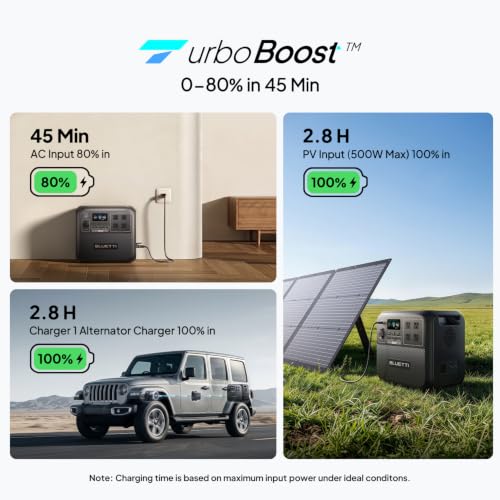

As an Amazon Associate we earn from qualifying purchases. Product prices and availability are accurate as of the date/time indicated.
Specs Side by Side
Figures come from the makers’ US product pages and the AC180 manual. Watt-hours (Wh) are the size of the tank; watts (W) are how fast you can pour from it.
| Spec | Jackery Explorer 1000 v2 | BLUETTI AC180 | Jackery Explorer 2000 v2 | BLUETTI FridgePower |
|---|---|---|---|---|
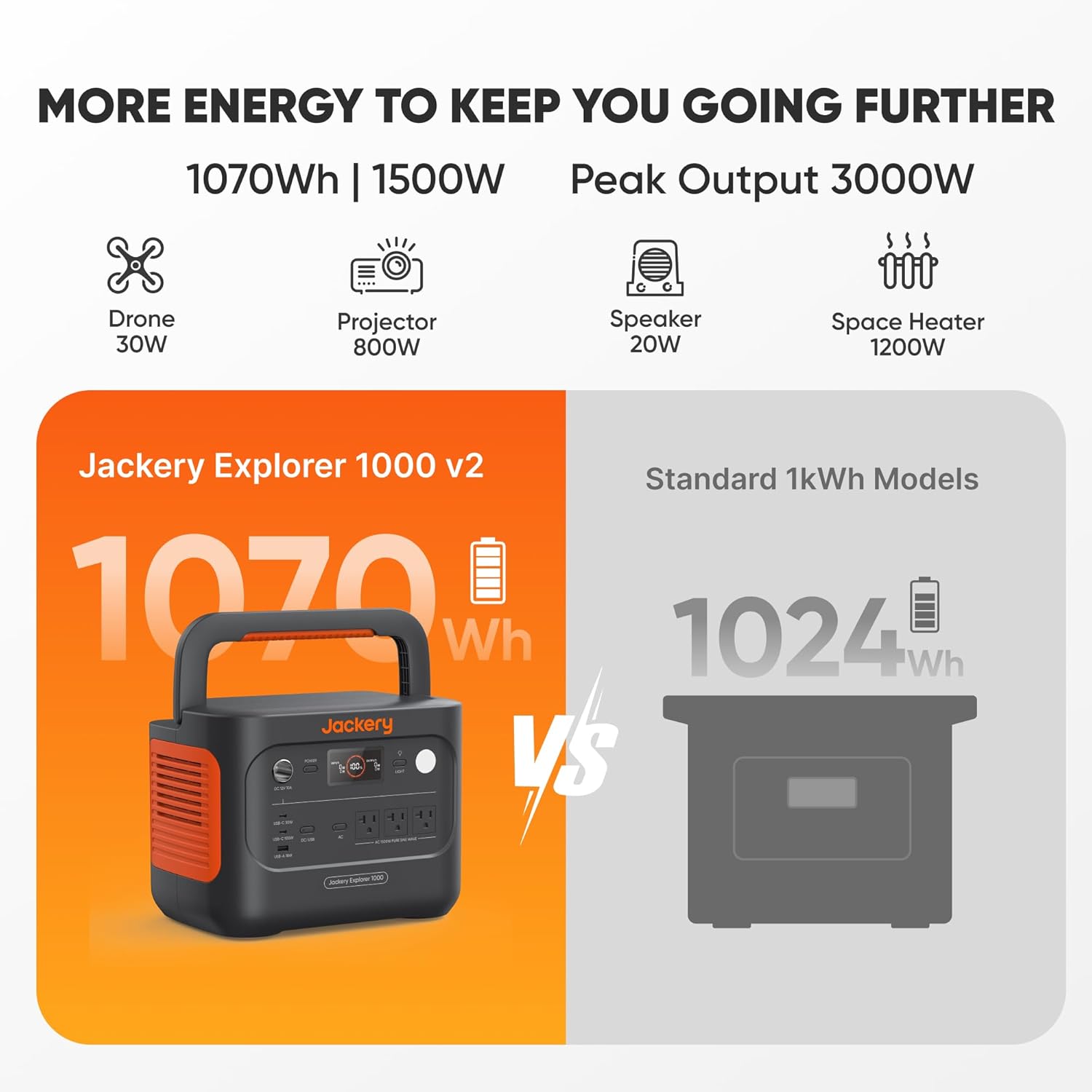
| Capacity | 1,070 Wh LiFePO4 | 1,152 Wh LiFePO4 | 2,042 Wh LiFePO4 | 2,016 Wh LFP |
| Continuous / peak | 1,500 W / 3,000 W | 1,800 W / 2,700 W surge | 2,200 W / 4,400 W | 1,800 W / 3,600 W |
| Expansion | None | None | None | Up to 8,064 Wh |
| Solar input | 400 W max, 12 to 60 V | 500 W max, 12 to 60 V, 10 A | 400 W max | Not stated here |
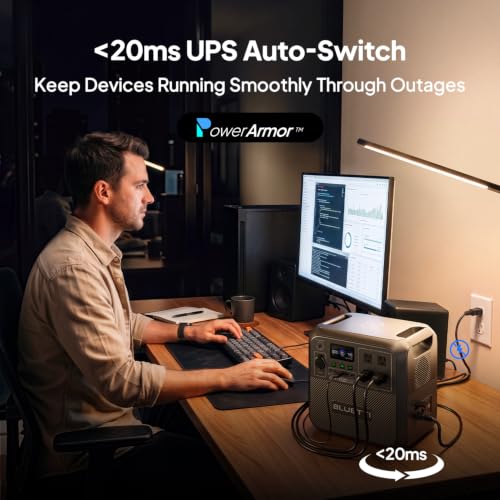
| UPS switchover | 20 ms or less | 20 ms or less | Under 20 ms | 10 ms or less |
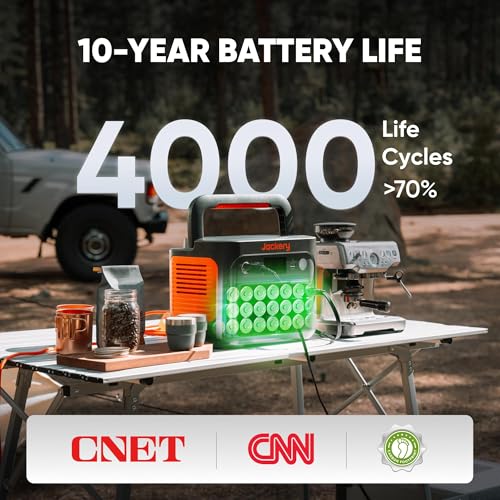
| Rated cycles | 4,000 to 70% | 3,500 or more | 4,000 to 70% | 4,000 to 80% |
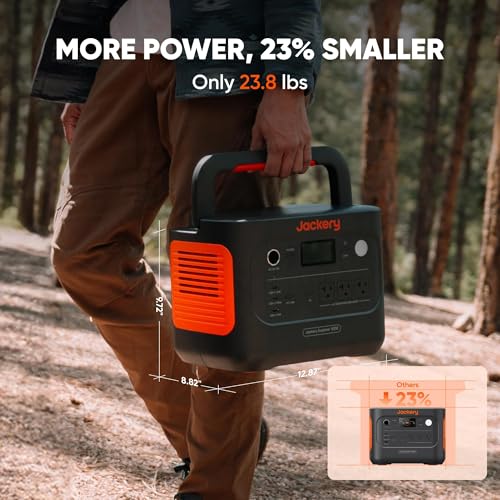
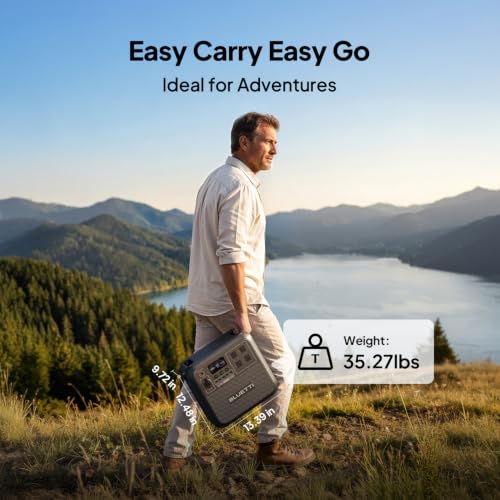
| Weight | 23.8 lb | 35.3 lb (other BLUETTI copy: 37 lb) | 39.5 lb | About 43.4 lb |
| Warranty | 3 years, plus 2 at jackery.com | 5 years | 3 years, plus 2 at jackery.com | 5 years |
Planning math for a fridge with a 600 kWh a year EnergyGuide label: 600,000 Wh / 8,760 h = about 68 W average. Outlet energy is rated Wh x 0.85 inverter efficiency. Jackery 1000 v2: 1,070 x 0.85 / 68 = about 13.4 hours. AC180: 1,152 x 0.85 / 68 = about 14.4 hours. Explorer 2000 v2: 2,042 x 0.85 / 68 = about 25.5 hours. FridgePower: 2,016 x 0.85 / 68 = about 25.2 hours.
The Four Differences That Matter
1. Continuous Output Against Surge
The AC180 offers 1,800 W continuous against the Jackery’s 1,500 W, which decides whether a 1,500 W microwave leaves headroom: 1,500 / 1,800 = 83 percent of the AC180’s rating, 100 percent of the Jackery’s. BLUETTI rates the AC180 at a 2,700 W surge; its separate Power Lifting mode, also up to 2,700 W, is described for heating devices, not compressor starts. The Jackery’s 3,000 W peak leaves more room for a motor. See running watts vs starting watts.
2. Solar Input
Hours of full sun to refill = rated Wh / (maximum solar watts x 0.75), with 0.75 as a planning derate. Jackery: 1,070 / (400 x 0.75) = about 3.6 hours. AC180: 1,152 / (500 x 0.75) = about 3.1 hours. Mind the amp limits: a 200 W panel rated 18 V and 11.5 A (the SolarSaga 200W figures) is held to the Jackery’s 10.5 A per input, or 18 x 10.5 = 189 W. Two such panels in series give 36 V, and the AC180’s 10 A cap trims them to 36 x 10 = 360 W. Connectors differ between brands, so confirm fit. More in how many watts of solar a power station needs.
3. Weight and Battery Wear
Energy per pound: Jackery 1,070 / 23.8 = about 45 Wh per lb; AC180 1,152 / 35.3 = about 33. The AC180 weighs 11.5 lb more, so it suits a station that stays put. After the rated cycles the Jackery holds 1,070 x 0.70 = about 750 Wh and the AC180 1,152 x 0.80 = about 920 Wh, though BLUETTI’s 3,500 is a minimum and Jackery’s is 4,000.
4. Expansion at 2 kWh
BLUETTI lists the FridgePower at up to 8,064 Wh (the base unit plus three BlueCell 200 batteries): 8,064 x 0.85 / 68 = about 101 hours of average fridge draw. Jackery’s 2000 v2 cannot accept expansion batteries, so its 2,042 Wh is a ceiling. The AC180 does not expand either. See what an expansion battery is. The FridgePower also lists a 4 W idle draw: 4 x 24 = 96 Wh a day, about 5 percent of its tank. Jackery states no idle figure.
Choose Jackery If
- You carry the station between rooms or into a car, where 23.8 lb beats 35.3 lb.
- You start motors and want the 3,000 W or 4,400 W peak rating.
- You buy at jackery.com to get the 3 plus 2 year warranty.
Best for: an apartment or garage fridge, router, and lights for one night.
Avoid if: you want to add capacity later, or you buy outside jackery.com and need the full 5 years.
Choose BLUETTI If
- You run 1,500 W to 1,800 W resistive loads and want 500 W of solar input.
- You want a flat 5-year warranty.
- You plan a multi-day fridge bank and can grow the FridgePower to 8,064 Wh.
Best for: a household whose goal is a fridge and freezer through a long outage.
Avoid if: you need a light box, or a compressor start needs more than the AC180’s 2,700 W surge.
We research and compare; we do not run our own product trials. Scores on each card reflect verified buyer ratings, explained on how we choose. Jackery’s support page says its stations are not recommended for medical devices, so check the manual before using either for a CPAP. See also the Jackery guide and Bluetti against EcoFlow.
FAQ
Is Jackery or BLUETTI better for a refrigerator?
They tie at 2 kWh: about 25 hours for a 68 W average fridge. BLUETTI pulls ahead only if you add batteries. See the refrigerator picks.
Can I add a battery to either 1 kWh model?
No. Jackery lists no expansion for the Explorer 1000 v2, and BLUETTI’s FAQ says the AC180 does not support capacity expansion.
Which has the longer warranty?
BLUETTI gives a flat 5 years. Jackery gives 3 plus 2 at jackery.com, so the extra 2 depends on where you buy.
Changelog: November 2026: first published.









