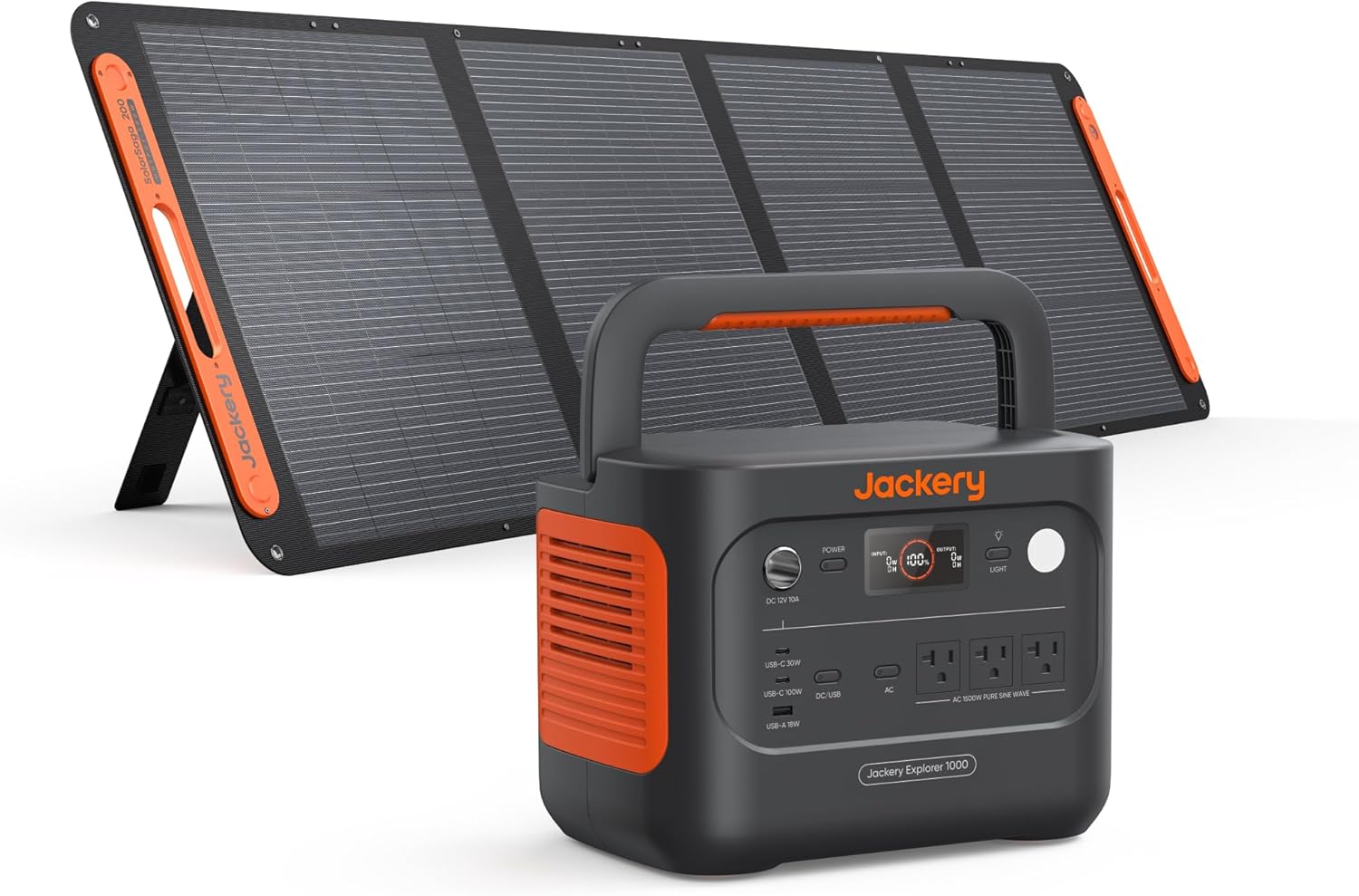
The Jackery most homes should buy is the Explorer 1000 v2: 1,070 Wh at 23.8 lb, enough for about 13 hours of a fridge rated at 600 kWh a year (1,070 Wh x 0.85 / 68.5 W), or about two CPAP nights with heat on. Step up to the Explorer 2000 v2 when the fridge has to last a full night and morning, and to the HomePower 3600 Plus only when you need a multi-day bank or a 240 V pair.



Quick Comparison
Runtimes are our math using Jackery’s own rule of thumb, capacity x 0.85 / load. The fridge is a 600 kWh a year label, which averages 600,000 Wh / 8,760 h = about 68.5 W. The CPAP night is 450 Wh: ResMed’s 56.1 W typical figure for the AirSense 11 with heat on, over 8 hours.
| Model | Capacity | Continuous / surge | Weight | Wh per lb | Solar input | Fridge hours | CPAP nights (heat on) | Best for |
|---|---|---|---|---|---|---|---|---|
| Explorer 1000 v2 | 1,070 Wh | 1,500 W / 3,000 W | 23.8 lb | about 45 | 400 W | about 13 | about 2 | Most homes, car camping |
| Explorer 2000 v2 | 2,042 Wh | 2,200 W / 4,400 W | 39.5 lb | about 52 | 400 W | about 25 | about 3.9 | Fridge through the night |
| HomePower 3600 Plus | 3,584 Wh | 3,600 W | 77.2 lb (listing) | about 46 | See text | about 44 | about 6.8 | Multi-day outages, RV parking |
| Solar Generator 1000 v2 (with SolarSaga 200W) | 1,070 Wh | 1,500 W / 3,000 W | 23.8 lb + 14.33 lb panel | about 45 (station) | 400 W | about 13 | about 2 | Off-grid camping, RV |
| Explorer 300 | 292 Wh | 300 W | 7.5 lb | about 39 | See text | about 3.6 | about 4.4 hours | Tent camping, a router |
How We Chose
We sized every Jackery in our product catalog against four household jobs: fridge backup, a CPAP night, a campsite, and an RV weekend. Then we ranked by how many of those jobs each one covers without a stretch. Specs come from the spec tables on jackery.com, with the Amazon listing noted where Jackery’s US page leaves a gap. The Yard & Grid Score on each card comes from verified buyer ratings. We research and compare; we do not run our own product trials. More on the method at how we choose.
Jackery’s current catalog listings give us four distinct stations, short of the five we usually want. We kept the Solar Generator 1000 v2 bundle as a fifth entry because the included panel changes what the station can do off grid, and we explain that below.
Matching a Jackery to Your House
- Fridge backup overnight. 14 hours from 6 p.m. to 8 a.m. at 68.5 W: 68.5 x 14 / 0.85 = about 1,130 rated Wh. The Explorer 1000 v2 at 1,070 Wh falls just short; the 2000 v2 clears it with about 11 hours to spare.
- CPAP. One heat-on night needs 450 / 0.85 = about 530 rated Wh. Any Jackery here except the Explorer 300 covers a full night. Note that Jackery’s own support page says its power stations are not recommended for use with medical devices; check with your equipment supplier and doctor first.
- Camping. The Explorer 300 is the only Jackery under 10 lb. The 1000 v2 is a two-hand carry from the trunk to the table.
- RV weekend. A labeled example day: a 12 V compressor fridge (360 Wh), a roof vent fan at 30 W for 8 hours (240 Wh), LED lights at 30 W for 5 hours (150 Wh), and devices (100 Wh) = 850 Wh. The 1000 v2 covers 1,070 x 0.85 / 850 = about 1.1 days before it needs a refill.
The Jackery Lineup, Ranked
1. Jackery Explorer 1000 v2
- 1,070 Wh LiFePO4, rated for 4,000 cycles to 70 percent or more, 1,500 W continuous and 3,000 W surge peak across three AC outlets, per jackery.com.
- At 23.8 lb it holds about 45 Wh per lb, the best ratio among the 1 kWh units in our wider catalog.
- AC recharge in 1.58 hours, or about 1 hour in the app’s emergency mode. Car charging from a 12 V socket takes 12 hours, so a 4 hour drive adds about 1,070 x 4 / 12 = about 360 Wh.
- Solar input runs from 12 to 60 V through two DC 8 mm ports, up to 400 W total; see the solar section below for what that means with one panel.
- Jackery’s US page lists a 3 + 2 year warranty; the extra 2 years are automatic only when you buy from jackery.com.
Best for: a fridge, router, and lights through an evening outage, then a weekend of car camping.
Avoid if: the fridge must run all night with no recharge, or you may want an expansion battery later.
2. Jackery Explorer 2000 v2
- 2,042 Wh LiFePO4, 2,200 W continuous and 4,400 W surge peak, 39.5 lb, per jackery.com.
- 2,042 / 39.5 = about 52 Wh per lb, the highest of any Jackery here. Per pound carried, it is the most battery Jackery sells in this list.
- About 25 fridge hours or 3.9 heat-on CPAP nights. Jackery’s US page lists a UPS switchover under 20 ms.
- Not expandable, so 2,042 Wh is the ceiling. AC recharge in 1.75 hours; car charging takes 24 hours, which makes the truck a slow backup source.
- Jackery rates it at 30 dB in Quiet Mode and 45 dB at full load, measured at 1 m.
Best for: a full-size fridge from dinner to mid-morning, or a CPAP for several nights in a bedroom.
Avoid if: you need a 240 V output or plan to grow the bank past 2 kWh.
3. Jackery HomePower 3600 Plus
- 3,584 Wh and 3,600 W, rated for 6,000 cycles, with wheels and a retractable handle, per jackery.com. The Amazon listing gives 77.2 lb.
- Expands to 21 kWh with up to five Battery Pack 3600 units. At 21 kWh: 21,000 x 0.85 / 68.5 = about 260 fridge hours, nearly 11 days for the fridge alone.
- Two units joined with the Jackery Connector (sold separately) give 7,200 W and 240 V, which Jackery pitches for well pumps and dryers. Connecting that to a home circuit is a job for a licensed electrician.
- Jackery’s page shows a NEMA TT-30 outlet, the RV-style plug, and lists a UPS switchover within 10 ms and a 5-year warranty when bought from jackery.com.
Best for: homes that lose power for two days or more, and RVs parked at a site with a TT-30 cord.
Avoid if: you need to carry it up stairs or into a car alone.
4. Jackery Solar Generator 1000 v2 (with SolarSaga 200W)
- The same Explorer 1000 v2 station plus one SolarSaga 200W panel, which Jackery lists at 14.33 lb and rates at 7.5 hours to recharge the 1000 v2.
- 7.5 hours to fill 1,070 Wh averages 1,070 / 7.5 = about 143 W into the battery, below the roughly 189 W port cap explained in the solar section.
- One panel in a typical 5 peak sun hour day, held to about 189 W by the port: 189 W x 5 x 0.75 derate = about 710 Wh, about 140 Wh short of the 850 Wh RV day above.
Best for: RVs and cabins that refill from the sun, bought as one matched kit.
Avoid if: the station will live indoors as fridge backup; buy the bare Explorer 1000 v2 instead.
5. Jackery Explorer 300
- 292 Wh LiFePO4 at 7.5 lb, 300 W from two AC outlets, a 100 W USB-C port, and a 120 W car port, per jackery.com.
- CPAP with heat on: 292 x 0.85 / 56.1 W = about 4.4 hours. A full night needs a lower draw.
- Jackery lists 80 percent in about 2.8 hours from a 100 W panel, and a 2 + 1 year warranty.
- Any AC load over 300 W shuts it off, per Jackery’s FAQ, which rules out a fridge or a coffee maker.
Best for: tent camping with phones, lights, and a small fan, or keeping a router and modem up for several hours at home.
Avoid if: anything you plug in draws more than 300 W.
Jackery Solar Input: What 12 to 60 V Means
The Explorer 1000 v2 accepts 12 to 60 V on each DC 8 mm port, but the current limit changes with voltage. Jackery lists 8 A at 12 to 16 V and 10.5 A at 16 to 60 V per port, with 21 A and 400 W as the combined ceiling. A SolarSaga 200W runs at about 18 V and 11.5 A at its rated point, so one panel on one port is held to about 18 V x 10.5 A = about 189 W. Two panels on two ports give about 2 x 189 = 378 W, just under the 400 W ceiling. The Explorer 2000 v2 is similar: 8 A at 11 to 16 V, 12 A at 16 to 60 V, 400 W total.
For other panel brands, check the panel’s open-circuit voltage against the 60 V limit and the plug against Jackery’s DC 8 mm port. Our solar sizing guide walks through the math.
Cost of Ownership
- Where you buy: Jackery’s longer warranties (3 + 2 on the Explorer v2 models, 5 years on the HomePower 3600 Plus) are tied to jackery.com purchases. Check the terms for the seller you use.
- Battery life: the Explorer v2 models are rated to 70 percent after 4,000 cycles. One cycle every outage day for 30 days a year is 4,000 / 30 = about 130 years of outage use, so for backup-only use the cycle rating is unlikely to be the limit.
- Panels and adapters: solar is extra except in the bundle. Jackery sells DC7909 to DC8020 adapters for older panels.
- Cold: the v2 models charge only between 32°F and 113°F, per Jackery. A station kept in an unheated garage needs to warm up before it will charge. See power stations in cold weather.
How to Pick Your Jackery
- How long must it last without a recharge? Rated Wh = watts x hours / 0.85. A fridge plus a 10 W router for 14 hours: (68.5 + 10) x 14 / 0.85 = about 1,290 Wh, which points to the 2000 v2.
- Will you add capacity later? Only the HomePower 3600 Plus expands. The Explorer 1000 v2 and 2000 v2 do not.
- Do you need 240 V? Only a pair of HomePower 3600 Plus units provides it in this list.
- How will you recharge away from home? Car charging is slow (12 hours on the 1000 v2, 24 on the 2000 v2), so plan on solar for multi-day trips.
If you are still choosing a brand, our EcoFlow vs Jackery comparison lines up each size tier, and the EcoFlow lineup guide covers the other side.
FAQ
What is the best Jackery for camping?
For a tent, the Explorer 300 at 7.5 lb. For car camping with a cooler, the Explorer 1000 v2 at 23.8 lb. Our camping power station guide compares them with other brands.
What is the best Jackery for RV camping?
For a weekend with solar, the Solar Generator 1000 v2. For a longer stay, the HomePower 3600 Plus, whose TT-30 outlet matches many RV cords. Check your RV’s load before relying on either.
Does the Explorer 1000 v2 have UPS mode?
Jackery’s US page text says it switches power in under 20 ms, though the US spec table lists no figure; the Australian page lists 20 ms or less. Whether a given device rides through that gap depends on the device. See what UPS mode is.
Can I use non-Jackery solar panels?
Jackery’s US spec table lists a 12 to 60 V input range and does not limit the brand. The “Jackery panels only” wording appears in the Amazon listing, not on jackery.com. Match the voltage and use the right adapter.
Changelog: November 2026: first published.