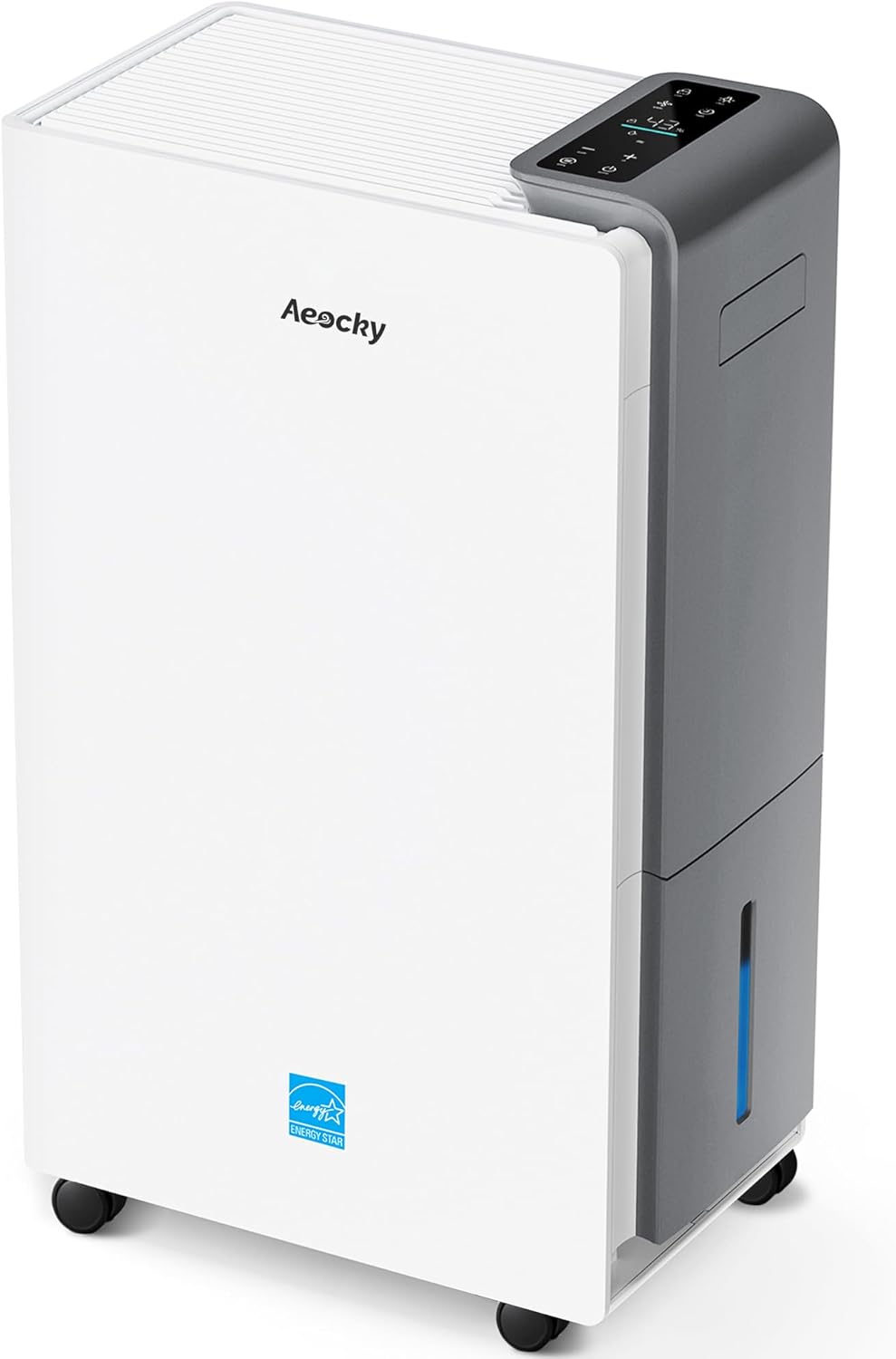
For a damp basement of about 1,000 to 1,500 sq ft, choose a dehumidifier rated roughly 30 to 40 pints per day under the DOE rating method in force since June 2019, and the AEOCKY RHEA-002 is the one we recommend first: ENERGY STAR lists it at 32 pints a day at 65°F and 60% relative humidity (RH), with an efficiency of 2.09 liters per kWh, the highest among the 30 to 40 pint models we compared. The “105 pint” figure on its listing is measured at 95°F and 95% RH, conditions a basement rarely sees.


Quick Comparison
The DOE column is the number to compare. It comes from the ENERGY STAR certified product database, checked in October 2026, and every model in it was rated at the same 65°F, 60% RH condition.
| Model | DOE pints per day | Efficiency (liters per kWh) | Drainage | Tank | Weight | Best for |
|---|---|---|---|---|---|---|
| AEOCKY RHEA-002 | 32.0 | 2.09 | Gravity hose or tank | 1.45 gal | 34 lb | Damp basements of 1,000 to 1,500 sq ft with a floor drain |
| Yaufey JD025Q-120 | 35.8 | 2.01 | Gravity hose (3.28 ft) or tank | 1.06 gal | 31.8 lb | Very damp basements up to about 1,500 sq ft |
| Waykar CTH120A | 32.5 | 2.01 | Gravity hose (3.3 ft) or tank | 1.24 gal | 28.8 lb | Cool basements that sit in the 50s |
| hOmeLabs HME1004 | Not in ENERGY STAR database | Not published | Built-in pump, gravity, or tank | 1.6 gal | 30.5 lb | Basements with no floor drain |
| AEOCKY RHEA-001 | 24.5 | 1.86 (Most Efficient) | Gravity hose or tank | 1.45 gal | 31 lb | Moderately damp basements under 1,000 sq ft |
How We Chose
We started by throwing out the number printed on most boxes. Since the DOE changed its rating method in 2019, a model’s rated capacity is measured at 65°F and 60% RH, a cool, damp condition close to a real basement. Many listings still lead with a figure measured at 95°F and 90% RH or higher, which can be about three times the DOE number. We ranked on:
- DOE capacity in pints per day, looked up by model number in the ENERGY STAR certified product database.
- Integrated energy factor (IEF), the liters of water removed per kWh of electricity, from the same database.
- Drainage options, because a basement unit that needs its bucket emptied twice a day will not stay in use.
- Low-temperature operation, since ENERGY STAR notes that frost can form on the coils below 65°F.
- Yard & Grid Score, built from verified buyer ratings, as a check on owner satisfaction over time.
Our sources are the ENERGY STAR database and dehumidifier guidance, the federal efficiency rules in 10 CFR 430, maker listings, and public owner reviews. We research and compare; we do not run product trials ourselves. The full method is on how we choose.
The Box Number vs the DOE Number
Across these models, the DOE rating comes out at about 30 percent of the headline figure. Use this table to translate any listing you see.
| Model | Headline on listing | Headline condition | DOE rating (65°F, 60% RH) | DOE as share of headline |
|---|---|---|---|---|
| AEOCKY RHEA-002 | 105 pints | 95°F, 95% RH | 32.0 pints | 32.0 / 105 = about 30 percent |
| Yaufey JD025Q-120 | 120 pints | 95°F, 90% RH | 35.8 pints | 35.8 / 120 = about 30 percent |
| Waykar CTH120A | 120 pints | 95°F, 90% RH | 32.5 pints | 32.5 / 120 = about 27 percent |
| AEOCKY RHEA-001 | 80 pints | 95°F, 95% RH | 24.5 pints | 24.5 / 80 = about 31 percent |
| Waykar CTH30A (not ranked) | 30 pints | 95°F, 90% RH | 9.2 pints | 9.2 / 30 = about 31 percent |
The last row is why we left small “30 pint” units off this list: at the DOE condition, that box removes about 9 pints a day, a closet-size figure. Older pre-2019 ratings used 80°F and 60% RH, and ENERGY STAR’s conversion table maps an old 50 pint rating to roughly 30 pints and an old 70 to about 40 to 45, varying by model. Our pint ratings explainer covers the change in detail.
The Picks
1. AEOCKY RHEA-002: the most water per kWh
- ENERGY STAR lists model RHEA-RCS32(Y)-N4-3, which names RHEA-002 as an alias, at 32.0 pints per day and an IEF of 2.09 liters per kWh. The federal minimum for a 25 to 50 pint portable is 1.60, so it beats the floor by 2.09 / 1.60 = about 31 percent.
- The listing calls it ENERGY STAR Most Efficient 2024; the current database record does not carry the Most Efficient flag, so we treat it as certified and efficient, not as Most Efficient.
- The listing gives a 40 to 80% humidity range, a lowest fan level of 44 decibels, a weight of 34 lb, and 3 years of coverage.
- It has an auto-defrost system, but AEOCKY does not publish a minimum operating temperature.
Best for: a 1,000 to 1,500 sq ft basement that reads 60 to 70% RH in summer and has a floor drain within reach of a hose.
Avoid if: your only drain point is a sink above the unit, since it has no built-in pump.
2. Yaufey JD025Q-120: the most DOE capacity
- ENERGY STAR lists the JD025Q-120 at 35.78 pints per day and 2.01 liters per kWh, the highest capacity of our picks.
- Its humidity range runs 30 to 80%, with preset modes at 45% (basement), 50%, and 55%.
- The tank holds 1.06 gal and a 3.28 ft drain hose is included; the listing quotes 55 decibels on low, louder than the AEOCKY.
- Coverage is 1 year, plus 1 more year when you register the unit.
Best for: a basement that stays above 65% RH even with a smaller unit running, or one with past water seepage along the walls.
Avoid if: the unit will sit near a bedroom or office where 55 decibels on low will bother someone.
3. Waykar CTH120A: built for cooler basements
- ENERGY STAR lists the CTH120A at 32.46 pints per day and 2.01 liters per kWh, close to the AEOCKY.
- The listing says its auto-defrost operates down to 42°F, the only specific low-temperature figure among our picks.
- A comfort mode targets 55% RH below 65°F, 50% from 65 to 77°F, and 45% above 77°F, per the listing.
- It weighs 28.8 lb, the lightest here, with a 1.24 gal tank and a 3.3 ft hose; coverage is 1 year plus an extended second year.
Best for: unheated basements that sit in the 50s through spring and fall.
Avoid if: you need more than about 33 pints a day at the DOE condition; step up to the Yaufey.
4. hOmeLabs HME1004: the pick with a built-in pump
- It is the only pick with a built-in pump, which pushes water through a hose to a sink or window instead of relying on gravity.
- Its listing rates it at 50 pints per day at 80°F and 60% RH, the pre-2019 condition, and 120 pints at 95°F and 90% RH. We did not find it in the ENERGY STAR database, so we have no DOE figure; by ENERGY STAR’s conversion table, an old 50 pint rating is roughly 30 pints today.
- The listing adds Wi-Fi control, a 1.6 gal tank, and a weight of 30.5 lb.
- Its listing carries more than 15,000 owner ratings, which is why it makes the list despite the missing DOE number.
Best for: a finished basement with no floor drain, where water has to go up to a laundry sink.
Avoid if: you want a verified DOE capacity and efficiency number before you buy.
5. AEOCKY RHEA-001: the efficient small-basement unit
- ENERGY STAR lists model RHEA-RCS25(Y)-N4-3-25, alias RHEA-001, at 24.5 pints per day and 1.86 liters per kWh, and flags it as Most Efficient.
- Against the 1.30 federal minimum for units of 25 pints or less, that is 1.86 / 1.30 = about 43 percent better.
- It shares the RHEA-002 body, 1.45 gal tank, and 3 years of coverage, at 31 lb per the listing.
Best for: a basement under 1,000 sq ft that feels damp or smells musty but never shows wet spots.
Avoid if: you see standing water or wet walls, where 24.5 pints a day will run nonstop and still fall behind.
Cost of Ownership
Electricity is the main running cost, and IEF lets you work it out. One pint is about 0.473 liters, so the energy to remove a day’s water is pints x 0.473 / IEF.
| Model | kWh to remove 20 pints | kWh at full DOE output per day | ENERGY STAR estimated kWh per year |
|---|---|---|---|
| AEOCKY RHEA-002 | 20 x 0.473 / 2.09 = about 4.5 | 32.0 x 0.473 / 2.09 = about 7.2 | 339 |
| Yaufey JD025Q-120 | 20 x 0.473 / 2.01 = about 4.7 | 35.8 x 0.473 / 2.01 = about 8.4 | 375 |
| Waykar CTH120A | 20 x 0.473 / 2.01 = about 4.7 | 32.5 x 0.473 / 2.01 = about 7.6 | 343 |
| AEOCKY RHEA-001 | 20 x 0.473 / 1.86 = about 5.1 | 24.5 x 0.473 / 1.86 = about 6.2 | 285 |
A basement that needs 20 pints a day for a 150-day humid season costs the RHEA-002 about 4.5 x 150 = 675 kWh. At the EIA’s August 2026 average residential rate of 18.16 cents per kWh, that is about 123 dollars for the season. The same work on the RHEA-001 takes about 5.1 x 150 = 765 kWh, so the larger, more efficient unit uses less power for the same water. Other costs to plan for: a longer drain hose if the floor drain is more than 3 ft away, a washable filter to keep clean, and coverage that runs 2 to 3 years on the models that state it.
How to Choose: Four Questions
How much water do you need to remove?
If you already run a small unit, count how often you empty it. One gallon is 8 pints, so a 1.06 gal tank emptied twice a day means 2 x 1.06 x 8 = about 17 pints a day, and that unit may be running flat out. Pick a model whose DOE rating is comfortably above that figure; ENERGY STAR advises that it is better to oversize than undersize. Our dehumidifier sizing guide covers sizing by square footage and dampness.
What humidity are you aiming for?
The EPA advises keeping indoor humidity below 60%, ideally 30 to 50%. After a flood, Delaware’s public health guidance says to keep drying until humidity returns to a normal 35 to 55%. Read the room with a separate gauge rather than the unit’s own display; our hygrometer explainer shows how to check one for accuracy.
Where will the water go?
A gravity hose needs a floor drain or sump pit lower than the unit’s outlet. If the nearest drain is a laundry sink, you need a built-in pump like the hOmeLabs, or a separate condensate pump. A tank alone works only if you can empty it daily.
How cold does the basement get?
Below 65°F, compressor units can frost and cycle without removing much water, per ENERGY STAR. If your basement spends months in the 50s, favor a model with a stated low-temperature limit like the Waykar, and read our guide on running a basement dehumidifier in winter.
FAQ
What size dehumidifier for a 1,000 sq ft basement?
ENERGY STAR’s sizing chart puts a very damp space under 2,000 sq ft at 25 to 40 pints per day; the chart does not say which rating method it uses, so compare against each model’s DOE figure and aim toward the top of that range if you see wet spots. On this list, that points to the RHEA-002, the Waykar CTH120A, or the Yaufey.
Why is the pint rating on the box so much higher than ENERGY STAR’s?
The box number is usually measured at 95°F and 90% RH or more, where warm, wet air gives up water easily. The DOE number is measured at 65°F and 60% RH. Across our picks, the DOE figure is about 27 to 31 percent of the headline.
How many hours a day should a basement dehumidifier run?
Set it to a humidity target and let the humidistat decide. If it runs almost all day and the gauge stays above 60%, the unit is too small. Our guide on how long to run a dehumidifier has the formula.
Is a Most Efficient model worth seeking out?
Only if it is also big enough. The RHEA-001 carries the flag, but removing 20 pints a day costs it more electricity than the larger RHEA-002, because its efficiency is lower: 1.86 versus 2.09 liters per kWh. Compare the IEF figure itself when you shop.
Changelog: October 2026: first published.