


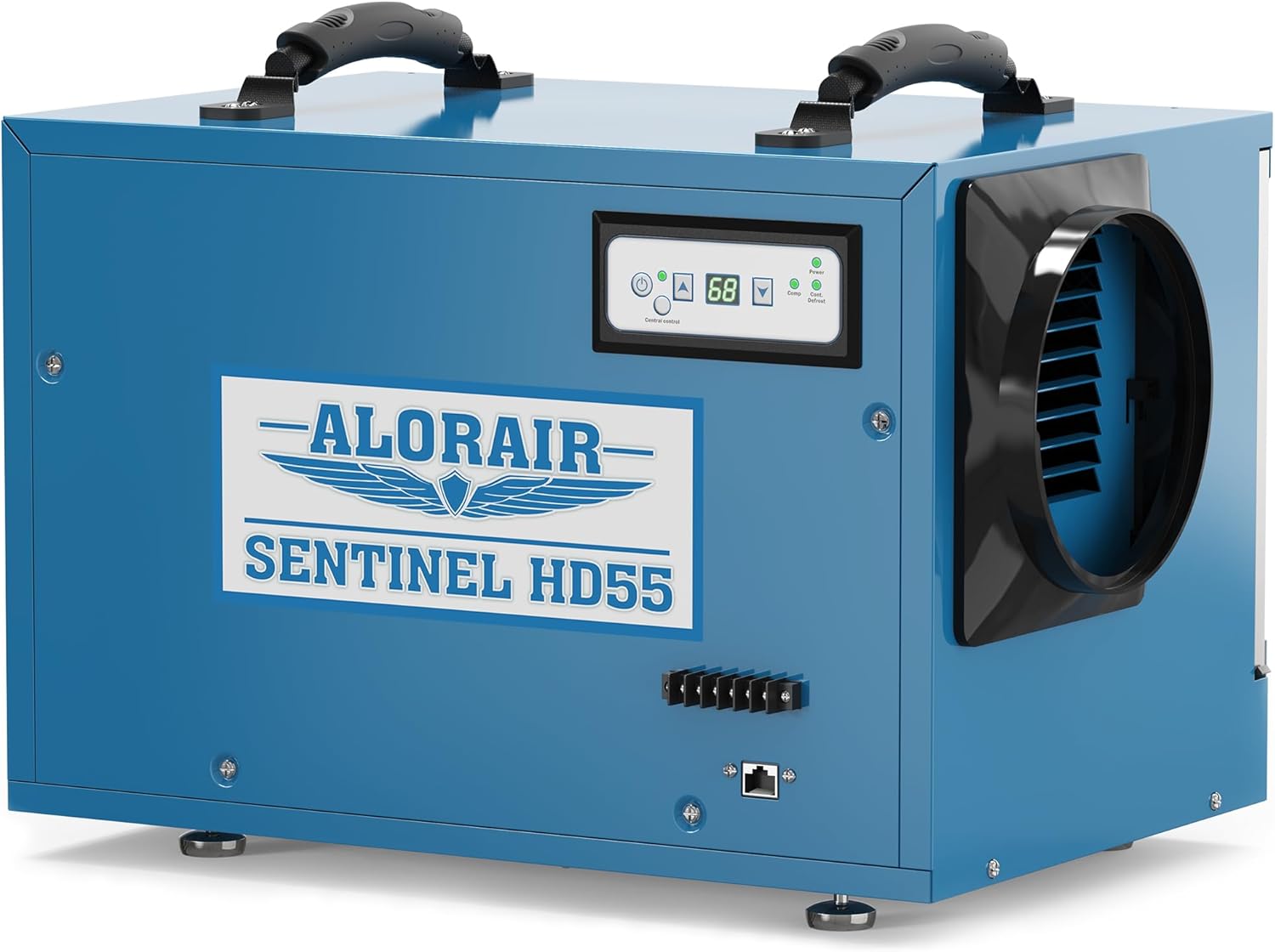
For most crawl spaces under about 1,300 sq ft, the first model to price is the AlorAir Sentinel HD55S: its listing gives 55 pints a day on AlorAir’s AHAM basis (80°F, 60% RH), a metal housing, and a listed warranty that reaches 5 years on refrigeration parts. It drains by gravity, so it suits a crawl space where a hose can run downhill to the outdoors. If the water has to go up and out, rank a pump model first.



Quick Comparison
Each row uses the maker’s listing numbers. The AHAM column is the one to compare, because the saturation figure is measured in far wetter air than a typical crawl space. Where a maker states the AHAM conditions (AlorAir, CADPXS), they are 80°F and 60% RH, warmer than the current DOE method at 65°F.
| Model | AHAM pints per day | Saturation pints per day | Listed coverage | Drainage | Best for |
|---|---|---|---|---|---|
| AlorAir Sentinel HD55S | 55 | 120 | 1,300 sq ft | Gravity hose | Gravity drain to the outdoors, cold-season crawl spaces |
| AlorAir Sentinel HD55 | 53 | 113 | 1,200 sq ft | Gravity hose | Same job, older listing with a 460 W figure |
| AlorAir 70-pint with pump (Wi-Fi) | 35 | 70 | 1,000 sq ft | Built-in pump or gravity | Small crawl spaces with no downhill route |
| CADPXS 80-pint with pump | 38 | 80 | 1,200 sq ft | Built-in pump or gravity | Mid-size spaces needing a pump |
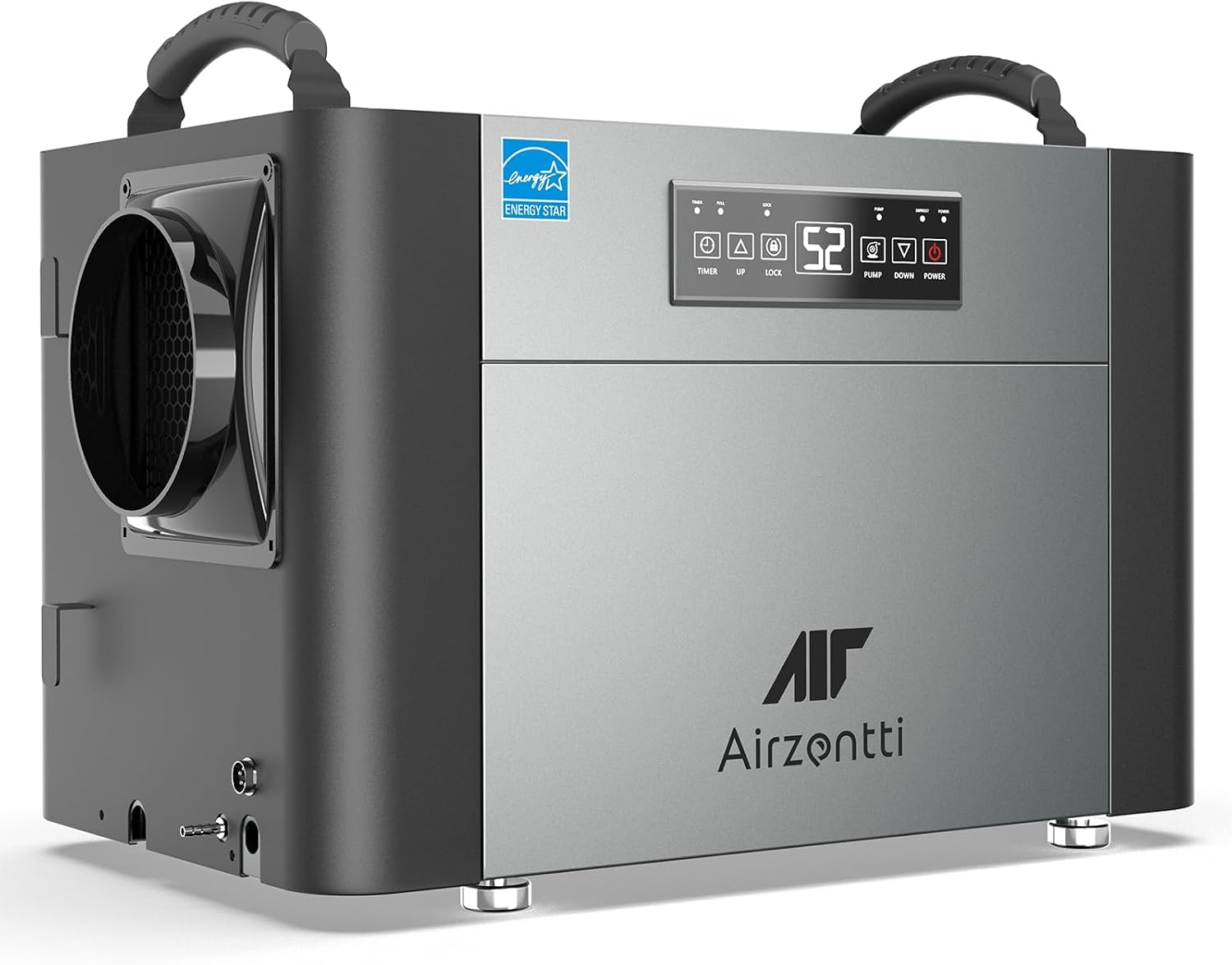
| Airzentti 155-pint with pump | 70 | 155 | 7,500 sq ft (listing) | Built-in pump or gravity | Very large or wide-open spaces; 59 lb |
How We Chose
We read spec sheets and maker listings, then compared them. We research and compare; we do not run our own product trials. Five things decided the order:
- AHAM rating first. A “113 pint” or “155 pint” headline is a saturation figure; the AHAM number is roughly 45 to 50 percent of it on these models (for example 53 / 113 = 47 percent).
- Drainage. A crawl space rarely has a floor drain, so a gravity hose to daylight or a pump with enough lift matters more than tank size.
- Low-temperature behavior. Compressor units collect frost in cool air, so we looked for a stated auto-defrost feature.
- Build and service: metal housing and published warranty terms.
- Buyer ratings, only where the catalog has them. The Sentinel models have verified-buyer ratings (4.0 and 4.2); the other three do not, so they rank on specs and brand clarity alone.
The method is on how we choose, and the pint-rating background is in our pint ratings explainer.
The Picks
1. AlorAir Sentinel HD55S
- The listing gives 55 pints a day at AHAM conditions and 120 at saturation, for up to 1,300 sq ft, with 130 cfm airflow.
- The listing says ENERGY STAR certified, and the ENERGY STAR database confirms it, rating the HD55S at 36.33 pints a day under the current DOE method (379 kWh a year). It is also listed as cETL, with a metal housing and auto-defrost; the buyer rating is 4.0 from 1,436 reviews.
- Warranty terms differ by source: the Amazon spec text gives 1 year parts and labor, 3 years parts and labor on the refrigeration system, and 5 years parts on it, while AlorAir’s own page advertises a 6-year limited warranty. Get the terms in writing.
- There is no tank. Water leaves through a drain outlet, so you need a downhill route or a separate condensate pump.
Best for: a crawl space of 1,000 to 1,300 sq ft where a hose can run downhill to the outside.
Avoid if: the lowest point of the space is below your drain route, because this model has no pump.
2. AlorAir Sentinel HD55
- The listing gives 53 pints a day at AHAM and 113 at saturation, for up to 1,200 sq ft, with a 104°F upper temperature rating and 120 cfm.
- The listing shows a 460 figure (labeled watt-hours) and a 41.7 lb weight. The buyer rating is 4.2 from 1,228 reviews.
- Same gravity-drain design and same warranty text as the HD55S, so the choice comes down to which one is in stock.
Best for: a buyer who wants the Sentinel build and a slightly higher buyer rating.
Avoid if: you want the ENERGY STAR claim that appears on the HD55S listing.
3. AlorAir 70-pint Wi-Fi model with pump
- The listing gives 35 pints a day at AHAM and 70 at saturation, for up to 1,000 sq ft, in a 38.2 lb unit.
- The listing says the built-in pump lifts water up to 19.6 ft through a 19.6 ft hose and that the Wi-Fi app shows live humidity.
- AlorAir sells a separate 70 PPD listing with the same dimensions and pump but no Wi-Fi mention; we list one ASIN for the machine.
- It has no buyer ratings in our catalog, so treat the claims as the maker’s.
Best for: a small crawl space where the water must go up to a window or sink.
Avoid if: your crawl space is closer to 1,300 sq ft, where 35 AHAM pints is thin.
4. CADPXS 80-pint with pump
- The listing gives 38 pints at AHAM (stated as 80°F, 60% RH) and 80 at saturation, for up to 1,200 sq ft, at 310 W and 37 lb. The listing text names two different model numbers, so confirm which one ships.
- The pump lifts water up to 19.6 ft per the listing, and a 6.56 ft gravity hose is included for floor-drain setups.
- The listing says it can be floor or ceiling mounted. No buyer ratings in the catalog.
Best for: a mid-size space that needs both drain options.
Avoid if: you need a brand with a long published warranty record.
5. Airzentti 155-pint with pump
- The listing gives 70 pints at AHAM and 155 at saturation, 220 cfm, 860 W, and 59 lb, with a pump rated for 16.4 ft. The ENERGY STAR database lists model ACD155P-PG100(B) at 49.83 pints a day under the current DOE method.
- It carries a 6 in duct collar, which lets you move air through ducting.
- It is the heaviest and has the highest listed wattage, and the catalog has no buyer ratings.
Best for: a very large or open crawl space, or one shared with other storage areas.
Avoid if: your space is under 1,200 sq ft; it will cycle often and cost more to run than it needs to.
Cost of Ownership
Electricity is the main cost. Energy use is watts times hours: a 310 W unit running 12 hours a day uses 0.31 kW x 12 h = 3.72 kWh a day, or about 112 kWh over 30 days. Multiply by your own rate. The Sentinel listings carry multi-year coverage; for the other three, ask the seller for written warranty terms before buying.
Choosing and Placement
- Drain route first: if you can run a hose downhill to daylight, a gravity unit works; if not, pick a pump and check its listed lift against your height (a 4 ft rise is well within a 15 ft lift).
- Size by AHAM pints, not saturation, and expect less in a cool crawl space; the ENERGY STAR DOE-method figures above run well below the AHAM numbers. A rough match is the listed coverage for the AHAM figure: 55 pints / 1,300 sq ft = 0.042 pints per sq ft per day.
- Fix liquid water first. A dehumidifier handles humid air; standing water or a bare dirt floor is a drainage and vapor-barrier job, and a contractor can assess it.
- Use a hygrometer to see what you actually have. Our hygrometer guide explains the readings.
- Power: plug into a grounded outlet. Avoid long extension cords, and see CPSC’s extension cord guidance. Have a licensed electrician add an outlet if none is nearby.
For basement use, see our basement dehumidifier picks and the sizing guide.
FAQ
Is a regular home dehumidifier fine for a crawl space?
Often not. Crawl spaces are cool, tight, and hard to drain. Models built for them list auto-defrost, a metal housing, and a drain hose or pump.
Should I run the unit all the time?
Most units cycle on a humidity setting. Set a target on the control and watch a hygrometer. See run times.
Does a dehumidifier replace sealing the crawl space?
No. Sealing and drainage work reduce how much moisture enters; the dehumidifier removes what remains. Ask a qualified contractor about your specific space.
Changelog: November 2026: first published.









