


A small ice-pack case is only a bridge in an outage, so pick the one whose cooling hours cover the gap between frozen-pack swaps. The DISONCARE Odyssey 60H has the longest published window of the four below, about 36 hours at 86°F ambient with its gel bottle frozen, per the maker. The three soft cases run on the order of hours, not days. None of them replaces a call to your pharmacist.



What the FDA says first
The U.S. Food and Drug Administration (FDA) page “Safe Drug Use After a Natural Disaster” names insulin and certain liquid antibiotics as medicines that need refrigeration. If a medicine was not kept at its recommended temperature during an outage, FDA says to contact a pharmacist, health care provider, or the manufacturer to find out whether it can still be used. FDA also warns that temperature-sensitive medicines may lose potency when stored outside their range.
For insulin, FDA’s emergency storage page says vials or cartridges, opened or unopened, may be left unrefrigerated between 59°F and 86°F for up to 28 days. It says to keep insulin as cool as possible, and “If you are using ice, avoid freezing the insulin.” Do not use insulin that has been frozen. This is general information, not medical advice. Your doctor or pharmacist knows your product and your dose. More in what to do with insulin during a power outage.
Quick Comparison
| Case | Size and weight (listing) | Cooling claim | Best for |
|---|---|---|---|
| DISONCARE Odyssey 60H | 9.84 x 4.76 x 2.99 in, 1.34 lb (package) | About 36 h at 2 to 8°C (36 to 46°F), up to 60 h if the range widens to 2 to 25°C, at 86°F ambient (maker) | Longest gap between pack swaps |
| AUVON Lightweight, 3-layer | 7.68 x 3.15 x 1.38 in, 3.17 oz | Up to 9 h within 36 to 86°F with a frozen pack (listing only) | Pocket carry, daily use |
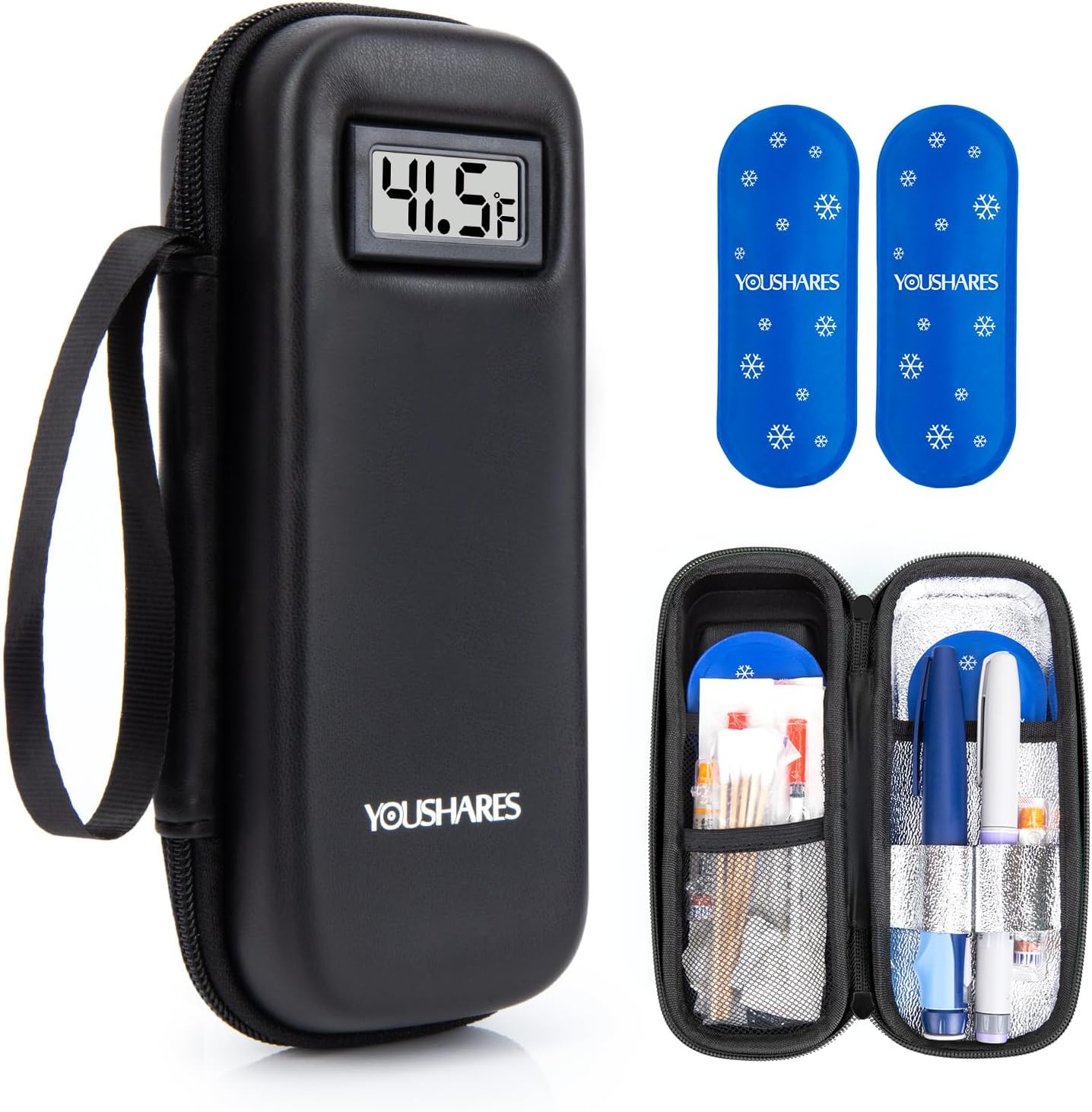
| YOUSHARES with temp display | 8.5 x 3.5 x 2.3 in, 9.52 oz | 6 to 8 h at 75 to 82°F (maker page for its H2 display case) | Seeing the inside temperature |
| SUZAMED, 2 x 150 g packs | Not in the data | No hours in the data; title lists two 150 g packs | Spare-pack backup |
How We Chose
We research and compare; we do not use or review the products ourselves. Each case was read against its listing and, where the page opened, the maker’s own page. Cooling hours are maker or listing claims at a stated room temperature, so treat them as best case. The data included an evaporative wallet with no rating, which we left out; that leaves four picks, not five. Scoring is explained on how we choose.
DISONCARE Odyssey 60H
- The maker separates two numbers: about 36 hours inside 2 to 8°C at 86°F ambient, and up to 60 hours only if the allowed range widens to 2 to 25°C (77°F). At 104°F ambient the figures drop to about 30 and 48 hours. DISONCARE says “up to 60 hours” does not mean 2 to 8°C the whole time.
- Double-wall stainless-steel body with a digital display, and the heaviest of the four at 1.34 lb (package weight).
- It is built around pens; the maker’s page lists 1 to 3 pens, so check vial fit before buying.
Best for: households that expect to be away from a freezer for a day. Avoid if: you carry vials or need a pocket-size case.
AUVON Lightweight Insulin Cooler
- At 3.17 oz and 7.68 x 3.15 x 1.38 inches it fits a jacket pocket or go-bag.
- The listing claims up to 9 hours within 36 to 86°F after the pack is frozen (we found no maker page to confirm it), which is a wide band, not a refrigerator range.
- Three-layer insulation per the title; no hours are published for a hot car or a 100°F day.
Best for: a light second case for the go-bag. Avoid if: you need more than a working day between pack swaps.
YOUSHARES Insulin Cooler with Temp Display
- The display lets you read the inside temperature without opening the case, useful when you decide whether to swap the pack.
- YOUSHARES’s page for its H2 display case gives 6 to 8 hours at 75 to 82°F (24 to 28°C) after the packs are frozen. This listing’s model number points to the H2, so confirm it matches.
- At 8.5 x 3.5 x 2.3 inches and 9.52 oz it is roomier than the AUVON.
Best for: people who want a reading in hand. Avoid if: you want a long-hour claim; its listed rating is the lowest of the four (4.2 stars).
SUZAMED 2 x 150 g Ice Pack Case
- Two 150 g packs let you keep one frozen in the freezer while the other is in use.
- The listing shows 4.6 stars from 4,056 ratings.
- No dimensions or hours appear in the data, so ask the seller before relying on it.
Best for: a rotation of two packs. Avoid if: you need published hours or sizes.
Cost of Ownership
The case is the small cost. The real dependency is a freezer: the makers we read ask for the pack to be frozen first: 6 to 8 hours for the DISONCARE gel bottle, 8 to 12 hours for the YOUSHARES packs. Per FDA, a full freezer holds temperature about 48 hours if the door stays shut, and a freezer alarm shows when it has warmed (best freezer alarms). Keep spare packs frozen at all times.
How to Choose
Pack swaps needed = outage hours divided by hours per pack. A 24-hour outage with a 6 to 8 hour pack: 24 / 8 = 3 to 24 / 6 = 4 swaps. A 72-hour storm with a 36-hour window: 72 / 36 = 2 swaps. Every swap needs a frozen pack, and the freezer is also losing cold, so a multi-day outage means moving the medicine, not stretching the case. Ask your pharmacist now about a plan: where to go, and what they can do for refills.
Keep the frozen pack from pressing on vials or pens, since FDA says to avoid freezing insulin, and follow the case’s own instructions. Pair the case with how to store medications for an emergency and the fridge steps in how to keep food cold during a power outage.
FAQ
Can a cooler replace my refrigerator for insulin?
Not for days. These cases hold a stated temperature range for hours with frozen packs. For what is acceptable for your product, ask your pharmacist or doctor, and read the label.
Is “TSA approved” a medical rating?
No. It is seller wording about ice packs and airport screening; DISONCARE’s own site does not claim TSA approval. It says nothing about medicine safety.
What if my medicine got warm?
Per FDA, contact a pharmacist, health care provider, or the manufacturer. Do not use medicine that is wet, altered, or came into contact with floodwater.
Changelog: November 2026: first published.









