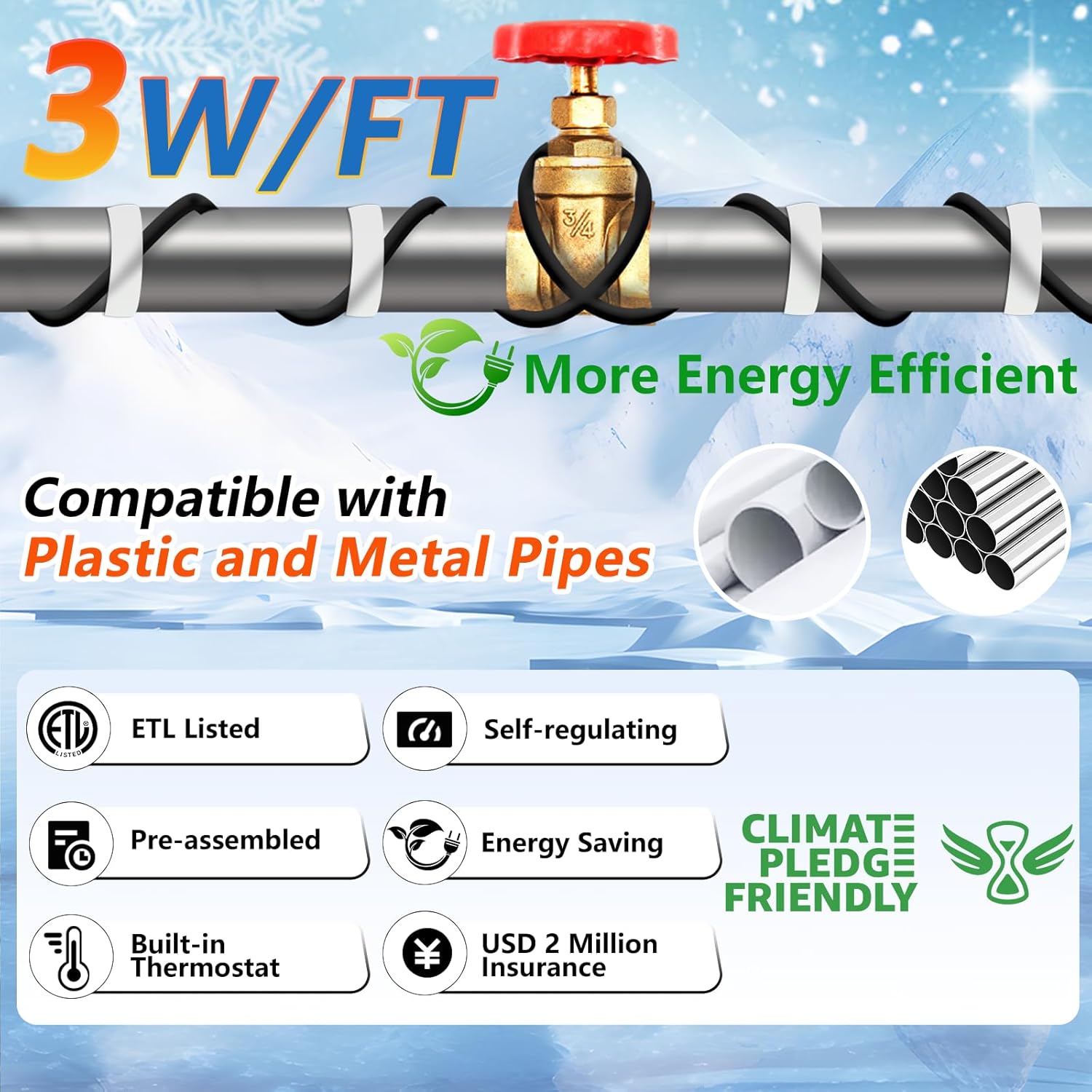
For most homes with a cold crawl space or an exposed basement line, a self-regulating cable with a built-in thermostat is the heat tape to buy, and the HEATIT 30 ft self-regulating cable is the one we would start with: it puts out 3 watts per foot, switches on at 38°F and off at 50°F, and HEATIT’s listing says the whole cable carries an ETL listing, with a UL certified plug. For a short run of 6 ft or less, the Frost King HC6A is the simpler hardware store choice, as long as you follow its no-overlap rule to the letter.


Heat tape is an electric heater wrapped around a water pipe, so it carries a fire risk when it is installed or covered the wrong way. The CPSC’s consumer guidance on heat tape dates from releases in October 1989 and January 1996, and both point to the same causes: overlapped cable, the wrong insulation on top, and old or damaged tape. Follow the manufacturer’s instructions for your exact cable, and treat everything on this page as a supplement to them.
Quick Comparison
Two cable types are on this list. Constant wattage cable puts out the same heat per foot whenever its thermostat is on. Self-regulating cable lowers its output as the pipe warms, which is why some of its makers allow overlap that constant wattage makers forbid.
| Model | Type | Output | Heated length | Thermostat on / off | Overlap allowed | Best for |
|---|---|---|---|---|---|---|
| HEATIT 30 ft Self-Regulating | Self-regulating | 3 W/ft | 30 ft (plus 2 ft cord) | 38°F / 50°F | Self-regulating design; follow the included instructions | A 15 to 30 ft run in a crawl space |
| Frost King HC6A | Constant wattage | 7 W/ft | 6 ft | Below 38°F / above 45°F | Never | One short exposed line |
| MAXKOSKO 6 ft Self-Regulating | Self-regulating | 5 W/ft | 6 ft (plus 3 ft cord) | On at 38°F | Listed as straight, spiral, or overlapped | A short run that needs spiraling at a valve |
| HEATIT 6 ft Constant Wattage | Constant wattage | 7 W/ft | 6 ft | 37°F / 50°F | No crossing | A budget fix on one water-filled pipe |
| HEATIT 50 ft Self-Regulating | Self-regulating | 3 W/ft | 50 ft (plus 2 ft cord) | 38°F / 50°F | Self-regulating design; follow the included instructions | A long supply line in a manufactured home |
How We Chose
We started with the CPSC’s 1996 heat tape guidance, which tells buyers to look for a product certified by UL, CSA, or FMRC (now FM Approvals), and then sorted the remaining cables by how much installation risk they leave to the homeowner.
- A certification mark claimed for the heating cable itself, with the plug listed separately. We left out several popular cables whose listings name only a CE mark or no North American listing at all.
- A built-in thermostat with published on and off temperatures, so the cable is not heating the pipe all winter.
- Clear manufacturer rules on overlap, insulation, and pipe material, because those rules decide whether the cable is safe on your pipe.
- Yard & Grid Score, built from verified buyer ratings, as a check on how owners rate the cable over several winters.
Our sources are manufacturer product pages, FAQ pages, and instruction text, CPSC releases, Red Cross frozen pipe guidance, and public owner reviews. HEATIT and MAXKOSKO publish no spec pages we could find, so their figures here come from their Amazon listings. We research and compare; we do not run product trials of our own. The full method is on how we choose.
The Picks
1. HEATIT 30 ft Self-Regulating: the first cable for most crawl spaces
- HEATIT lists 3 W per foot, 120 V, and a built-in thermostat that turns the cable on at 38°F and off at 50°F.
- The listing says the full cable is ETL certified and the plug is UL certified, which lines up with the CPSC advice to buy certified heat tape.
- Self-regulating cable lowers its output as the pipe warms. At full output, 30 ft x 3 W/ft = 90 W.
- HEATIT rates it for metal and plastic water pipes and lists operation down to minus 40°F. The same cable is sold from 3 ft up to 160 ft, so you can match the heated length to the pipe.
Best for: a 20 to 30 ft supply line in a vented crawl space that drops below freezing a few weeks each winter.
Avoid if: your pipe run is under 10 ft, where a shorter cable avoids leftover length you cannot coil safely, or there is no grounded GFCI outlet within reach of the 2 ft cord.
2. Frost King HC6A: the short-run classic, with strict rules
- Frost King lists the HC6A at 6 ft, 120 V, and 7 W per foot, a constant wattage cable with a built-in thermostat.
- Frost King’s FAQ says the thermostat switches the cable on when the pipe is below 38°F and off above 45°F.
- Frost King states the kits are made for copper, iron, or Schedule 40 plastic water pipes, with plastic supply lines between 3/8 in and 1-1/2 in outside diameter.
- The FAQ is blunt: “Never ever overwrap the heat cable,” never use a cable longer than the pipe, and never install it inside walls, floors, or ceilings. It recommends covering the cable with 1/2 in fiberglass insulation with a vapor seal.
- It is the most-reviewed cable in this group, which gives a long record of owner feedback.
Best for: one 6 ft copper line under a kitchen sink on an outside wall, or a short stub in an unheated utility room.
Avoid if: you need to wrap around a valve or meter body, because a constant wattage cable cannot cross itself, or your plastic pipe is not marked Schedule 40.
3. MAXKOSKO 6 ft Self-Regulating: the short cable that can spiral
- MAXKOSKO lists 5 W per foot, 120 V, and a built-in thermostat that turns on at 38°F.
- The listing says the cable can be run straight, spiraled, or overlapped, which helps on a short run with a valve or a fitting cluster.
- MAXKOSKO rates it for plastic or metal water pipes up to 2 in diameter and includes glass cloth tape for fastening.
- The listing says the cable is now CSA certified, though some packages may not yet show the mark. Look for the mark on the cable or packaging when it arrives.
Best for: a 4 to 6 ft line with a shutoff valve or a pressure tank fitting that needs a spiral wrap.
Avoid if: you want a published shutoff temperature, which the listing does not give, or the package that arrives carries no certification mark.
4. HEATIT 6 ft Constant Wattage: the budget fix for one pipe
- HEATIT lists 7 W per foot, 120 V, and a thermostat that turns on at 37°F and off at 50°F.
- The listing names CSA and ETL certification for the cable and a UL certified plug, plus a grounded plug with an indicator light.
- HEATIT limits it to water-filled plastic (including PEX) or metal pipes, allows a maximum of 1/2 in fiberglass insulation over the cable, and says no crossing.
- The listing names a two-year limited warranty.
Best for: a straight 6 ft PEX or copper line exposed in an unheated garage.
Avoid if: the pipe can drain and sit empty, such as a seasonal hose bib line, or you plan to use foam pipe sleeves over it.
5. HEATIT 50 ft Self-Regulating: for long runs
- This is the same 3 W per foot cable as our top pick, with the same 38°F on and 50°F off thermostat, in a 50 ft length.
- At full output it draws 50 ft x 3 W/ft = 150 W, and 150 W / 120 V = about 1.3 A, a small share of a household circuit, though it still needs a GFCI outlet.
- HEATIT lists the full cable as ETL certified and the plug as UL certified.
Best for: a manufactured home or cabin with a long supply line from the meter pit to the house.
Avoid if: your exposed pipe is under 30 ft, where the 30 ft version fits better.
The Fire Rules That Come With Every Cable
Constant wattage cable is the type that needs the most care, because it does not lower its output when it is crossed, bunched, or buried under the wrong material. These are the points that the CPSC’s 1989 and 1996 releases and the manufacturers above agree on.
- Do not overlap a constant wattage cable. Frost King and HEATIT both forbid it, and the CPSC’s 1989 release says no overlap unless the maker permits it.
- Use only the insulation the maker names. The CPSC’s 1996 release warns against foam or vinyl insulation over heat tape; Frost King and HEATIT both specify 1/2 in fiberglass.
- Do not add more insulation than the manual allows, and never wrap the tape on top of existing insulation, per the CPSC’s 1989 release.
- Plug into a grounded three-prong outlet with GFCI protection, as the CPSC’s 1996 release advises. If no such outlet exists near the pipe, have a licensed electrician add one.
- Inspect the cable every fall before it is needed. Replace it if the jacket is cracked, cut, charred, or discolored, as the CPSC’s 1996 release describes, or if the indicator light flickers, which Frost King says can mean the cable is not working correctly.
Self-regulating cable lowers the risk of a hot spot, but its maker’s rules still apply. Our comparison of heat tape vs pipe insulation covers when insulation alone is enough.
Cost of Ownership
The electricity cost is small next to a burst pipe, and the formula is the same for every cable: watts per foot x feet x hours on x days / 1,000 = kWh, then multiply by your rate. The EIA’s average U.S. residential rate for August 2026 was 18.16 cents per kWh. As a planning assumption, say the thermostat keeps the cable on 12 hours a day for 60 cold days.
- Frost King HC6A: 7 W/ft x 6 ft = 42 W. 42 W x 12 h x 60 days / 1,000 = about 30 kWh, and 30 x 18.16 cents = about 5.50 dollars a winter.
- HEATIT 30 ft at full output: 3 W/ft x 30 ft = 90 W. 90 W x 12 h x 60 days / 1,000 = about 65 kWh, and 65 x 18.16 cents = about 11.80 dollars a winter. Self-regulating cable draws less as the pipe warms, so treat this as a ceiling.
Beyond power, budget for fiberglass pipe wrap with a vapor barrier, aluminum or glass cloth tape to fasten the cable, and a replacement cable after a few winters if the yearly inspection turns up wear. HEATIT’s 6 ft listing names a two-year limited warranty; check the warranty card for the others.
How to Choose the Right Cable
Answer these four questions in order, and the list narrows to one or two cables.
How long is the exposed pipe?
Measure only the part that sits in unheated space. For a straight run, cable length = pipe length. Frost King says never to use a cable longer than the pipe, so with constant wattage cable, buy the next size down rather than up and protect any leftover pipe with insulation. For a 14 ft crawl space run, that means the longest constant wattage kit that does not exceed 14 ft, plus insulation on the rest, or a self-regulating cable sized to the run.
Does the run include valves or fittings?
Valves and meter bodies lose heat faster than straight pipe, and makers of self-regulating cable often allow extra wraps there. A constant wattage cable cannot cross itself, so pick a self-regulating cable for any run that needs a spiral.
What is the pipe made of?
Read the pipe label before you order. Frost King lists copper, iron, and Schedule 40 plastic; HEATIT’s constant wattage cable lists water-filled plastic, including PEX, and metal. If the pipe is unmarked or is a drain line, call a licensed plumber before you buy.
How cold does the space get?
A commonly cited rule of thumb puts the danger point for pipes in unheated spaces around 20°F, though it has no single published source; our guide to what temperature pipes freeze explains the range. If the space drops well below that for days, combine cable with insulation and the other steps in how to keep pipes from freezing.
FAQ
Is heat tape the same as heat cable?
For homeowners, mostly yes. Both names describe an electric heating element run along a pipe; “heat trace” is the trade term. Our explainer on heat tape vs heat cable vs heat trace sorts out the labels.
Can I use foam pipe sleeves over heat tape?
No. The CPSC’s 1996 release says not to use foam or vinyl insulation that could catch fire from a failing heat tape, and Frost King and HEATIT both call for fiberglass.
Will heat tape keep pipes from freezing during a power outage?
No. Heat tape stops working when the power goes out, which is often when a freeze is worst. Have a backup plan in place, such as shutting off and draining the line, and see our guide to heaters for power outages for keeping the house above freezing.
Can I leave heat tape plugged in all winter?
All five cables here have built-in thermostats meant to switch on and off on their own, and their makers present them as automatic. Check the indicator light and the cable at the start of each winter, and follow your manual on seasonal use.
Printable Checklist
- Exposed pipe measured, material and size read off the label
- Cable type chosen: self-regulating for spirals, constant wattage only for straight runs
- Certification mark on the cable confirmed (UL, CSA, ETL, or FM)
- Grounded GFCI outlet within cord reach, or an electrician booked to add one
- Fiberglass wrap of the thickness the manual allows; no foam or vinyl over the cable
- Indicator light and jacket checked every fall
Changelog: October 2026: first published.