


A 200 W folding panel adds about 200 W x 5 peak sun hours x 0.75 real-world derate = about 750 Wh on a clear day, about three quarters of a 1 kWh power station, and the Renogy 200W Portable Solar Panel is our first pick because at 13.9 lb it is the lightest of the four. Before you buy any of them, check one thing: the panel’s open-circuit voltage and current must fit your station’s solar input, and three of these four listings do not publish those numbers cleanly.


Quick Comparison
Three electrical terms do the work in this guide. Vmp is the voltage at maximum power, the voltage the panel runs at while charging. Voc is the open-circuit voltage, the highest voltage the panel produces with nothing connected, which is the number that must stay under your station’s limit. Isc is the short-circuit current, the most current the panel can push. The table shows what each seller publishes and how it labels it.
| Panel | Weight | Lb per watt | Voltage and current as published | Station plugs in the box | Warranty (listing) | Best for |
|---|---|---|---|---|---|---|
| Renogy 200W Portable Solar Panel | 13.9 lb | about 0.07 | Renogy spec table: 21.6 V Voc, 11.3 A Isc, 18.8 V Vmp, 10.6 A Imp | MC4 only; 4-in-1 adapter sold separately | Not stated | Carrying the panel any distance |
| TWELSEAVAN 200W | 15.7 lb | about 0.08 | 19.8 V “maximum voltage”, 23.4 V “output voltage”, 10.8 A; labels unclear | Anderson, XT60, DC8020, DC7909, DC5521 | 24 months | Mixed household of station brands |
| SOKIOVOLA N-Type 200W | 16.3 lb | about 0.08 | 18 V “output voltage” only | XT60, DC5521, DC7909, DC8020, Anderson | 12 months | Jackery owners who want a long cable |
| EBL 200W (ESP-200) | 18 lb | about 0.09 | 35 V “maximum voltage” only; unlabeled | XT60, Anderson, DC7909, aviation (no DC8020) | 1 year | EcoFlow, BLUETTI, or Anker XT60 owners |
Lb per watt is listed weight / 200 W. Only the Renogy figures come from a maker spec table; the other three are listing values we could not confirm, which is why the next sections use the Renogy numbers for the math and tell you to read the label on the back of the panel you receive.
How We Chose
We limited the list to standalone 200 W folding panels with enough verified buyer ratings to score, which left four; bundles that pair a panel with a station are covered in our station guides. We ranked on weight per watt, which plugs come in the box, warranty, and how clearly the seller states Vmp, Voc, and Isc. Station input limits come from each station maker’s page or manual. The Yard & Grid Score on each card is built from verified buyer ratings. We research and compare; we do not run our own product trials, so efficiency and output figures here are seller claims. Details are on how we choose.
Will a 200W Panel Work With Your Station?
Yes for most 1 kWh stations, with one panel or two in series, but the watts that reach the battery depend on the station’s current limit. For the math we use the figures Renogy publishes on renogy.com for the 13.89 lb, 25 percent cell efficiency panel ranked first below (Voc 21.6 V, Isc 11.3 A, Vmp 18.8 V, Imp 10.6 A), because the other three listings do not publish a full set. Swap in the numbers from your own panel’s label.
| Station | Solar input as published | Plug | One 200 W panel | Two in series (37.6 V Vmp, 43.2 V Voc) |
|---|---|---|---|---|
| Jackery Explorer 1000 v2 | 12 to 60 V; 10.5 A from 16 to 60 V, 8 A below 16 V; 400 W total over two ports | DC8020 (DC 8mm), two ports | 10.6 A is just over 10.5 A, so the port caps it: 10.5 A x 18.8 V = about 197 W in full sun | Fits the 60 V limit: 10.5 A x 37.6 V = about 395 W; or use one panel per port: 2 x 197 = about 395 W, under the 400 W total |
| Anker SOLIX C1000 Gen 2 | 600 W, 60 V max; 8.2 A from 11 to 28 V, 14.5 A from 29 to 60 V | XT60i (Anker’s name) | Low band caps current: 8.2 A x 18.8 V = about 154 W | Moves to the high band: 10.6 A x 37.6 V = about 399 W |
| BLUETTI AC180 | 500 W, 12 to 60 V, 10 A max | DC7909 | Capped at 10 A: 10 A x 18.8 V = about 188 W | 10 A x 37.6 V = about 376 W; a parallel pair (21.2 A) would exceed the 10 A rating |
| Anker SOLIX C300 DC | 100 W, 11 to 28 V, 8.2 A | XT60 | About 100 W, the station’s cap | No: 43.2 V is over the 28 V limit |
Cold raises voltage, so check Voc at your coldest charging temperature. Using 0.3 percent per °C as a planning coefficient (check your panel’s datasheet), a 21.6 V Voc at 14°F, which is 35°C below the 77°F rating point, becomes 21.6 x (1 + 0.003 x 35) = about 23.9 V. Two in series reach about 47.7 V, under a 60 V limit; three would reach about 71.6 V, over it. EcoFlow’s DELTA 3 Plus manual adds a current rule for that model: total Isc within 15 A, which one 11.3 A panel meets and a parallel pair (22.6 A) does not. The full method is in how to choose a solar panel for a power station.
What 200 Watts Delivers by Season
Daily Wh = 200 W x peak sun hours x 0.75 derate, a common planning figure for heat, angle, and wiring loss. Peak sun hours below are typical-year averages from PVWatts, run by the National Laboratory of the Rockies (formerly NREL).
| Location and month | Peak sun hours | Daily Wh from one 200 W panel | Share of a 1,024 Wh station |
|---|---|---|---|
| Atlanta, annual average, tilted 34° | 5.08 | 200 x 5.08 x 0.75 = about 760 | about 74% |
| Chicago, June, tilted 42° | 5.43 | 200 x 5.43 x 0.75 = about 815 | about 80% |
| Chicago, December, tilted 42° | 2.66 | 200 x 2.66 x 0.75 = about 400 | about 39% |
| Chicago, December, lying flat | 1.39 | 200 x 1.39 x 0.75 = about 210 | about 20% |
The last two rows are the case for kickstands: in a Chicago December, angling the panel nearly doubles the harvest, 2.66 / 1.39 = about 1.9 times. For timing a full recharge, see how long it takes to charge a power station with solar.
The Panels, Ranked
1. Renogy 200W Portable Solar Panel
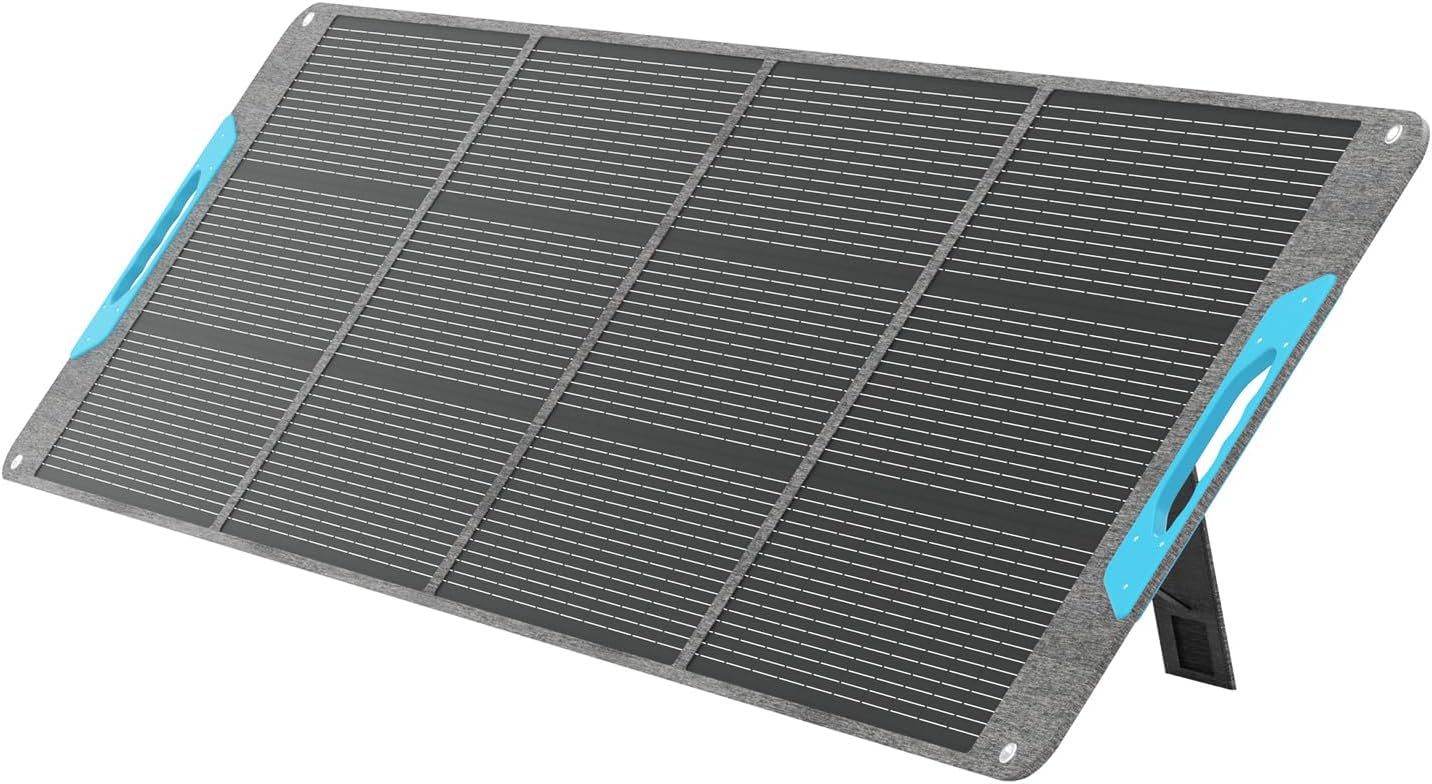
- 13.9 lb (13.89 lb on renogy.com) and 23.72 x 22.99 x 1.97 in folded; about 0.07 lb per watt, the best ratio here.
- 16BB N-Type cells, with a 25 percent efficiency claim from the seller.
- USB-C PD at 45 W and two USB-A ports let it charge a phone directly.
- MC4 output only; the 4-in-1 adapter for station plugs is sold separately. Renogy’s FAQ says Voc must not exceed the station’s maximum input voltage.
- Renogy’s own spec table, not the Amazon listing, gives Voc 21.6 V and Isc 11.3 A, plus IP65; still check the label on the panel you receive.
Best for: carrying a panel from the car to a campsite or up to a sunny spot in the yard.
Avoid if: you want every station plug included in the box.
2. TWELSEAVAN 200W Portable Solar Panel
- The widest plug kit: an MC4 cable to Anderson, XT60, DC8020, DC7909, and DC5521, plus three DC adapters.
- 15.7 lb, 23 x 22 in folded, IP65, ETFE surface, 24 percent efficiency claim.
- 24-month warranty, the longest stated on the four listings.
- The listing shows 19.8 V and 23.4 V with labels that do not say which is Vmp and which is Voc, and 10.8 A.
Best for: households with more than one station brand.
Avoid if: you need confirmed Voc and Isc from a datasheet before buying.
3. SOKIOVOLA N-Type 16BB 200W
- Includes a 10.49 ft cable ending in XT60, DC5521, DC7909, DC8020, and Anderson plugs, so a Jackery DC8020 port needs no extra purchase.
- 16.3 lb, 21 x 23 in folded, ETFE surface; the seller claims IP68.
- 12-month warranty.
- Only an 18 V “output voltage” is listed, with no Voc or Isc, so read the label before connecting.
Best for: Jackery Explorer owners who want the panel well away from a shaded station.
Avoid if: you want a warranty longer than a year.
4. EBL 200W Portable Solar Panel (ESP-200)
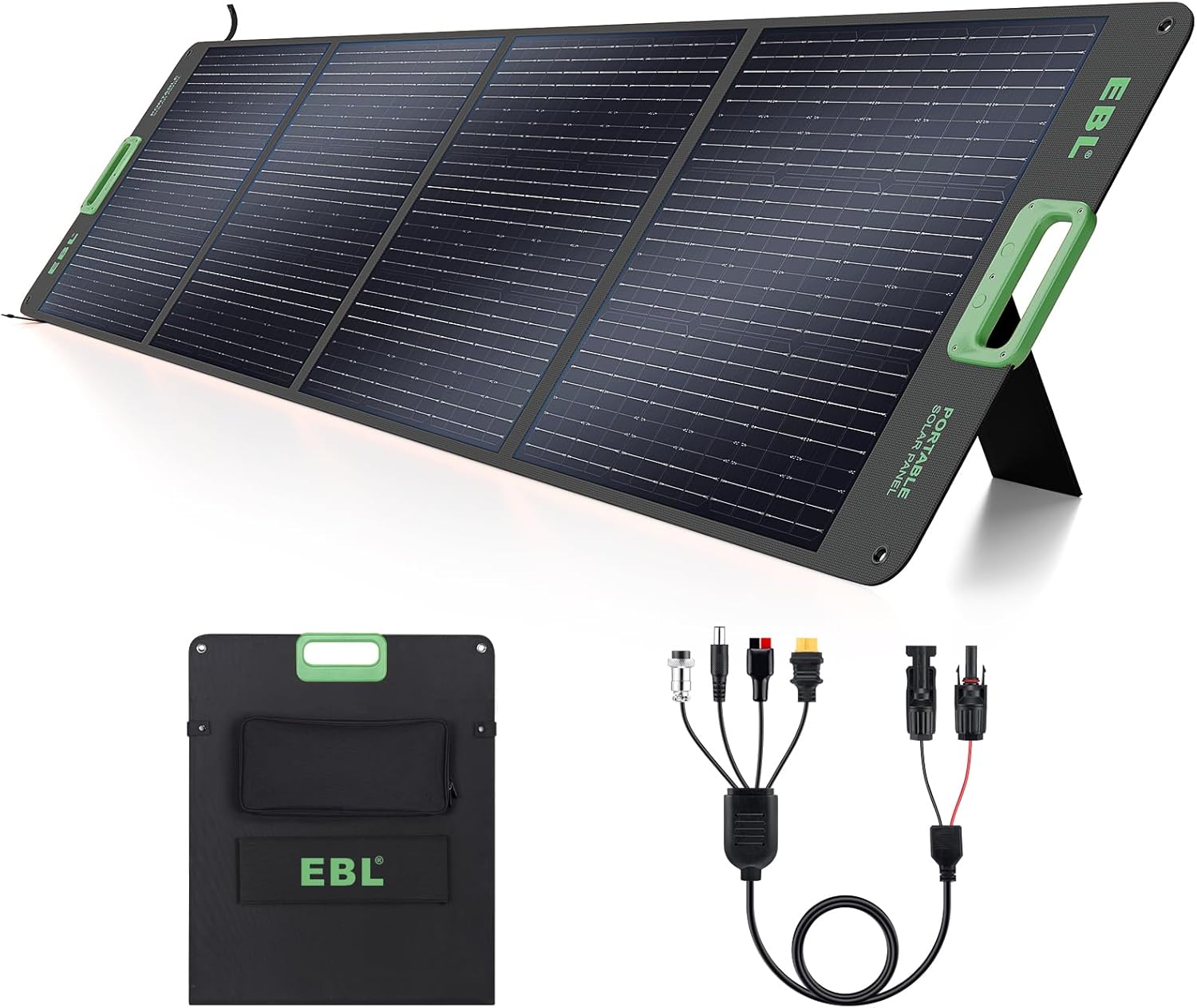
- 18 lb and 25.31 x 20.87 x 2.17 in folded, the heaviest here; PET laminate with an 840D Oxford cloth shell.
- Cable ends in XT60, Anderson, DC7909, and an aviation plug, but no DC8020, so Jackery Explorer v2 owners need an adapter.
- 23.5 percent efficiency claim, IP65 in the title, 1-year warranty.
- The spec table shows a 35 V “maximum voltage” with no Voc or Vmp label; at 200 W that figure does not fit a typical 12 V class folding panel, so read the label.
Best for: EcoFlow, BLUETTI, or Anker XT60 owners on a tight budget.
Avoid if: you own a Jackery, or you will carry the panel far.
Cost of Ownership
- Adapters: budget for one if your station’s plug is not in the box (Renogy for every station; EBL for Jackery).
- Extension cable: an MC4 extension lets the station stay indoors while the panel sits in sun; size the wire for the run.
- Warranty: 24 months (TWELSEAVAN), 12 months (SOKIOVOLA and EBL); Renogy’s listing does not state one.
- Second panel: two in series doubles harvest on stations with a 60 V input, as the compatibility table shows.
How to Choose
- What plug does your station take? Jackery v2: DC8020; Anker: XT60 type; BLUETTI AC180: DC7909. Match it to the box contents.
- Does Voc fit, cold? Panel Voc x (1 + 0.003 x degrees C below 25) x panels in series must stay under the station’s maximum.
- Does current fit? Compare Imp to the station’s amp limit in the band the voltage lands in. On the Anker C1000 Gen 2, one Renogy panel gets 8.2 A x 18.8 V = about 154 W; two in series get about 399 W.
- How far will you carry it? 13.9 lb and 18 lb feel different on a half-mile walk.
- How much do you need per day? Daily Wh needed / (peak sun hours x 0.75) = panel watts. A 1,024 Wh refill in a 5 hour sun day needs 1,024 / (5 x 0.75) = about 273 W, so one 200 W panel falls short and two cover it.
For larger arrays and 400 W blankets, see the best solar panels for power stations; for rated vs real output, see how many watts a solar panel produces.
FAQ
How long does a 200 watt panel take to charge a power station?
Divide capacity by real panel output: 1,070 Wh / (200 W x 0.75) = about 7.1 hours of full sun for a Jackery Explorer 1000 v2. Jackery itself states 7.5 hours with one SolarSaga 200W panel.
Is a 100 watt portable panel enough for a power station?
For a small station, yes: 100 W x 5 x 0.75 = about 375 Wh a day, more than a 292 Wh Explorer 300 holds. For a 1 kWh station it is about a third of a refill per sunny day.
Can I use a non-matching brand of panel?
Usually, if the plug, Voc, and current fit. Jackery’s own site lists a 12 to 60 V input window for the Explorer 1000 v2; a claim that only Jackery panels work appears in a retail listing, not on jackery.com. Follow the station maker’s manual.
Can a 200W panel charge through a window?
It will produce something, but glass, screens, and a fixed angle cut output. Put the panel outside and run an MC4 extension to the station indoors.
Changelog: October 2026: first published.









