If a hygrometer in your basement reads above 60% relative humidity (RH), buy a dehumidifier first: it takes water out of the air, and an air purifier does not. An air purifier filters particles such as dust and smoke from the air that passes through it, and the two machines are rated in different units, pints of water per day for one and cubic feet of filtered air per minute for the other. The EPA advises keeping indoor humidity below 60%, ideally between 30 and 50%. We research and compare maker pages and agency guidance; we do not run product trials of our own, as our how we choose page explains.
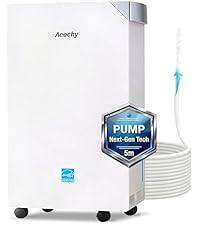
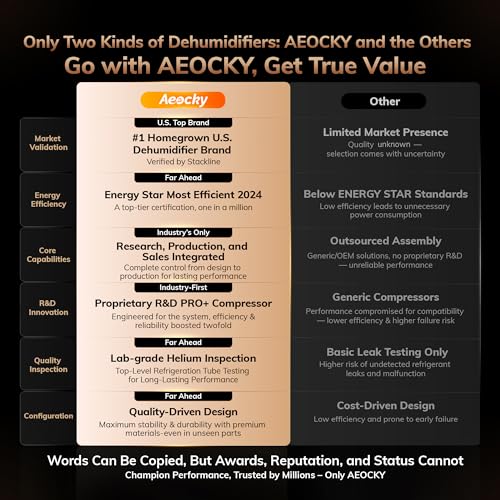
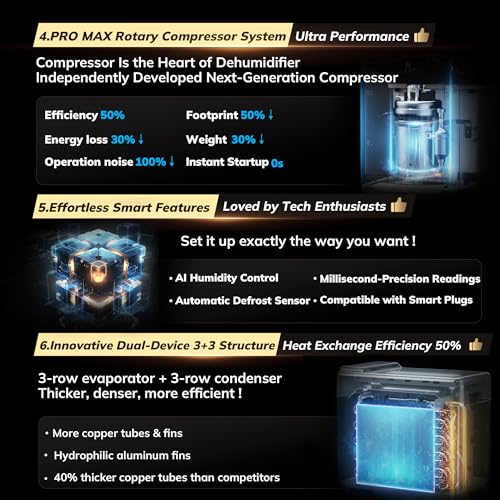
The dehumidifier we recommend first for a damp basement of 1,000 to 1,500 sq ft is the AEOCKY RHEA-002. We do not pair it with an air purifier card, because the product data we have contains no air purifier with a published clean air delivery rate.

AEOCKY 6000Sq.Ft Commercial Dehumidifier







As an Amazon Associate we earn from qualifying purchases. Product prices and availability are accurate as of the date/time indicated.
Side by Side
| Dehumidifier | Air purifier | |
|---|---|---|
| What it changes | Water vapor, so relative humidity falls | Particles in the air that pass through its filter |
| How it is rated | Pints per day at 65°F and 60% RH (DOE), plus liters per kWh | Clean air delivery rate (CADR) in cfm, measured for tobacco smoke, dust, and pollen |
| Sizing guide | ENERGY STAR chart: 25 to 40 pints per day for a very damp space under 2,000 sq ft (rating method not stated) | ENERGY STAR chart: minimum CADR of 65 cfm for 100 sq ft, 130 for 200, 390 for 600 (8 ft ceilings) |
| Agency reference | EPA: keep RH below 60%, ideally 30 to 50% | EPA: filtration can supplement source control and ventilation |
| What you manage | A tank, or a drain hose or pump | A replacement filter |
| Watch for | Frost on the coils below about 65°F (ENERGY STAR) | Units that intentionally produce ozone, which the EPA advises avoiding |
What Each Machine Changes in a Basement
1. A dehumidifier works on water, which an air purifier leaves alone
Work out how much water the air itself holds. Take a 1,000 sq ft basement with an 8 ft ceiling, which is 1,000 x 8 = 8,000 cu ft, at 65°F and 60% RH.
- Saturated air at 65°F has a vapor pressure of 0.622 inHg, so 60% RH is 0.6 x 0.622 = 0.373 inHg.
- The humidity ratio is 0.622 x 0.373 / (29.92 minus 0.373) = about 0.0079 lb of water per lb of dry air.
- Air weighs about 0.075 lb per cu ft, a common planning figure, so 8,000 cu ft is about 600 lb of air.
- Water in that air is 600 x 0.0079 = about 4.7 lb, and a pint of water weighs about 1.04 lb, so about 4.5 pints.
Bringing the same air down to 50% RH leaves about 3.8 pints, so the air itself gives up under 1 pint. A dehumidifier with a DOE rating of 32 pints per day is sized for water that keeps arriving through the slab, the walls, and laundry, more than 40 times what that drop in the air amounts to. An air purifier circulates the air and filters it, but CADR measures smoke, dust, and pollen, and none of those is water vapor.
2. An air purifier works on airborne particles, which a dehumidifier does not rate
Air changes per hour = CADR x 60 / room volume. ENERGY STAR’s chart works out to 0.65 cfm of CADR per sq ft: 65 / 100, 130 / 200, and 390 / 600 all give 0.65. Extending that ratio to the same basement gives 0.65 x 1,000 = 650 cfm, and 650 x 60 / 8,000 = about 4.9 air changes per hour. The chart stops at 600 sq ft, so treat 650 cfm as an extension of the ratio, not a published row.
Dehumidifier spec sheets give pints per day and efficiency, not CADR. A dehumidifier’s own filter is a screen that protects its coil, and none of the dehumidifier listings in our product data gives a CADR. If your problem is dust from a workshop or sanding, size a purifier by that formula. If your problem is a damp basement, size a dehumidifier by our dehumidifier sizing guide.
3. Mold needs moisture, so humidity comes first
The EPA says none of the many types of mold will grow without water or moisture, and that filtration is a supplement to source control, not a replacement for it. That is why a humidity reading decides the order. After a flood, Delaware’s public health guidance says to keep drying until humidity returns to a normal 35 to 55%, and the EPA advises drying wet materials within 24 to 48 hours. Our ideal basement humidity level guide explains the ranges.
4. Running cost depends on the job
The electricity to remove a day’s water is pints x 0.473 / IEF, where IEF is liters per kWh. ENERGY STAR lists the RHEA-002 at 2.09, so removing 20 pints takes 20 x 0.473 / 2.09 = about 4.5 kWh. An air purifier’s use is watts x hours: a unit drawing 50 W around the clock uses 50 x 24 / 1000 = 1.2 kWh a day. The 50 W is an example, not a rating, so read the label of the unit you are considering.
Which Problem Do You Have?
| What you see | Start with | Reason |
|---|---|---|
| Hygrometer reads above 60% RH in summer | Dehumidifier | The EPA’s ceiling is 60%, ideally 30 to 50% |
| RH reads 30 to 50%, but sanding or workshop dust hangs in the air | Air purifier | CADR rates dust; the humidity is already in range |
| Damp feel or musty room, no reading yet | A hygrometer | The reading tells you which machine fits; see our hygrometer explainer |
| Standing water or wet walls | Fix the water source | Neither machine replaces stopping the leak or seepage |
| After a flood | Dehumidifier, until RH is back to 35 to 55% | Delaware’s public health guidance |
Choose a Dehumidifier If
- Your basement reads above 60% RH for weeks at a time.
- You see condensation on cold pipes or windows, or a damp feel on the walls.
- You have a floor drain within reach of a hose, or can empty a tank daily.
Avoid if: the basement sits in the 40s or 50s most of the year, where coils can frost. Read our winter dehumidifier guide first, or look for a model with a stated low-temperature limit.
Choose an Air Purifier If
- Your RH already sits at 30 to 50%, and dust is the complaint.
- You run a workshop or laundry corner that stirs up particles.
- You will size by the CADR chart and replace filters on the maker’s schedule.
Avoid if: your hygrometer reads above 60%, since the purifier leaves the water in the air where it was. Skip any model that intentionally produces ozone, as the EPA advises.
FAQ
Does an air purifier lower humidity?
Makers rate air purifiers by CADR for smoke, dust, and pollen, and not by water removed. For humidity, use a dehumidifier and check a separate gauge. Our guide to the best dehumidifiers for basements ranks models by their DOE pint rating.
Dehumidifier or air purifier for mold?
The EPA ties mold to moisture and advises keeping humidity below 60%, ideally 30 to 50%, which is a dehumidifier’s job. For visible mold, follow the EPA’s cleanup guidance for the material involved.
Dehumidifier or air purifier for a musty smell?
Neither is rated for odor by default. The EPA notes that some air cleaners filter gases as well as particles, so look for a gas filter in the spec sheet. Check the humidity reading first, since it tells you whether moisture is part of the picture.
Can I run both in the same basement?
Yes, because they change different things. Start with the dehumidifier if the reading is high, and add a purifier only for a particle problem. Our guide on how long to run a dehumidifier covers settings.
Changelog: November 2026: first published.