


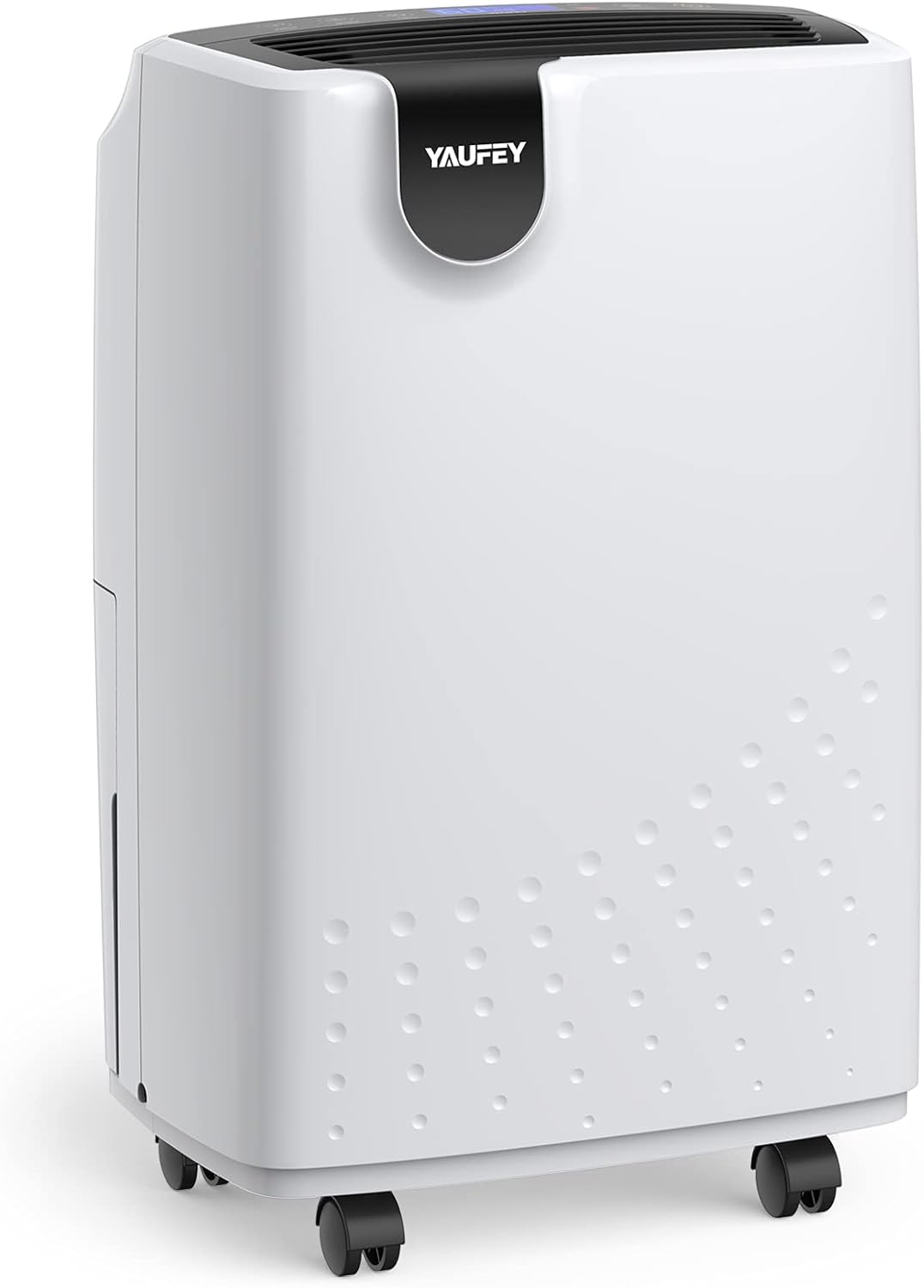
Three dehumidifiers in our product data fit under $150, and the best of them for a small damp room is the Yaufey PD161D. The catch is capacity. Its listing says 31 pints a day at 95°F and 90% relative humidity (RH), but under the DOE rating condition of 65°F and 60% RH, a copy of its manual lists about 8.5 pints, roughly a quarter of the box number. At this price, plan on drying one damp room or a small basement area, not a whole 1,000 sq ft basement.


Quick Comparison
None of the three is in the ENERGY STAR certified dehumidifier database (we searched by brand and model number in October 2026), so the capacity figures below come from listings and manual copies hosted on third-party sites. Treat them as the makers’ numbers, not independent ratings.
| Model | Box rating | At 65°F, 60% RH (manual copy) | Tank | Drainage | Operating range | Best for |
|---|---|---|---|---|---|---|
| Yaufey PD161D | 31 pints at 95°F, 90% RH | About 8.5 pints; 120 W input | 0.48 gal | Tank, or included 6.56 ft hose | 41 to 100°F (manual) | One damp room that stays above 50°F |
| VEAGASO VG380 | 34 pints at 95°F, 90% RH (retailer) | About 8.5 pints; rated 230 W | 0.53 gal | Tank, or included hose | Not stated | A basement corner with a floor drain |
| BEDRED CT11 | About 34 fl oz a day at 86°F, 80% RH (OEM spec sheet) | Not published | 95 fl oz | Tank only | Not stated | A closet, a gear locker, or a small bathroom |
How We Chose
We started with every dehumidifier in our product data that has verified buyer ratings and a listed price under the tier at the time we pulled it. Only three qualified, which is why this list has three entries and not five. We then ranked them on what the makers publish: a rating condition close to a real basement, an operating temperature range, drainage options, and the size of the review base behind the Yard & Grid Score. We research and compare; we do not run product trials of our own. Our how we choose page explains the method.
The Box Number Is Not the Basement Number
Since June 2019 the DOE rates portable dehumidifiers at 65°F and 60% RH, a cool, damp condition close to a basement. The box ratings here still use 95°F and 90% RH, where warm, wet air gives up water easily. Here is the gap for the two compressor models, using the manual copies.
| Model | Box rating | 65°F, 60% RH | Share of box number |
|---|---|---|---|
| Yaufey PD161D | 31 pints | 8.5 pints | 8.5 / 31 = about 27 percent |
| VEAGASO VG380 | 34 pints | 8.5 pints | 8.5 / 34 = about 25 percent |
That 25 to 27 percent is close to the pattern in the ENERGY STAR database: the certified Waykar CTH30A carries a 30 pint box rating and a DOE figure of 9.2 pints, and 9.2 / 30 = about 31 percent. The manual copies also list 13 pints at the older 80°F, 60% RH condition. Our pint ratings explainer covers how to translate any box number. The ENERGY STAR sizing chart starts at 20 pints a day for a moderately damp space under 2,000 sq ft, though it does not say which rating method it uses, so an 8.5-pint unit sits below its smallest row.
The Picks
1. Yaufey PD161D: the best-documented small unit
- A manual copy gives 120 W input and about 8.5 pints a day at 65°F and 60% RH, and a second copy lists an energy factor of 1.30 liters per kWh, which is the federal minimum for a portable unit of 25 pints or less.
- The manual copies give an operating range of 41 to 100°F, the only stated low-temperature limit in this group.
- The listing adds a 0.48 gal tank, a 6.56 ft drain hose, a 24-hour timer, a washable filter, a weight of 22 lb, and a 12-month warranty that Yaufey’s own manual says registration extends by one more year.
- It has the largest review base here, more than 6,500 ratings on its listing.
Best for: one damp room, such as a finished basement bedroom or laundry nook, that stays above 50°F and has a floor drain or sink within hose reach.
Avoid if: your gauge stays above 60% RH all summer across an open 1,000 sq ft basement; step up to a 30 to 40 pint DOE model.
2. VEAGASO VG380: the quieter pick with a longer listed warranty
- A manual copy on a third-party site lists about 8.5 pints a day at 65°F, 60% RH and 13 pints at 80°F, 60% RH, with a rated 230 W and 2.0 A. That site repeats the same table under other VEAGASO model names, so confirm against the label on your unit.
- The listing adds a 0.53 gal (2 L) tank, a drain hose, automatic defrost, power failure memory, and a low-speed noise of 40 dB or less.
- The listing gives a 2-year warranty, a year longer than the base term on the Yaufey.
- We found no minimum operating temperature from VEAGASO.
Best for: a basement corner or utility area where a 40 dB low setting matters because it sits near a bedroom.
Avoid if: the space drops into the 40s in winter; with no stated limit, ENERGY STAR’s warning about frost below about 65°F applies.
3. BEDRED CT11: a small thermoelectric unit, not a basement unit
- Its listing describes semiconductor (thermoelectric) cooling instead of a compressor. BEDRED’s listing gives no daily figure; a factory spec sheet for the CT11 lists about 1,000 mL (about 34 fl oz) a day at 86°F and 80% RH, which is 34 / 16 = about 2.1 pints, measured warmer and wetter than the DOE condition. That sheet shows a smaller tank than BEDRED’s listing, so treat the figure as approximate.
- Listings show 85 W, a 95 fl oz tank, a weight of 5.8 lb, a 1,000 sq ft claim, and no drain hose. The listing’s voltage field reads 220 V, which does not match a US wall outlet, so confirm the adapter on the label.
- It stops when the tank is full: 95 / 34 = about 2.8 days at that rate.
Best for: a closet, a gear locker, or a small bathroom where a few ounces a day is the problem.
Avoid if: you are drying a basement room; 2.1 pints a day is about a quarter of the other two units at the DOE condition.
Cost of Ownership
Electricity to remove a day’s water is pints x 0.473 / IEF, where IEF is liters per kWh and one pint is about 0.473 liters. Take a small damp room that needs 6 pints a day over a 150-day humid season, at the EIA’s August 2026 average residential rate of 18.16 cents per kWh.
- Yaufey at 1.30: 6 x 0.473 / 1.30 = about 2.2 kWh a day, x 150 = 327 kWh, x 0.1816 = about 59 dollars.
- ENERGY STAR Waykar CTH30A at 1.70: 6 x 0.473 / 1.70 = about 1.7 kWh a day, x 150 = 250 kWh, about 45 dollars. It sat above this price tier in our listing pull, so check its current listing.
- BEDRED: 85 W x 24 h = 2.0 kWh a day for the listed 2.1 pints, so 2.1 x 0.473 / 2.0 = about 0.5 liter per kWh. That figure comes from 86°F and 80% RH, so treat it as a best case.
Tank size matters more than watts on a budget unit. At 8.5 pints a day, the Yaufey’s 0.48 gal tank (0.48 x 8 = 3.8 pints) fills in 3.8 / 8.5 x 24 = about 11 hours, and the VEAGASO’s 0.53 gal tank fills in about 12 hours. Plan to run a hose to a drain, since both include one. Also budget for a washable filter you rinse on a schedule.
How to Choose
Work through these four questions in order.
- What does a gauge read? The EPA advises keeping indoor humidity below 60%, ideally 30 to 50%. Read the room with a separate gauge; our hygrometer explainer shows how to check one.
- How much water is there? Count how often you empty a bucket. Pints per day = times emptied x tank gallons x 8. A unit that fills a 0.48 gal tank twice a day is already moving 2 x 0.48 x 8 = about 7.7 pints, which is nearly all an 8.5-pint unit can do.
- Where will the water go? Both compressor units include a hose, but it needs a floor drain or sink lower than the outlet.
- How cold does the space get? Below 65°F, ENERGY STAR notes that frost can form on the coils. Read our basement dehumidifier in winter guide before running one in an unheated basement.
If the gauge stays above 60% after the unit has run continuously for a week, the unit is too small. Our dehumidifier sizing guide and the best dehumidifiers for basements ranking cover the next class up, rated 30 to 40 pints at the DOE condition.
FAQ
Is a dehumidifier under $150 big enough for a basement?
For one damp room, often yes. For an open 1,000 sq ft basement, the two compressor models here rate about 8.5 pints a day at the DOE condition, below ENERGY STAR’s smallest sizing row of 20 pints for a moderately damp space under 2,000 sq ft.
Why does a 31 or 34 pint box rating deliver so little?
These box ratings use 95°F and 90% RH. The DOE rating uses 65°F and 60% RH. Across the models we checked, the DOE figure comes out near 25 to 31 percent of the box number.
What humidity should I aim for?
The EPA says below 60%, ideally 30 to 50%. After a flood, Delaware’s public health guidance says to keep drying until humidity returns to 35 to 55%. Our guide to the ideal basement humidity level explains the ranges.
How long should it run each day?
Set a humidity target and let the humidistat decide. If it runs nearly all day and the gauge stays above 60%, it is undersized; our run-time guide has the formula.
Changelog: November 2026: first published.









