


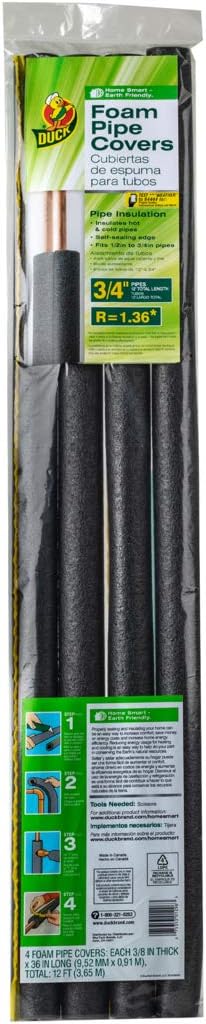
Start with pre-slit foam sticks for any straight, reachable run of 1/2 inch or 3/4 inch pipe, and the Duck Brand foam pipe covers are the pack to begin with: the listing says they fit both sizes and rates them to 212°F. Switch to 1 inch thick fiberglass wrap, such as the Frost King fiberglass pipe wrap, where a pipe bends, bunches, or crosses joists. Either way, insulation slows heat loss; it adds none, so a pipe in a space that stays under 32°F for days can still freeze.



Quick Comparison
| Product | Type | Listed size | Length as sold | Best for |
|---|---|---|---|---|
| Duck Brand foam pipe covers, 6 pack | Pre-slit foam sleeve | Fits 1/2 to 3/4 in pipe | 6 sticks x 1 ft = 6 ft | Short runs, tight spots, mixed pipe sizes |
| Duck Brand 3 ft sticks, 4 pack | Pre-slit foam sleeve | 3/4 in pipe | 4 sticks x 3 ft = 12 ft | Longer straight runs with fewer seams |
| Frost King foil-backed fiberglass wrap | Spiral wrap with vapor barrier | 3 in wide x 1 in thick | 25 ft roll | Elbows, valves, odd shapes, cold crawl spaces |
| QWORK foam insulation tape | Adhesive foam tape | 2 in wide x 1/8 in thick | 33 ft roll | Sweat control, patching small gaps |
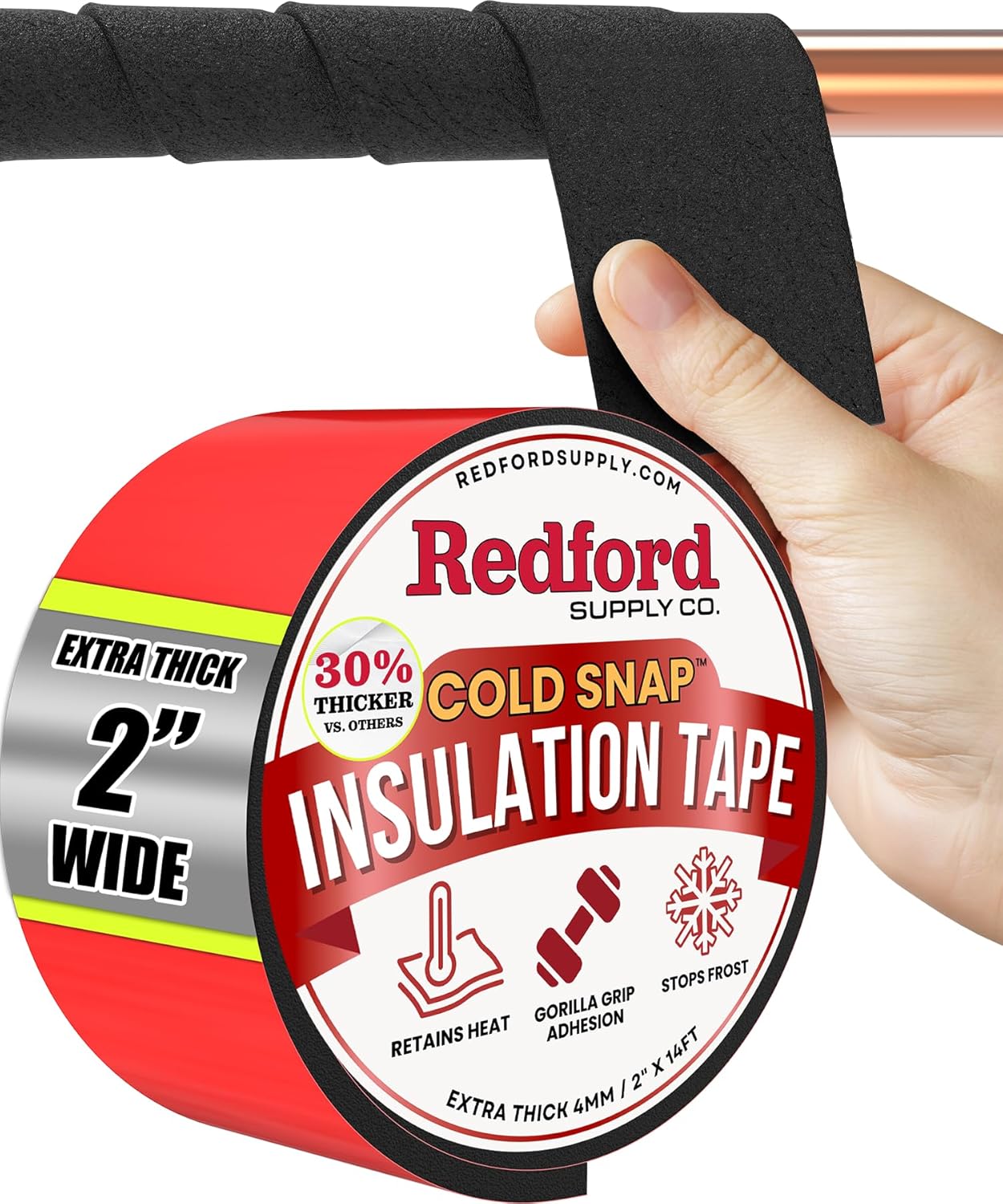
| Redford Supply Co. pipe insulation wrap | Foam wrap | 2 in wide | 14 ft roll | Short outdoor or HVAC line runs |
How We Chose
We ranked on fit, thickness, how the seam closes, and where each product can go, then used the Yard & Grid Score, which comes from verified buyer ratings, to break ties. All size figures come from retail listings; we could not match the listed R-values to a maker data sheet, so we ranked on thickness and fit instead. We research and compare; we do not run our own product trials. See how we choose.
Match the Sleeve to the Pipe
Foam sleeves are sold by pipe size, but the pipe’s outside diameter runs larger than its nominal size. A Johns Manville dimensional data sheet lists copper tube at nominal 1/2, 3/4, and 1 inch with outside diameters of 5/8, 7/8, and 1-1/8 inch. PEX is generally sold in the same sizes, but PVC and CPVC differ, so read the size printed on your pipe before you buy.
| Pipe nominal size | Copper tube outside diameter | What to buy |
|---|---|---|
| 1/2 in | 5/8 in | Sleeve marked for 1/2 in pipe |
| 3/4 in | 7/8 in | Sleeve marked for 3/4 in pipe |
| 1 in | 1-1/8 in | Sleeve marked for 1 in pipe |
A sleeve one size too big leaves an air gap that moves heat out; one too small will not close around the pipe. The wraps and tapes are less picky, which is their main advantage.
Worked Example: A 30 ft Crawl Space Run
Say a 3/4 inch supply line runs 30 ft under a vented crawl space, with four elbows and two valves. These counts are planning estimates; the roll instructions govern.
- 3 ft sticks: 30 / 3 = 10 sticks, so three 4-packs (12 sticks) leave two spare for cutting elbows.
- 1 ft sticks: 30 / 1 = 30 sticks, five 6-packs, and 30 seams to seal instead of 10.
- Fiberglass wrap, half-width overlap: each turn around a 3/4 inch pipe is about 3 in around and advances 1.5 in. The strip length per turn is the square root of (3 x 3 + 1.5 x 1.5) = about 3.35 in. A 25 ft roll is 300 in, so 300 / 3.35 = about 90 turns x 1.5 in = about 134 in, or at most 11 ft of pipe per roll, and less once the 1 inch thickness lengthens each turn. The 30 ft run needs at least three rolls.
- Foam tape, half-width overlap: the same math with a 2 in strip advancing 1 in per turn gives the square root of (3 x 3 + 1 x 1) = about 3.16 in per turn, so 396 / 3.16 = about 125 turns x 1 in = about 125 in, or 10 ft of pipe per 33 ft roll. Two layers of 1/8 inch foam is still 1/4 inch, a quarter of the 1 inch on the fiberglass.
The Picks
1. Duck Brand Foam Pipe Covers, 6 Pack
- The listing says the sticks are pre-slit with a self-sealing edge, fit 1/2 to 3/4 inch pipe, and are made in the USA.
- Each stick is 1 ft, so long runs mean many seams. Tape them.
- Highest rating of the five at 4.6 from more than 1,700 reviews.
Best for: Basement lines, under-sink supply, short exposed sections. Avoid if: You have long runs, or a hot flue pipe nearby; follow your water heater manual for clearances.
2. Duck Brand 3 ft Sticks, 4 Pack
- Same product family in 3 ft lengths, listed for 3/4 inch pipe and rated to 212°F.
- Twelve feet per pack and one-third the seams of the 1 ft sticks.
- The listing text mixes inside-diameter and thickness wording, so confirm the pipe size on the package.
Best for: Long, straight 3/4 inch supply lines along a rim joist. Avoid if: Your pipe is 1/2 inch and you want a snug fit.
3. Frost King Foil-Backed Fiberglass Pipe Wrap
- The listing gives 3 in wide x 1 in thick x 25 ft with a vapor barrier, the thickest clearly stated figure on this list.
- Wraps elbows and valves that sleeves cannot follow. Wear gloves and follow the roll’s directions.
- The listing shows a 90 day warranty and conflicting model numbers; check the label.
Best for: Cold crawl spaces and pipes with many fittings. Avoid if: The wrap will sit wet or outdoors without a weatherproof jacket.
4. QWORK Foam Insulation Tape
- Adhesive foam, 2 in x 1/8 in x 33 ft. Thin, so it gives modest protection.
- Conforms to any shape and cuts with scissors.
- Better at stopping condensation than at holding off a hard freeze.
Best for: Patching bare spots and sweating cold lines. Avoid if: The pipe is in an unheated space that stays below freezing.
5. Redford Supply Co. Pipe Insulation Wrap
- Listed as 2 in x 14 ft foam wrap for outdoor lines, copper, PVC, and AC line sets.
- The listing gives conflicting thickness figures and a 132 in length field against the 14 ft title, and its strength claims come from the seller, so treat it as a short-run wrap.
- Lowest rating on the list at 4.1.
Best for: A short outdoor line or AC line set. Avoid if: You need a long run; a 14 ft roll (168 in / 3.16 in per turn = about 53 turns x 1 in) covers about 4.4 ft of 3/4 inch pipe at half overlap.
Cost of Ownership
Insulation has no running cost, which is its edge over heat cable; see our heat tape vs pipe insulation comparison. Budget for tape or zip ties at every joint and gloves for the fiberglass. Replace any sleeve that is crushed, soaked, or split, and look over the runs each fall. Never wrap over heat tape unless the cable maker allows it; our heat tape guide covers the CPSC warnings.
How to Choose
- Which pipe size? Read the printed size, then match the sleeve.
- How cold does the space get? Under-sink and basement runs usually need only sleeves; vented crawl spaces need thickness, and sometimes heat cable too.
- How many fittings? More than two elbows per 10 ft favors wrap.
- Did it freeze before? Then insulation alone is not the plan; see how to keep pipes from freezing.
FAQ
Will pipe insulation stop my pipes from freezing?
Not by itself. It slows heat loss, which buys hours, but the American Red Cross also advises opening cabinet doors and letting a faucet drip in a hard freeze. The temperatures that matter are in our pipe freeze guide.
Do I insulate hot or cold water pipes?
Both, in unheated spaces. Either line can freeze when the water sits still, and insulating hot lines also cuts heat loss.
Do outdoor faucets need pipe insulation too?
The faucet itself needs a cover; see outdoor faucet covers and how to winterize outdoor faucets.
Changelog: November 2026: first published.









